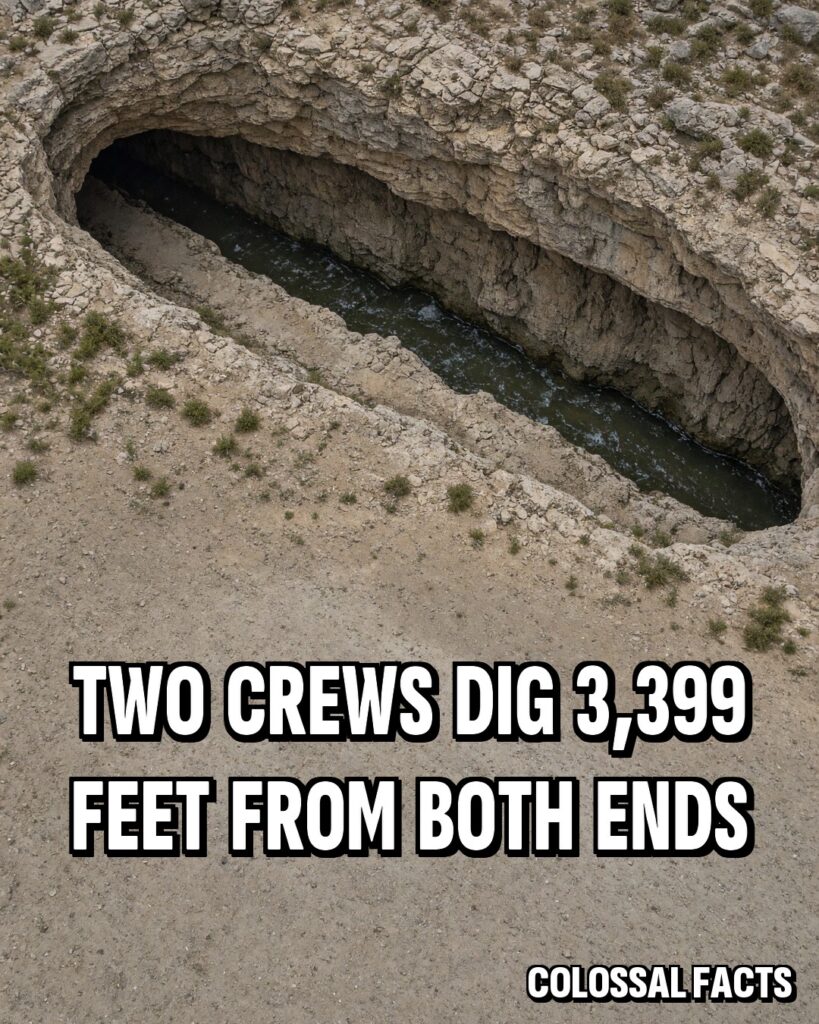
On the island of Samos, an ancient water line runs through Mount Kastro. It was built in the 6th century BC to bring fresh water from the Agiades spring to Pythagoreion. Eupalinos of Megara directed the work. Two crews of stonemasons started at the same time from opposite entrances. They worked with hammers and chisels. They met deep in the mountain, almost dead on.
It is the second known tunnel dug from both ends. It is the earliest known tunnel aimed by geometry. Geometry told them which way to dig before they could see each other. The build took about 10 years. The passage is about 6 feet by 6 feet (1.8 by 1.8 meters). A deeper channel beside it carried the water. Herodotus described the tunnel and ranked it among the greatest works on Samos. Without his account, the tunnel might have stayed hidden longer.
Meeting in the dark
Those 3,399 feet (1,036 meters) are about as long as eleven football fields, only through solid rock, from both sides. The two crews cannot see each other. They meet in the dark. If the angle is wrong, the headings miss, and a decade of work is wasted. If the level is wrong, the water will not flow. That is why Eupalinos did not trust luck. He trusted measurement: a straight line, a level and a bearing, carried from the surface into the mountain.
Digging from both ends cuts the time in half, but it doubles the risk. Every error meets in the middle as a kink, or as two parallel corridors that never join. The fact that the meeting was almost exact is the proof of the skill. In rock, with chisels, without lasers and without modern explosives, it is a feat still taught as an early case of applied geometry.
The water does not run on the floor where people walk. It has its own, deeper channel. The tunnel can therefore be maintained: a person can walk through and clean the conduit without wading the full section. That practical detail separates engineering from mere wonder. Ten years of digging only make sense if the water then actually reaches the city.
Why Herodotus remembered it
Herodotus did not describe every wall on Samos. He noted what seemed to him worth wonder. The tunnel entered that list with other great works on the island. The ancient text is a reason the structure was not forgotten once it was no longer used every day. Later excavation confirmed the account on the ground: there is a tunnel, there are two approaches, there is a water channel.
Pythagoreion needed a secure supply, especially if the spring lay on the other side of the mountain and the city had to endure a siege or simply a dry summer. The tunnel hides the line. Outside, an enemy cannot cut an open aqueduct with one stroke. Inside, the city drinks. That civil and military value explains why the work was worth a decade of labor.
It was used for centuries. 1,036 meters through rock, dug from both ends, remain a measure of what geometry can do before modern instruments. The two crews cannot see each other. They meet in the dark. The meeting is the whole project. Without it, two expensive corridors remain. With it, Samos got water, and the world got one of the early proved lessons that measurement can drive a hole through a mountain more reliably than guesswork.
Sources: Pythagoreion and Heraion of Samos – UNESCO, Tunnel of Eupalinos – Encyclopaedia Britannica, Herodotus on the works of Samos – World History Encyclopedia