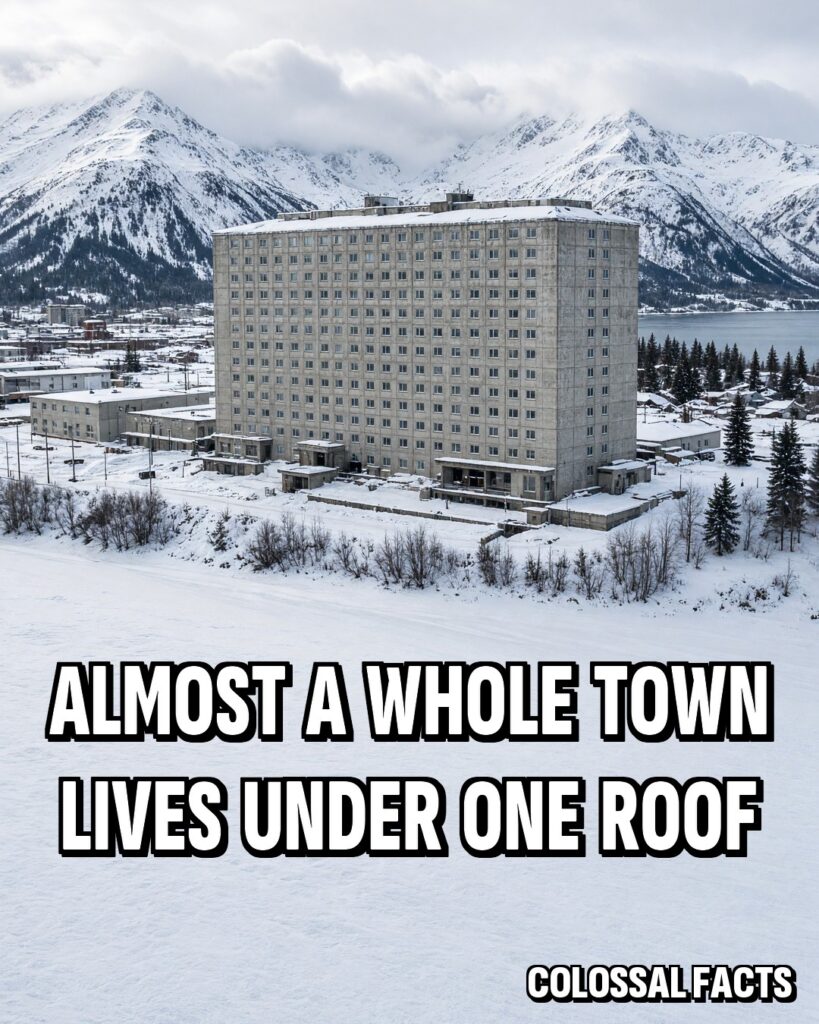
Whittier is a town in Alaska, on Prince William Sound, with only a few hundred people. The 2020 census counted 272 residents. Almost nobody lives in a separate house. Between 80 and 90 percent of them live in Begich Towers, a 14-story building with 196 apartments. A smaller share lives in another condo nearby. The towers were built by the U.S. Army in the 1950s, first as the Hodge Building, to house officers and staff at a cold-war port. From 1953 to 1957, the east, middle, and west sections were joined into one. It was built to take rough weather, and to keep people mostly self-sufficient when the snow closed in.
What sits inside? A post office, a corner store, a laundromat, a church, a police station, a city office, a clinic, and an indoor playground. A pedestrian tunnel connects the building to the school, so children do not have to walk a winter street. One visitor calls Whittier the strangest city in Alaska. The population lives mostly under one roof and does not have to step outside for mail, a loaf of bread, or a meeting with the police. Traffic, for many residents, is not on the road. It is in the elevator.
A town at the end of a one-way tunnel
The only car road in or out runs through the Anton Anderson Memorial Tunnel, a 2.5-mile (4-kilometer) passage under Maynard Mountain. It is the longest highway tunnel in North America and one of the few that also carries a railroad on the same roadbed. The tunnel is one-way. Traffic is allowed through on a schedule, in one direction at a time, and it closes at night. Then the town stays alone with the snow and the wind, unless a boat or a plane comes in. The tunnel was first a rail link, completed in the Second World War to reach the ice-free port. It was later rebuilt to take cars as well, and opened to public highway traffic in 2000.
Whittier began as a military port and was named after the poet John Greenleaf Whittier. After the Army left, the big housing block became a condominium and the civic center of a tiny civilian town. Another large military building, the Buckner Building, still stands nearby but is abandoned and unsafe. The working town is the tower, the school, the harbor, and the tunnel.
A roof that does the work of a neighborhood
Residents either accept the arrangement or joke about it. In practice the building is the town: the clinic, the police, and the food store share a roof with the beds. Rain, avalanche country, and some of the heaviest snowfall in Alaska make that compact life a practical choice, not only a curiosity for visitors who ride in through the mountain, look around the lobby, and ride back out before the next tunnel slot.
There is no need for a neighborhood. There is a need for an elevator, and for a timetable on a tunnel that is the town’s front door.
In summer, day-trippers and cruise passengers come through the tunnel or arrive by water, walk the harbor, and leave again before the night closure. In winter the town shrinks back to the people who actually live in the towers, watch the snow, and wait for the next open slot under Maynard Mountain. The port stays ice-free, which is why the military wanted it in the 1940s and why the railroad still matters. Whittier is not a stunt. It is a port at the end of a shared tunnel, with a 14-story building doing the work that a street of houses would do in a milder place. The oddity is real. So is the reason for it: weather, access, and a block the Army had already paid to build.
Sources: Whittier, Alaska – Wikipedia, Do All Residents of Whittier, Alaska, Live in This One Building? – Snopes, Whittier – Travel Alaska