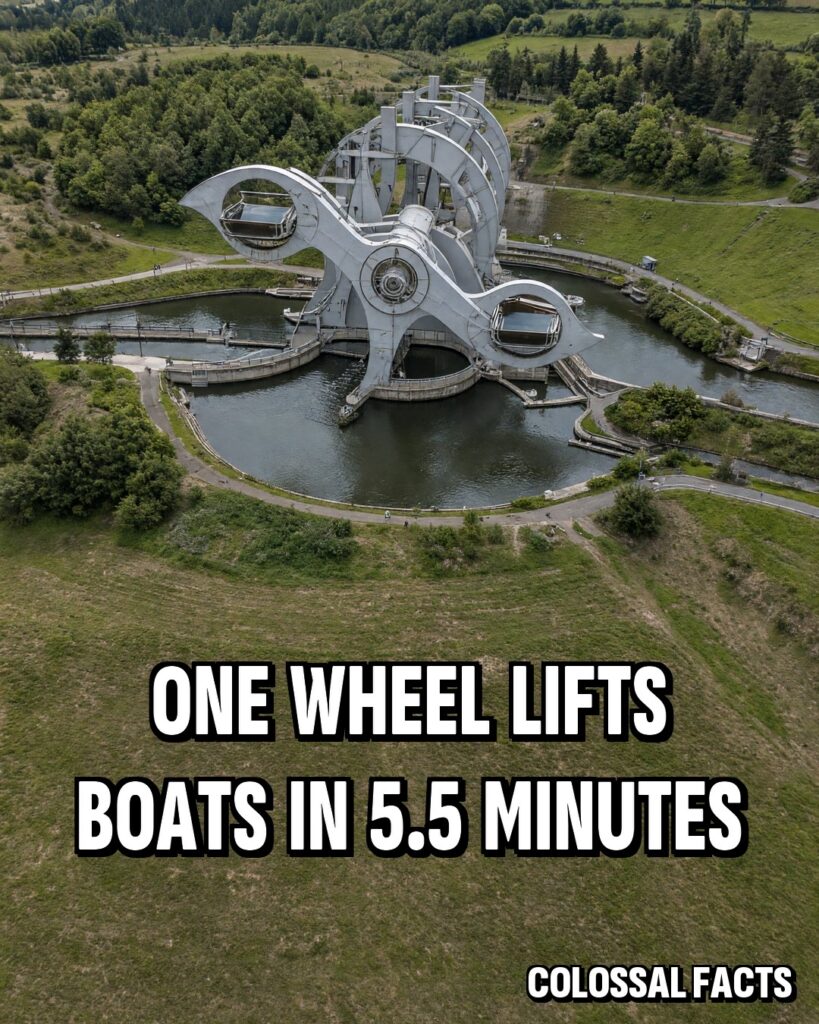
The Falkirk Wheel is the only rotating boat lift of its kind in the world. It links the Forth and Clyde Canal with the Union Canal in central Scotland, near Falkirk. Boats once climbed a staircase of 11 locks between the two canals. The trip took nearly a whole day. In 1933, those locks were dismantled, and the canals lost their connection. A structure 115 feet (35 meters) tall now stands in their place, as high as eight double-decker buses stacked one on another. It is the centrepiece of the Millennium Link, a project to reopen the old lowland canals. Two gondolas, closed troughs for the boats, raise or lower them 79 feet (24 meters), the difference in water level that the old locks had handled in a long flight.
How does it work? The wheel makes a half turn in about five and a half minutes. The energy used is, according to the operators, roughly equivalent to boiling eight kettles of water. Balance does the rest. When a boat enters, it displaces water that weighs exactly the same as the boat, so the gondola stays level no matter the load — Archimedes’ principle, applied to a pair of tanks on a wheel. The motors do not lift the unbalanced weight of a boat. They only turn a wheel that is already balanced, one gondola against the other.
On 24 May 2002, during the Golden Jubilee, Queen Elizabeth II opened it, and it became the heart of the link between the two canals. Since then, it has been an engineering landmark and a stop for visitors, with a visitor centre and a basin where trip boats queue for a ride. Those 79 feet? A full day of locks fits into one quiet half turn. The old route swallowed hours. The wheel almost turns itself.
A unique machine, on purpose
There are other boat lifts in the world, including vertical lifts with tanks and counterweights. There is no other rotating lift quite like this one. The design, led in architectural form by a team at RMJM, with the wheel built by Butterley Engineering, was meant to be a landmark as well as a lock-replacement. The arms have a Celtic-inspired curve. The function is still a canal connector: without the wheel, or without a long staircase of new locks, pleasure boats and work boats could not move between the Union Canal, which runs toward Edinburgh, and the Forth and Clyde, which runs toward Glasgow and the sea.
The elegance is the physics. Two troughs, the same weight if they are both full, turn on an axle, and a small motor does what a day of lock-keepers and a great many tons of lost water used to do. The spectacle is a side effect, and it is why people come to watch a boat rise as if the canal had learned to wheel.
The two canals had been industrial arteries in the era of coal and barges. By the late 20th century they were half-forgotten, and the missing lock flight at Falkirk was a break in a route that civic and national bodies wanted to reopen for leisure and for the look of a working waterway. The Millennium Link restored the connection at a cost far above a simple lock staircase, and the wheel is the reason the cost was accepted. A boat can now travel, with patience, between Edinburgh and Glasgow by canal again. The half turn is the postcard, and also the lock. Without it, the Union Canal would still end in the air, 24 meters above the Forth and Clyde, with no way down that a boat could use.
Sources: The Falkirk Wheel – Scottish Canals, Falkirk Wheel – Wikipedia, Falkirk Wheel – Institution of Civil Engineers