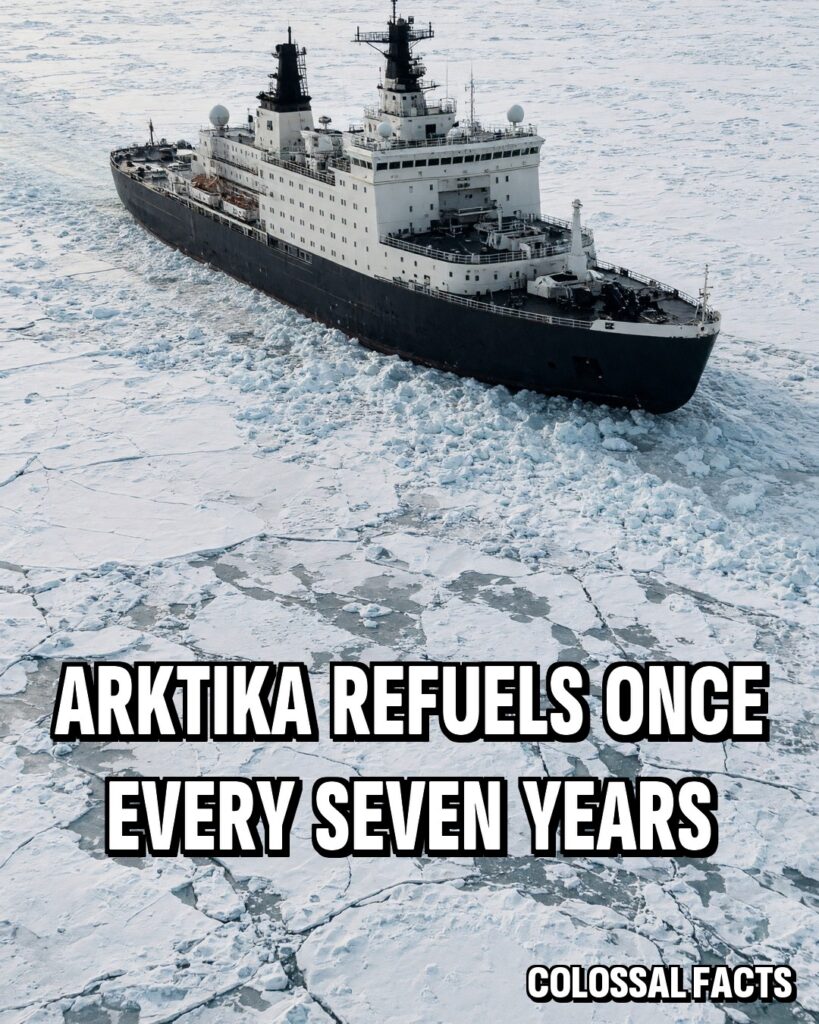
Arktika is a nuclear icebreaker of Project 22220, the lead ship of a new Russian class, and ships of this type are now the largest and most powerful icebreakers in the world. She should not be confused with an older Soviet icebreaker of the same name, which in 1977 became the first surface ship to reach the North Pole. The new Arktika was laid down in 2013, launched in 2016, and delivered in October 2020. She stretches 569 feet (173.3 meters) and is 34 meters wide. She runs on a pair of RITM-200 reactors instead of diesel engines.
Each reactor makes 175 megawatts of heat. That heat boils water into steam. The steam spins generators, and 60 megawatts reach the propeller shafts, the push that drives the hull through the ice. Why not diesel? A nuclear icebreaker is more powerful, and in the ice there is often nowhere to take on fuel. Official design figures say the fuel is reloaded every five to seven years. In open water she makes about 22 knots, or about 25 mph. She is designed to keep moving in ice 2.8 to 2.9 meters (about 9 feet) thick, at a slow walking pace of about 2 knots. That official ice figure is what the class is built for, and it is thicker than a casual mid-ice cruise would suggest.
A second trick sits below the waterline. Her draft, how deep she sits, can change, from about 10.5 meters down to about 8.5 or 8.65 meters, by taking on or pumping out ballast, in a matter of hours. The same ship works in deep Arctic seas and in the shallow channels of Siberian rivers, including approaches to the Yenisei and the Gulf of Ob. She is meant to replace, in one hull, work done by the heavy icebreakers of the older Arktika type (Project 10520) and some of the work of the smaller, shallower Taymyr type. The fleet loses no job. The running cost, and the number of different hulls required, is supposed to fall.
A name with two ships behind it
Rosatomflot operates the class from Murmansk. Sister ships have followed: Sibir, Ural, and others still being built at the Baltic Shipyard in St. Petersburg. In October 2020, during ice trials, the new Arktika reached the geographic North Pole, a trip the older namesake had made 43 years before. The point of the new design is not a polar flag. It is year-round escort of cargo on the Northern Sea Route, including large tankers, through ice that can run close to three meters thick, and then a change of draft for river mouths where a deep Arctic hull would run aground.
And the length? A little over half the height of the Eiffel Tower. Only this half does not stand on shore. It splits ice. Diesel stops when the tank runs dry. The reactor counts years, not the tank.
A crew of about 53 to 54 is designed to run the new ship, far fewer than the hundred-odd sailors needed on some older nuclear icebreakers, because more of the plant is automated. Displacement is about 33,000 tonnes at deep draft. The class is built for a service life of around 40 years. On the Northern Sea Route, the value of a 60-megawatt, variable-draft hull is practical: it can lead a tanker in heavy pack ice and then go lighter to follow cargo into a river mouth. Diesel icebreakers still do a lot of the world’s ice work. They cannot match this endurance, or this power, without a string of fuel stops that the Arctic does not always provide.
Sources: Project 22220 universal nuclear icebreaker – Rosatomflot, Project 22220 icebreakers – Iceberg Central Design Bureau, Arktika (2016 icebreaker) – Wikipedia