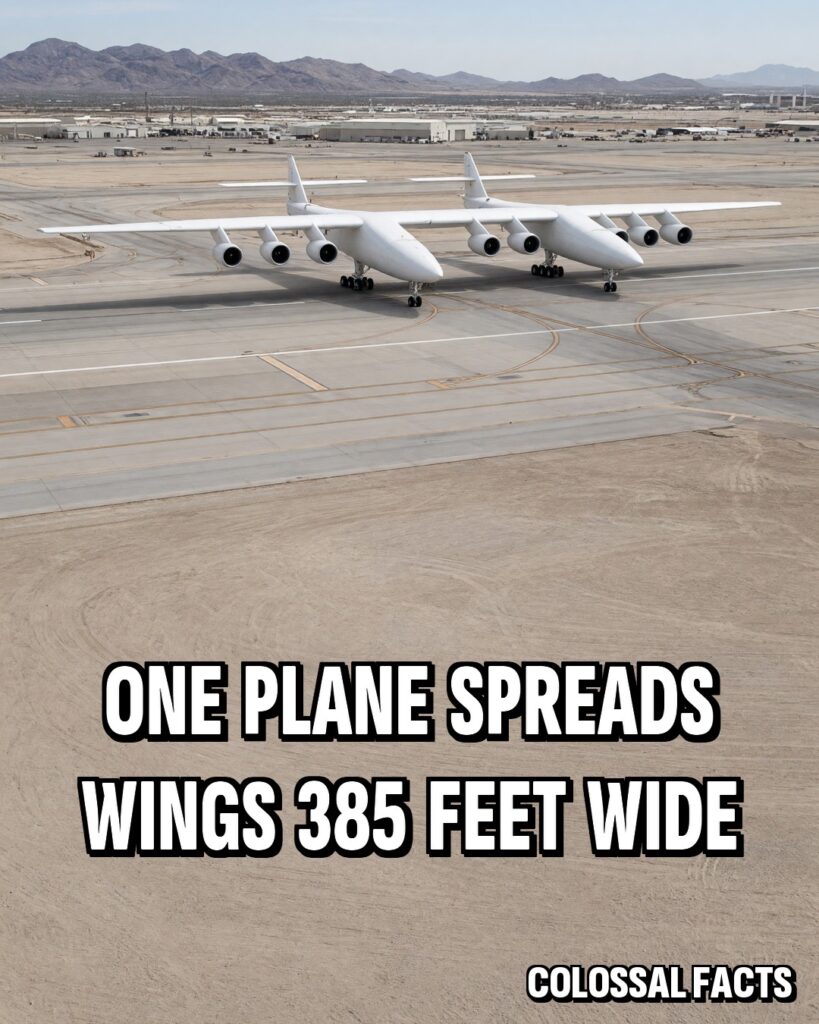
Stratolaunch’s Roc has a wingspan of 385 feet — 117.35 metres. That is the largest wingspan of any aircraft that has flown, a record recognised by Guinness World Records. The aeroplane is a twin-fuselage carrier, built to lift a heavy load to altitude and release it. It first flew on 13 April 2019 from Mojave Air and Space Port in California.
The span is wider than a football pitch is long. Standing under the wing, the two fuselages look like a pair of airliners joined by a single, vast centre section.
How it was built
Paul Allen founded Stratolaunch in 2011. The aircraft itself was built by Scaled Composites at Mojave. The design uses two fuselages, a single high wing, and six Pratt & Whitney PW4056 turbofan engines taken from retired Boeing 747 airliners. The landing gear is spread across both fuselages. The centre wing is the reason for the record: it has to be stiff enough to carry a payload between the two bodies and long enough to give the aircraft its 385-foot span.
Allen died in October 2018, months before the first flight. The company continued the test programme without him. On that April morning in 2019 the aeroplane left the runway at Mojave, flew a conservative circuit, and landed. It was the first time an aircraft this wide had been in the air.
The payload figure, corrected
An earlier version of this article gave the rated payload as 550,000 pounds, or about 249,500 kilograms. That figure is not the one used by Guinness and by later technical accounts of the aircraft. The documented maximum payload is 500,000 pounds — 226,796 kilograms. That is still an enormous load for an aeroplane: a quarter of a million kilograms, hung between two fuselages, designed to be carried to altitude and released.
The original mission was air-launch to orbit: a rocket would leave the centre wing in flight and go on to space. That plan changed. Stratolaunch later turned Roc into a mothership for high-speed test vehicles, notably the reusable Talon-A hypersonic testbed, rather than a routine satellite launcher. The wingspan did not change. The job did.
Why the span matters
Wingspan, not length and not weight, is the record Roc holds. Other large aircraft are heavier, or longer, or carry more passengers. None that has flown is wider. The number is exact enough to quote in both systems: 385 feet, 117.35 metres. The twin-fuselage layout is not a gimmick. It leaves a clear space under the centre wing for a payload that would not fit under a conventional fuselage, and it spreads the landing loads between two bodies.
First flight confirmed that an airframe this wide could be controlled, rotated off a Mojave runway, and brought back. Later flights have been used to carry and release test vehicles. The record is still the wing.
Wider than what came before
Roc’s record is easiest to see by comparison. The Hughes H-4 Hercules, the wooden flying boat better known as the Spruce Goose, had a wingspan of 320 feet 9 inches, or 97.77 metres, and held the mark for decades. The Antonov An-225 Mriya was heavier and longer, and could lift a larger commercial payload, but its wingspan was 88.4 metres — wide, but not as wide as Roc. When the Stratolaunch aircraft left the runway at Mojave in April 2019, it was the first time a heavier-than-air machine with a 385-foot wing had flown.
The six PW4056 engines are a practical choice as well as a visual one. They are a well-known 747 powerplant, already certified, and they give the twin-fuselage airframe enough thrust to leave a high-desert runway with a large load on the centre wing. Scaled Composites, the Mojave firm known for unusual experimental aircraft, built the airframe for Allen’s company. The name Roc comes from the enormous bird of myth; the official designation of the carrier is often given simply as Roc.
From orbital launcher to test mothership
The first-flight programme was conservative: a take-off, a circuit in the Mojave airspace, a landing, and a mass of data on how a wing that wide behaves close to the ground and in a gentle climb. Later flights stretched the envelope and, after the company changed course, began to use the centre station for drop tests. The Talon-A vehicle is a reusable hypersonic testbed, not the orbital rocket of the original brochure. That shift does not shrink the wing, and it does not change the payload figure that should be quoted: 500,000 pounds, 226,796 kilograms, not the higher 550,000-pound number that appeared in an earlier version of this article.
The aircraft remains a rare thing: a twin-fuselage carrier with the widest wings ever flown, built in the Mojave desert, first flown after its founder had died, and later put to a different job than the one first advertised. The record is still on the wing.
The flight crew sits in the right-hand fuselage. The left-hand body is a matching structure that helps carry fuel, systems and landing gear, and keeps the giant centre wing balanced. From a distance the pair can look like two airliners flying in formation under one roof. Up close, the story is the wing between them: 385 feet from tip to tip, rated to lift up to 500,000 pounds, and still the widest that has ever left the ground under its own power.
Sources
- Guinness World Records – Largest aircraft by wingspan (385 ft / 117.35 m; payload up to 500,000 lb)
- Stratolaunch – Roc
- Stratolaunch – first-flight announcement, 13 April 2019, Mojave