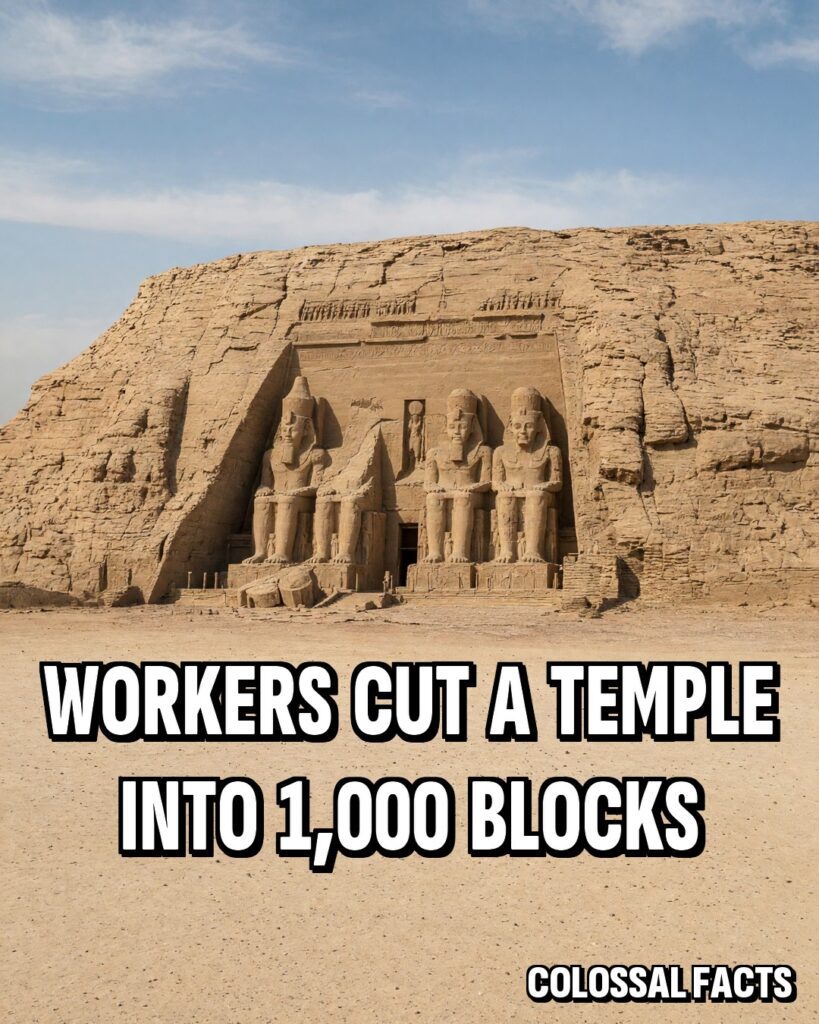
When the Aswan High Dam began filling Lake Nasser, water threatened the sandstone cliffs of Abu Simbel, in southern Egypt. The ancient temples were not built as free-standing halls. They were carved straight into the rock in the 13th century BCE, in the reign of Ramesses II. The great temple is fronted by four colossal seated statues of the king, each about 20 meters tall. A smaller temple nearby is dedicated to the queen, Nefertari, and to the goddess Hathor. If the water rose, the flood would swallow them forever.
A UNESCO-led campaign, the International Campaign to Save the Monuments of Nubia, launched in 1960, did not want a copy. It wanted to save the originals. From 1964, workers cut the sandstone with wire saws and hand saws. The blades moved slowly to avoid damaging the soft stone. More than 1,000 huge blocks, some weighing up to 30 tons, were numbered and moved into storage. Then the job reversed. UNESCO’s account says the temples were reassembled 180 meters inland and 64 meters above the old site, inside an artificial hill. (Rounded figures of about 200 meters and 65 meters are also widely used.)
The halls do not hang in the air. They rest under concrete domes, shells that support the weight of the artificial hill above, so that the rooms feel like a cliff temple again and not like a building under a roof. The project at Abu Simbel is often put at about $40 million; the wider Nubia campaign, which also saved Philae and many other sites, cost about $80 million, with help from dozens of countries. On 22 September 1968, Abu Simbel was inaugurated in its new location. The dam water was rising, but the temples stood above it.
The sun still finds the sanctuary
The rebuild was designed to preserve the original alignment of the great temple. Twice a year, sunlight still enters the inner sanctuary and lights statues of the king and the gods, leaving the figure of Ptah, a god tied to the underworld, in shadow. Many accounts say the move shifted the event by one day, so that it now falls on 22 February and 22 October, rather than on the 21st. The exact ancient dates are themselves a matter of tradition. What matters for the engineering is that the new cliff was aimed carefully enough for the sun to still perform the same trick, twice a year, after the temple had been taken to pieces and stacked back together.
Twenty-two monuments and complexes in Nubia were saved in the wider campaign. Abu Simbel is the one people picture: four stone faces, cut from a mountain, and then from the mountain again, and set on a new shore of a new lake.
Cut into pieces, still a temple
The stone was cut into pieces. The temple stayed whole. Visitors walk into a hill that did not exist in the 13th century BCE, and the sun, on two mornings a year, still finds the faces at the back of the hall.
The great temple runs more than 50 meters into the new hill, a sequence of halls that still ends in the small sanctuary of four seated figures. The four facades on the cliff, including the famous broken colossus whose fragments were also moved and reset, had to line up again as a single composition, not as a pile of numbered stones. Surveyors and stonecutters worked to tolerances tight enough that a visitor, unless told, may not see a joint. That was the artistic test of a job whose engineering test was simpler and harsher: finish before Lake Nasser reached the old floor of the valley.
Sources: Working Together: Abu Simbel – UNESCO, Nubian Monuments from Abu Simbel to Philae – UNESCO, Temples still shining at Abu Simbel – Ahram Online