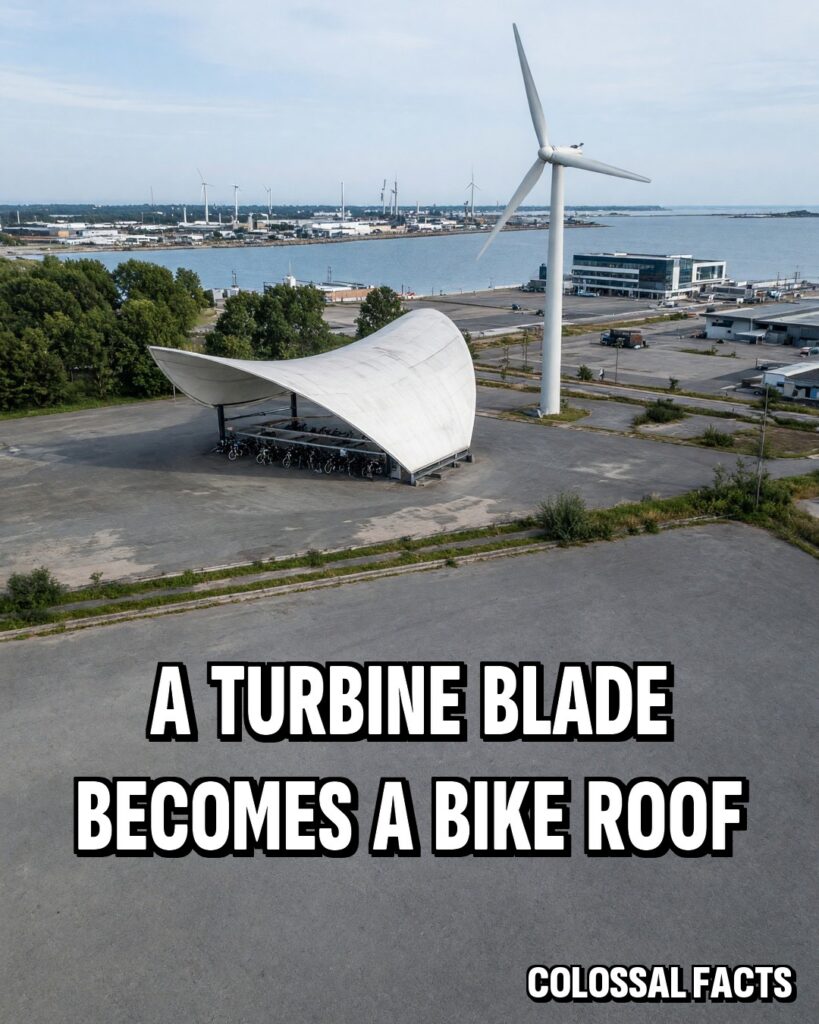
In 2019, staff at the Port of Aalborg in northern Denmark were waiting for a new bike shed. Environmental coordinator Brian D. Rasmussen scrolled the web for something to buy. In New York, he found a shelter that looked like a wind turbine blade. The idea started there, even if the final shed was a Danish job. A Siemens Gamesa site operated nearby. Danish authorities had already asked the manufacturer to look for new uses for retired blades, which are made of fiberglass and other composites that do not break down easily and are awkward to recycle. The company donated the middle section of a decommissioned blade.
Not the small scraps most blades become. A long piece of the blade’s outer composite shell, made of tough layered material, became the roof. Kærsholm Diamond Drilling cut away the excess. Brunø Stål, a blacksmith shop in Aalborg, made the steel supports the blade rests on and is secured to. The hollow side faces the ground. The bikes sit underneath. Why this material? Composite is hard to recycle, yet it lasts outdoors and shields the bikes from North Sea weather. The engineer put it plainly. Instead of chopping the blade up and burning it for fuel, use it for something else.
Europe retires tens of thousands of tonnes of blades a year as turbines from the early 2000s come down; one figure often cited around the time of the project was about 27,000 tons a year, and the number has been rising as the first generation of large farms is replaced. Similar reuse projects have appeared elsewhere, as shelters, playgrounds, or pedestrian bridges, because a blade already has a long, strong, weatherproof curve. Seven years later, the Aalborg shed still stands as a small, practical answer: a roof that began as a machine for catching wind.
A waste problem with a useful shape
The hard part of a turbine blade is not strength. It is the end of life. The same qualities that let a blade work for 15 or 20 years in salt air — a tightly bound composite — make it a poor candidate for ordinary recycling. Cement kilns and new chemical methods can take some of the material back, but a lot of blades have been landfilled or burned. A bike shed does not solve a continent’s scrap problem. It does show that a retired blade can have a second, visible job, and that a port can buy a roof by asking a nearby factory for a piece it no longer needs.
The blade does not reach a landfill. It becomes a roof over the bikes. In Aalborg, that sentence is literal. The curve that once faced the wind now faces the rain, and the steel from a local shop holds it just high enough for a bicycle to roll under.
Aalborg’s port is a working industrial site, not a design museum, which makes the shed more convincing as a test. If a blade roof only appeared at a show, it would be a sculpture. Here it has to keep bicycles dry in Danish weather, year after year. Other countries have since tried blade playgrounds, noise barriers, and even short bridges, all of them experiments in the same direction. None of them, including Aalborg’s, will absorb the full stream of retired blades. They can, however, keep a few long, curved pieces out of a pit, and they can make the waste visible as a useful object instead of as a problem hidden in a yard. That visibility is part of the point Rasmussen was after when he went looking for a shed and found a blade.
Sources: Wind turbine blade recycling – Wikipedia, Siemens Gamesa, Port of Aalborg