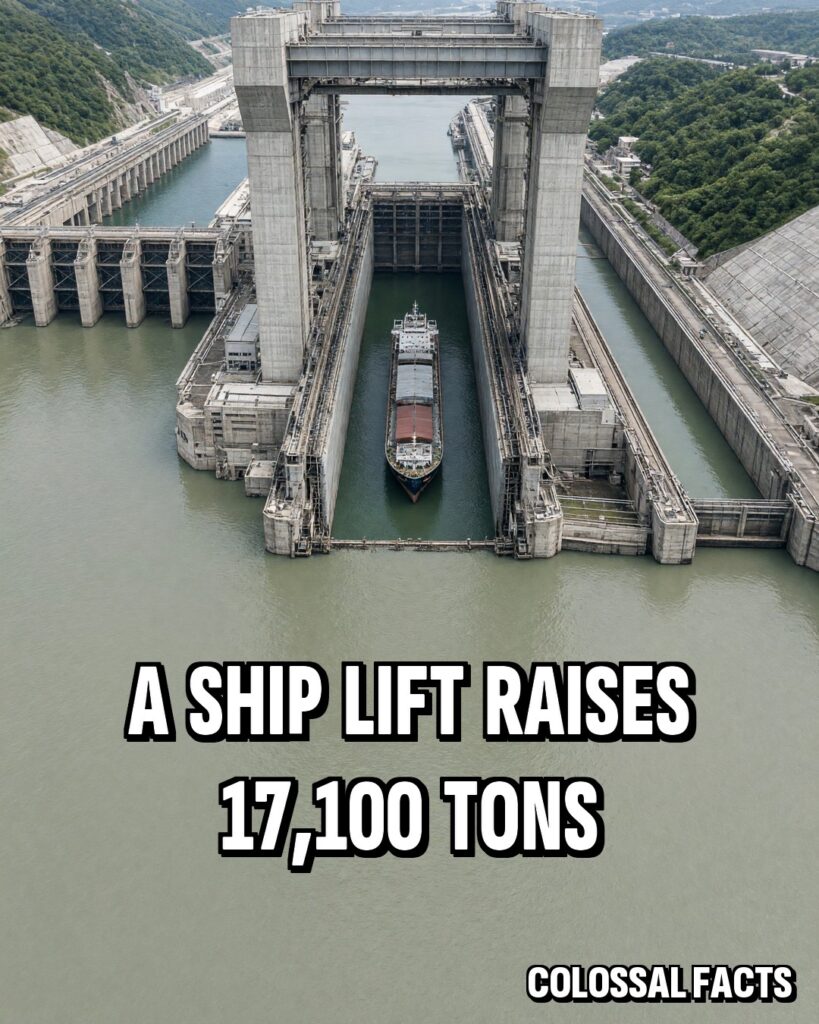
At the Three Gorges Dam on China’s Yangtze River, at Yichang in Hubei Province, sits the world’s largest mechanical ship lift. It takes vessels of up to 3,000 metric tonnes (about 3,300 US tons) and raises or lowers them through a vertical distance of 113 meters (371 feet). Guinness World Records lists it as the largest boat lift, and China Three Gorges Corporation describes it as a fast passage for passenger, cargo, and special-purpose ships around the dam.
The ship is only part of the load. After the vessel enters, the chamber seals tight. The ship stays in the water. That water rises with the ship, the steel chamber, and its mechanical systems. Official figures put the chamber’s useful size at 120 meters long, 18 meters wide, and 3.5 meters of water depth. The moving mass reaches about 15,500 metric tonnes (17,100 US tons) — roughly the weight of 6,200 pickup trucks — and travels as one balanced system.
A rack-and-gear elevator for ships
Unlike a lock, the lift does not fill or empty a chamber to change the water level. It is a gear-and-rack climbing lift: a fixed rack of gear teeth runs the full height, and the chamber climbs or descends on that rack. Four drive units, set symmetrically, support the chamber at four points and must stay in exact sync for the full climb. The design is meant to keep the water in the chamber from tilting enough to unbalance the load. The lift never pulls the ship out of the water to carry it to the other level.
Guinness notes that the system was designed by the German engineering firm Lahmeyer and became operational in 2016. The Three Gorges project itself is far larger than the lift. Beside it, on the same left bank, is a double line of five-step ship locks, built for much bigger tows. Those locks remain the main route for heavy freight. The lift is the shortcut for smaller ships that can fit the 120-by-18-meter chamber.
Forty minutes instead of hours
The designed time for a vessel to pass through the ship lift is about 40 minutes. The same trip through the locks takes about 150 minutes, and some official accounts put the lock transit, with waiting, closer to three or four hours. That difference is the reason the elevator exists. Once the dam blocked the river, ships had to be lifted the full difference in water level — up to 113 meters — to keep the Yangtze open as a working waterway.
The five-step locks next to the lift are a different machine altogether. Official project figures give each lock chamber a useful length of 280 meters and a width of 34 meters, with a minimum depth of 5 meters over the sill — large enough for much heavier tows than the 3,000-tonne limit of the elevator. The locks’ design capacity is tens of millions of tonnes of freight a year, and they had already been running for years, sometimes beyond their original annual target, before the lift opened. The elevator was added as a second door through the dam, not as a replacement for that heavy route.
Trial navigation on the ship lift began in 2016. China Three Gorges Corporation has since described it as one of the dam’s permanent navigation facilities, used together with the locks so that traffic can be split by size and urgency: smaller passenger and cargo ships can take the 40-minute climb, while the largest tows stay in the five-step staircase of chambers. The greatest technical demand is not the height alone, but keeping a 15,500-tonne tank of water and steel level while it climbs more than 100 meters on four synchronized pinions. The ship keeps floating. The lift raises the water that carries it.
Sources: Largest boat lift – Guinness World Records, World’s largest ship elevator at Three Gorges – China Three Gorges Corporation, Three Gorges ship lift acceptance – Ministry of Water Resources of China