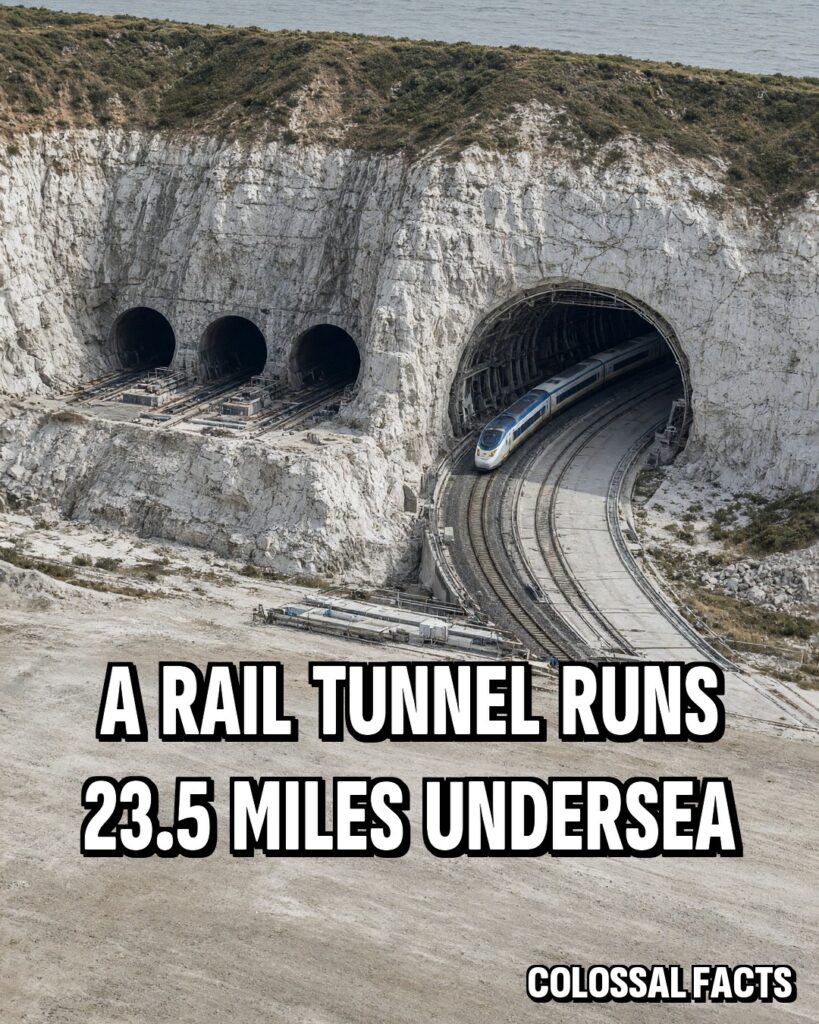
The Channel Tunnel is a railway, not a road, under the water that separates Britain from France. The whole link runs about 50.45 kilometres (31.4 miles) between Folkestone in Kent and Coquelles, near Calais. Of that length, 37.9 kilometres — 23.5 miles — lie under the sea. That undersea stretch is the longest in the world. At its deepest the rails sit about 75 metres below sea level, and on average about 45 metres below the seabed.
No cars drive themselves through the chalk. Vehicles roll onto trains, and the trains take the undersea stretch at speed, under rock and a shipping lane.
Three tunnels, not one
What is usually called “the Channel Tunnel” is in fact three parallel tunnels. Two are single-track rail tunnels, one in each direction, for passenger, car-shuttle and freight trains. Between them runs a smaller service tunnel, used for maintenance and as an escape route. Cross-passages link the three tubes at regular intervals, so that a train can be evacuated into the service tunnel if something goes wrong.
The operator today is Getlink, the company formerly known as Eurotunnel. LeShuttle carries cars, coaches and lorries. Eurostar runs passenger trains between London and the Continent. Freight trains use the same pair of running tunnels. The layout has not changed since the line opened: two rail tubes, one service tube, and 37.9 kilometres of seabed overhead.
How the two sides met
Serious construction ran from the late 1980s until 1993. British and French teams bored toward each other through the chalk. The first historic breakthrough was in the service tunnel on 1 December 1990, about 22.3 kilometres from the British coast and 15.6 kilometres from the French. The headings met close enough to join: later accounts record alignment errors of a few tens of centimetres, not metres, which was tight enough to connect the two countries by rail.
About 13,000 people worked on the project at its peak. Workers died during the build, a cost that official memorials on both sides of the Channel still mark. The bored chalk, once the machines were through it, proved sound enough for a lining that has carried decades of train traffic. Queen Elizabeth II and President François Mitterrand formally opened the link on 6 May 1994.
Fires, freight and the mid-tunnel design
The safety design was tested in service. A serious fire in 1996, and later incidents, led to tighter rules on freight, on how lorries are loaded, and on how crews respond in the running tunnels. The service tunnel and the cross-passages are not decoration: they are the route out, and the route in for firefighters. Through all of that, the basic numbers have stayed the same. The railway is 50.45 kilometres long. Most of it, 23.5 miles, is out of sight of both coasts.
What the numbers actually mean
It is easy to mix the figures. The often-quoted 23.5 miles is the undersea section, not the whole tunnel. The whole link is about 31.4 miles. Some popular roundings use 50.5 kilometres or 32 miles for the full length; the consistent set used by engineering references is 50.45 kilometres total and 37.9 kilometres under the sea. “Under the sea” is also not the same as “under the seabed”: the deepest point is about 75 metres below sea level, and the average cover of chalk above the tunnels is about 45 metres.
For a driver, the crossing is a train ride, not a tunnel walk. For an engineer, it is still the longest undersea path opened to traffic — a 31.4-mile railway that spends most of its run out of sight of England and France.
A railway under a shipping lane
The terminals sit at Folkestone and at Coquelles, not in the city centres of Dover and Calais. On the British side, cars and lorries drive onto LeShuttle trains at the Folkestone terminal; on the French side, they roll off near Calais. Eurostar passenger trains use the same running tunnels but different stations, linking London with Paris, Brussels and other cities on the Continent. Freight trains share the rail tubes with both. The point of the project was always this mix: a fixed rail link, not a road tunnel with ventilation for a continuous stream of drivers.
The geology helped. The machines bored mainly through chalk marl, a layer that was stable enough to cut and to line. Even so, the meeting of the two headings had to be precise. The first handshake was in the service tunnel, on 1 December 1990. The running tunnels followed. Queen Elizabeth II and President François Mitterrand opened the completed link on 6 May 1994, after years of digging and a great deal of money.
A serious fire on 18 November 1996, started on a heavy-goods shuttle, showed why the service tunnel and the cross-passages matter. Later incidents tightened the rules again. For all the later changes to freight practice and emergency response, the civil-engineering fact has not moved: 50.45 kilometres of railway, 37.9 kilometres of it under the sea, still the longest undersea tunnel in service.
One comparison is worth keeping straight. Japan’s Seikan Tunnel is longer overall than the Channel Tunnel, but a smaller share of it runs under the sea. The Channel Tunnel’s 37.9-kilometre undersea section is still the longest underwater stretch of tunnel in the world. That is why the title figure is 23.5 miles, not the full 31.4-mile railway, and why popular roundings that mix the two lengths are misleading.
Sources
- Getlink – The Channel Tunnel
- Getlink – The Group’s history (service-tunnel breakthrough, 1 December 1990)
- Institution of Civil Engineers – The Channel Tunnel
- Encyclopaedia Britannica – Channel Tunnel