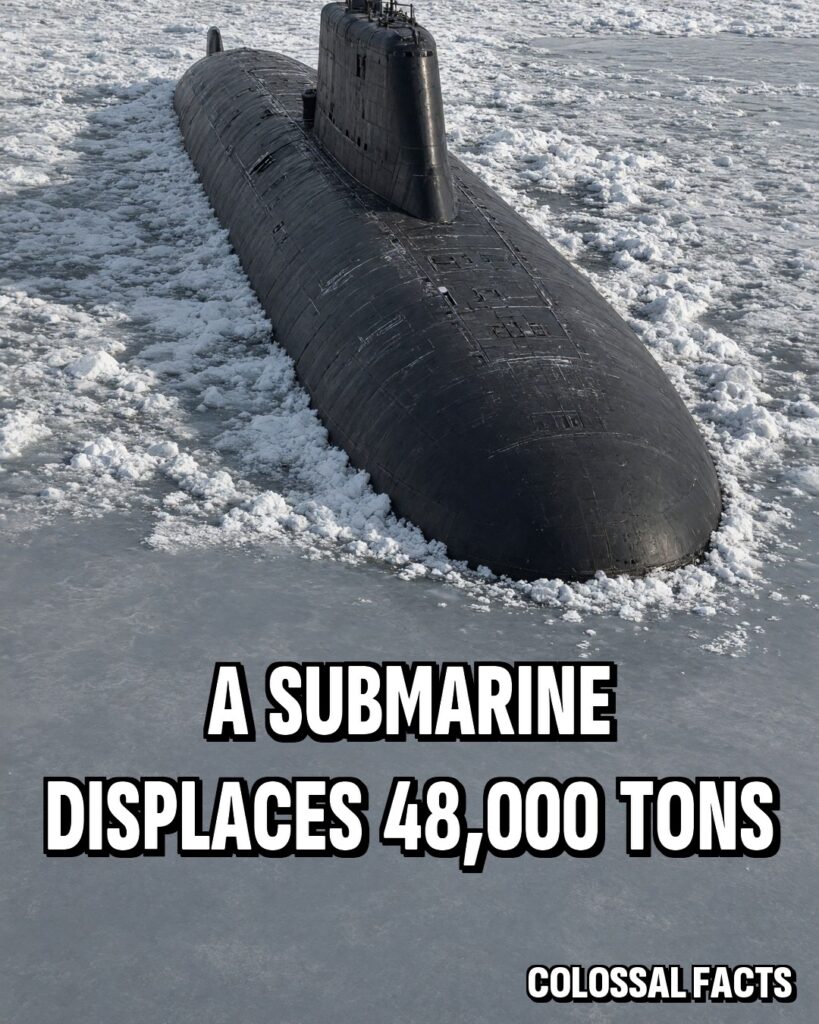
The Soviet Project 941 submarine, named Akula — “shark” — is the largest submarine ever built. NATO calls the same boats Typhoon. The two names are easy to mix up, because NATO also uses “Akula” for a different, smaller Soviet attack submarine, Project 971. The giant ballistic-missile boats are Project 941 to the Soviet navy and Typhoon in Western reporting.
Underwater, one of these submarines displaces about 48,000 tons. The hull is about 23 meters (75 feet 6 inches) wide, wider than any other submarine, and about 170 to 175 meters long. Why is the hull so wide? The two main pressure hulls sit side by side, and additional inner hulls sit inside the outer structure, commonly described as five inner hulls in all. The missile tubes are in front of the sail, not behind it. That arrangement is unusual, and it leaves crew space that does not feel like a cramped submarine.
A patrol boat the size of a cruiser
About 160 people live aboard. Under the ice of the Arctic, a patrol can last more than 120 days. So life on board is not only a bunk and a watch. The class is well documented as carrying a small swimming pool and a sauna, amenities almost unheard of on a submarine and made possible by the extra volume of the double-hull layout. The point was not luxury for its own sake. A crew that may stay under the ice for months still has to remain fit for duty.
The main weapons are 20 R-39 (RSM-52) submarine-launched ballistic missiles, carried in those tubes ahead of the sail. Each missile was designed to carry multiple warheads, and together the 20 tubes can carry up to 200 nuclear warheads. The boats also have torpedo tubes for self-defense. The class was a direct answer to the American Ohio-class missile submarines. An Ohio-class boat is itself a large vessel, but it displaces far less than 48,000 tons when submerged and carries its 24 Trident missiles in the more usual place, behind the sail. The Typhoon’s extra beam is the price of putting two main pressure hulls side by side and still leaving room for the missile battery up front.
Six Typhoon-class boats were built at the Sevmash yard in Severodvinsk, beginning in the late 1970s and entering service in the 1980s. They were designed to operate under Arctic ice, where a wide, heavily built hull and a long patrol endurance were part of the Soviet ballistic-missile submarine force. Most have since been withdrawn from service. One of them was later used as a test platform for a newer missile, a second career that still depended on the same oversized hull.
The record is the scale
No later design has matched this submerged displacement or this beam. The Typhoon remains a Cold War answer written at extreme size: two pressure hulls in one outer ship, a row of twenty missiles forward of the sail, and enough interior volume for a crew to live under Arctic ice for months. No other submarine has reached this scale. And none has carried a pool under Arctic ice.
On the surface the boats already displace more than many cruisers of their era; submerged, the figure rises to that record 48,000 tons. Two nuclear reactors give them the endurance to stay under the ice, and the wide hull is strong enough, in the design, to operate in that Arctic environment. The swimming pool and sauna are the details everyone remembers. They are also a reminder of the real record: enough interior volume, in a submarine, for 160 people to live for months with a missile battery over their heads.
Sources: Typhoon-class submarine – Wikipedia, Project 941 Typhoon specifications – GlobalSecurity.org, Typhoon class submarines – Naval Encyclopedia