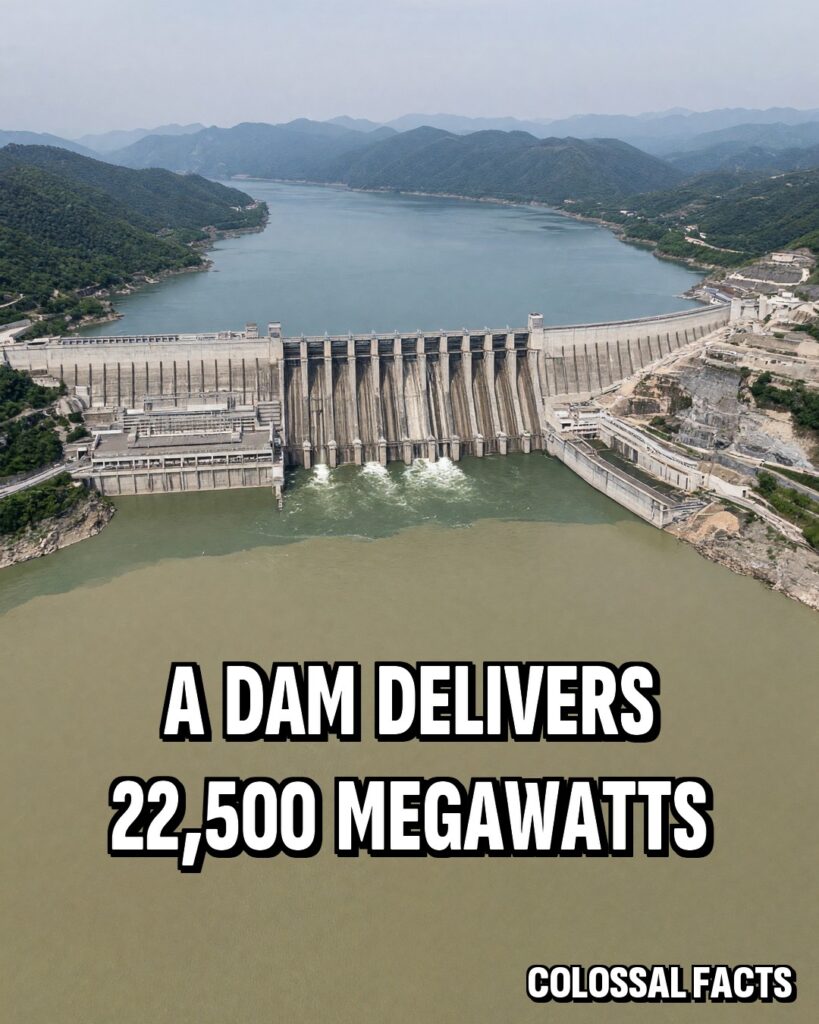
Three Gorges is a concrete gravity dam on the Yangtze River at Sandouping, in Yichang, Hubei, in central China. It stands by its own weight, not by arches or braces. The wall is about 181 meters (594 feet) high and runs 7,770 feet (2,335 meters) along the river. That is about as long as 26 American football fields set end to end.
It is the world’s largest hydroelectric plant by installed capacity. River water spins turbines and makes electricity. The project reached full generating capacity in 2012: 22,500 megawatts. That is how much power it can generate at one instant, a world record for a single hydropower station. The plant has 32 main turbines, each rated at 700 megawatts, and two smaller 50-megawatt units. The first machines began producing power in 2003. Dam construction had been authorized in the 1990s, after decades of debate, and the main structure rose through the 2000s.
The twist is the river. For about six months a year, the Yangtze carries too little water for full generation. Output can drop significantly. So over a full year, the biggest plant may make about as much electricity as a smaller hydro plant on a river that flows strongly every month. In 2020, after heavy monsoon rains, official figures put output at about 111.8 terawatt-hours, a world record for annual generation by a single hydropower station. That mark passed the previous record set by Itaipu, on the Paraná River, which had reached 103.1 terawatt-hours in 2016.
A dam that is also a shipping stair and a reservoir
Along with the power, the dam opens a shipping path far inland on the Yangtze. A five-step ship lock lifts large vessels, and a ship lift handles smaller ones, so traffic can pass the wall rather than stop at it. The reservoir stretches for hundreds of kilometers. It was designed to help control floods on a river that has drowned cities, and to deepen the channel for commerce. Those gains came at a high human and environmental cost. About 1.3 million people were moved from towns and villages that the water would cover. Critics have also pointed to silt, the loss of landscapes and sites, and the pressure on fish and other species in the river. The project remains both a landmark of civil engineering and a subject of dispute.
The river still decides the output
Installed capacity is a ceiling, not a promise. A 22,500-megawatt plant can set records when the monsoon is heavy and sit well below its peak when the basin is dry. Operators have to balance power, flood storage, and navigation at the same time. From the bank, the wall looks like a single unmoving block of concrete. Behind it is a managed lake. Below it, the river is a working staircase of locks and turbines.
The capacity is the record. The river decides whether it shows up.
The dam is a flood-control structure as well as a power station. The Yangtze has a long record of lethal floods, and the reservoir was designed to hold back peak water as well as to feed turbines and lift ships. Those uses can pull in opposite directions: a reservoir kept low for a coming flood holds less head for power, and a reservoir kept high for generation has less room for a surge. Operators have to choose, season by season. Concrete of this mass also buries towns, fields, and a stretch of the famous Three Gorges landscape. The 22,500-megawatt figure is the easy headline. The harder fact is a river that now works as a managed machine, with people, silt, and flood risk still in the balance.
Sources: Three Gorges Dam – Wikipedia, Three Gorges Dam sets world record for annual power generation in 2020 – China Three Gorges Corporation, Thousands being moved from China’s Three Gorges – Reuters