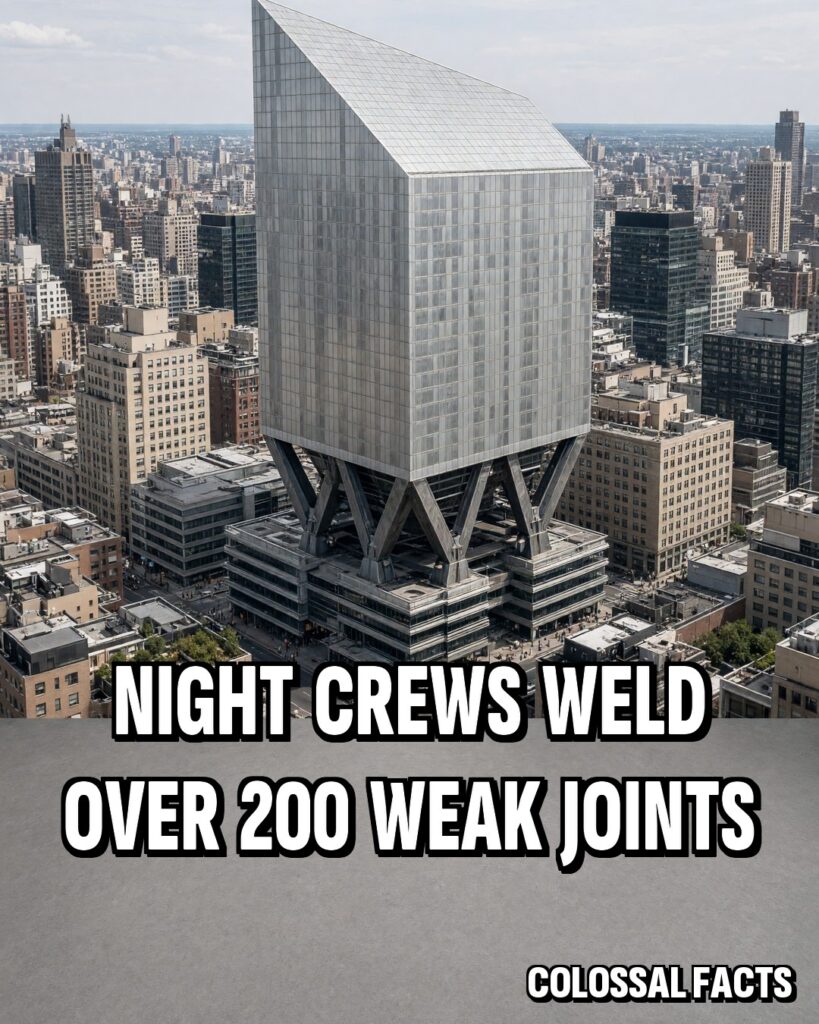
In the summer of 1978, a recently completed tower in midtown Manhattan looked like a bold engineering bet. Citicorp Center, now Citigroup Center, stood on four huge columns at the middle of each side, not in the corners. Its 59 stories sat raised over the street, with St. Peter’s Lutheran Church tucked under one corner. The church had refused to give up its lot, so the tower’s architect, Hugh Stubbins, and its structural engineer, William LeMessurier, had placed the legs at the midpoints and carried the building on diagonal braces, or chevrons, that stepped up the shaft.
At first glance, the structure held. Then the math flipped. The original steel joints in the braces had been specified as welds. They were built as bolted joints instead, a cheaper change that still met the letter of the code for winds hitting the face of the building. LeMessurier, reviewing the design later, looked at quartering winds — storms that strike the tower on a diagonal. Those winds put far more load on the bolts. By his estimate, a storm expected once every 16 years could bring the tower down.
He warned the owners and took on the fix. A crew welded steel plates at night over each of more than 200 bolted joints, while the offices above stayed open and the public was not told. Six weeks later, only half the work was done. Hurricane Ella sat off Cape Hatteras and headed toward the East Coast. Emergency plans were drawn up, including a possible evacuation. Ella turned east and veered out to sea. The welding went on until every weak joint had a plate.
A secret repair over a living office tower
After the last weld, by LeMessurier’s estimate, the tower could withstand an event expected once every 700 years. That is almost 44 times rarer than the storm that could have brought it down in the bolted state. The story became widely known years later, especially after a 1995 account in The New Yorker. A Princeton student, Diane Hartley, had also questioned the wind calculations in a thesis project; her questions, and LeMessurier’s own later review, sit at the start of the tale. The precise chain of who first saw the danger has been retold in more than one version. The engineering fact is clearer: the bolted joints were inadequate for quartering winds, and they were quietly made adequate by welding.
The building still stands on those mid-side columns, a familiar roof slope on the New York skyline. People ride the elevators who have never heard of Ella, or of the nights when welders worked above a church and below a storm track.
One new calculation, and a tower that stayed up
The repair passed overhead, with no noise at all for most of the city. A tower ready to fall stayed standing on one new calculation, a change of joints, and a hurricane that turned away before the last plate was in place.
The tower rises 915 feet and is still easy to pick out because of its sloped crown. Inside the top sits a tuned mass damper, a four-hundred-ton concrete block designed to reduce sway in the wind, one of the first such devices in a United States skyscraper. That damper could not have saved a building whose diagonal braces failed. It was meant for comfort and motion, not for a joint that might come apart in a quartering storm. The nighttime welds were the real repair. For weeks, the offices kept ordinary hours while the steel plates went on after dark. Only a small group knew why the welders were there. The public learned the full story later. The skyline never had to record a 59-story failure in midtown.
Sources: Citigroup Center – Wikipedia, The Fifty-Nine-Story Crisis – The New Yorker, The secret plan to rescue a New York skyscraper – NPR