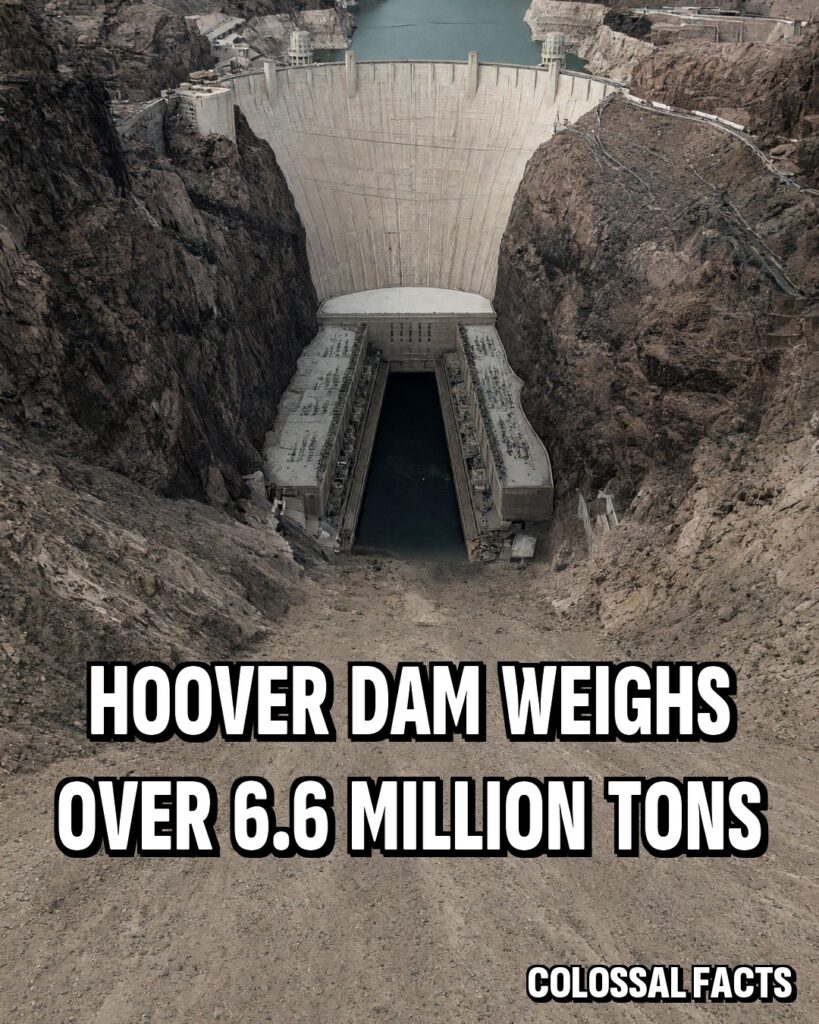
Hoover Dam is a concrete arch-gravity dam in Black Canyon on the Colorado River, on the border between Nevada and Arizona. It is a curved wall that holds the water with its weight and its shape. It stands 726 feet (221 meters) from the rock foundation to the road on the crest. It is the highest concrete dam of its kind in the United States. It contains about 3.25 million cubic yards of concrete and weighs more than 6,600,000 tons.
Construction began in 1931, during the Great Depression, under a contract with Six Companies, Inc. Crews worked around the clock. They finished the dam about two years ahead of the seven-year schedule. President Franklin D. Roosevelt dedicated it in 1935; the last of the work was completed in 1936. The reservoir behind the wall is Lake Mead. The dam was planned for flood control, irrigation, and hydroelectric power for the Southwest, including cities in California, Nevada, and Arizona.
The mass does not do all the work. The curve sends the push of the water sideways, into the canyon’s rock walls. What about the heat as the concrete hardens? If the dam had been poured as one mass and left to cool on its own, Bureau of Reclamation engineers calculated that it could have taken more than a century, and the wall would have cracked. Instead it was built in interlocking columns. More than 582 miles of 1-inch steel pipe sit inside the concrete. River water, then ice-cold water from a refrigeration plant that could make 1,000 tons of ice a day, ran through those pipes and carried the heat away. Cooling was completed in March 1935. The pipes were later grouted in place.
High scalers, and a highway of concrete
Before the pour, climbers called high scalers hung from ropes at the rim. They climbed down cliffs about 656 feet (200 meters) high and knocked off loose rock with jackhammers and dynamite, so the concrete would sit on sound canyon walls. There is enough concrete in the dam, official accounts say, to pave a highway two lanes wide from San Francisco to New York. And more than 6,600,000 tons? More than a million African elephants. Official records list 96 deaths from industrial accidents on the project. The work also built Boulder City, a government town in the desert, because a job this large could not be run from a temporary camp alone.
For a time the Hoover powerplant was among the largest hydroelectric plants in the world. The wall still holds the river, and Lake Mead still stores its water, though the reservoir has fallen in dry decades. The design lesson has not changed: a dam this thick would tear itself apart if the heat of setting concrete had nowhere to go, and a straight gravity wall would need even more mass than a curve that leans on the rock.
Shape, not weight alone
The desert stays quiet. The wall holds the river by shape, not by weight alone. Inside the concrete, hundreds of miles of silent pipe mark the trick that let the dam cool in years instead of a century.
The crest of the dam is 1,244 feet (379 meters) long, a two-lane road that still crosses from Nevada to Arizona, though most visitors now use a later bypass bridge downstream. Intake towers stand in the reservoir like four concrete sentinels, feeding water to the turbines in the powerplant at the foot of the wall. The Bureau of Reclamation still runs the dam. In wet cycles Lake Mead has backed up toward the Grand Canyon; in dry ones, a white “bathtub ring” on the cliffs has shown how far the water has dropped. The wall was built for a river that would always arrive. The concrete does not depend on that promise. The reservoir does.
Sources: Hoover Dam FAQs – Bureau of Reclamation, Colorado River and Hoover Dam facts – Bureau of Reclamation, Concrete – Bureau of Reclamation