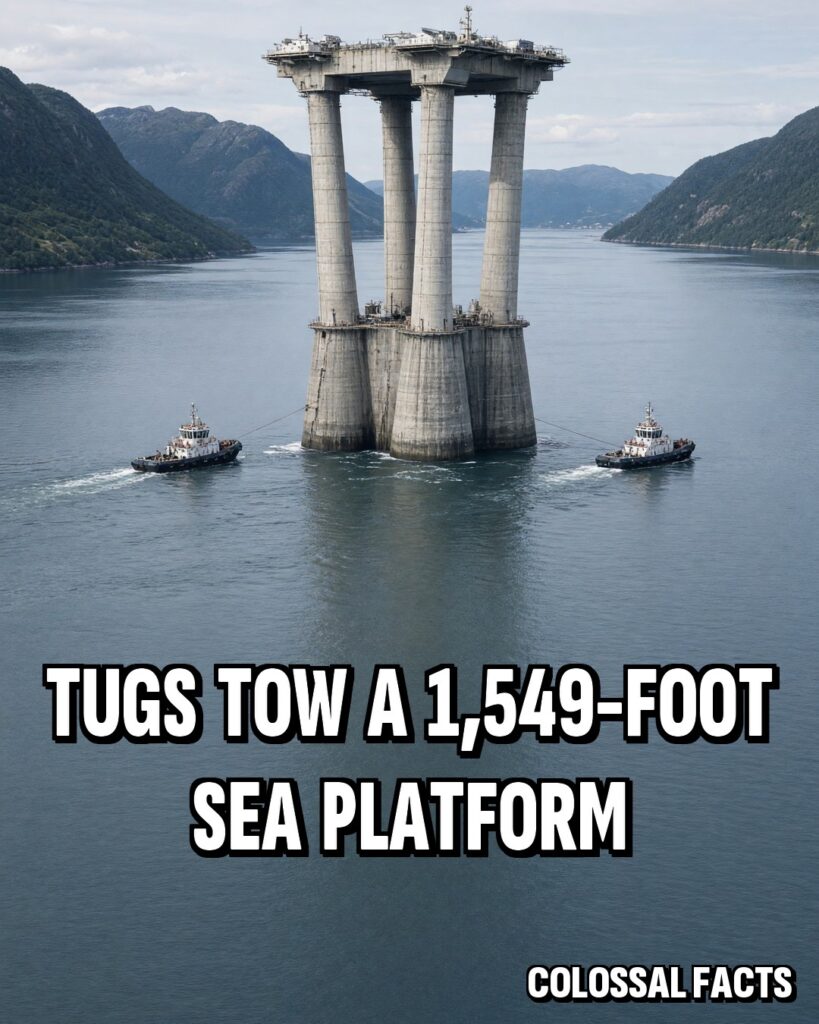
Troll A is a gravity-base gas platform in the North Sea, built for the Troll field off western Norway. It rises 1,549 feet (472 meters) and weighs 683,600 metric tonnes without ballast, about 754,000 US tons. With ballast in place, the operating weight is more than 1.2 million tonnes. It holds the record for the tallest structure humans have ever moved.
Crews towed it 124 miles (200 kilometers) from Vats, in Rogaland, to the Troll gas field. The trip lasted seven days under constant weather watch. It left on the afternoon of 10 May 1995. On 17 May it was in position, and they lowered it to the seabed in 994 feet (303 meters) of water. A few days later its concrete skirts had been pressed about 36 meters into the soil. No extra mooring was required. The platform stands by its own weight.
Two thousand people worked on the build at Vats. The concrete gravity base, a Condeep design, was started at Hinnavågen in Stavanger by Norwegian Contractors and finished at Vats, where it was joined to the topsides built at Aker Stord. The structure uses on the order of 245,000 cubic meters of concrete and about 100,000 tonnes of reinforcing steel. Four great shafts run down through the water to the seabed.
Ten tugs and a week of weather
There is one day when the forecast gets special care: the day you move a platform worth billions of kroner toward the open sea. Ten tugs took part, eight pulling and two steering from behind. During the inshore part of the tow, more than 200 meters of the 472-meter height stayed underwater, and the convoy crawled at about one to two knots. The operation became a television sensation. Journalists followed the slow procession out of the fjord and into the North Sea.
The tow had been delayed by extra safety work. Only a few years earlier, the concrete base for another North Sea platform, Sleipner A, had sunk in a fjord during trials. The lesson was still fresh. When Troll A finally moved, it moved as one piece. They did not assemble the tower out on the water.
A concrete tower that sits on the sea floor
Reinforced concrete makes the platform self-supporting. Its weight alone keeps it on the seabed. Statoil, now Equinor, put Troll A into production in 1996. Gas from the field has long been a major supply for Europe, piped ashore to the plant at Kollsnes, northwest of Bergen. The platform later drew electric power from the mainland rather than generating all of it on board.
And that height? It is almost one and a half times the Eiffel Tower. Only this tower was moved whole across the sea. They did not cut it into pieces. They towed it, then let it stand by itself.
Troll A went into production in 1996 and has been a mainstay of Norwegian gas exports to Europe ever since. The field lies about 80 kilometers northwest of Bergen. The platform is often described as the last and largest of the classic Condeep concrete giants. One shaft holds risers that carry gas, and an elevator in a leg takes a long ride from the deck down toward the seabed. The structure later received electric power from the Norwegian mainland, a way to cut the fuel burned offshore. From the water, only the topsides and a short run of concrete show. The rest of the 472 meters is out of sight, standing on the floor of the North Sea.
Sources: Tallest man-made object moved – Guinness World Records, Troll A – giant move from fjord to field – Equinor industrial heritage, Troll A Condeep – Aker Solutions