Near Hamadan in Iran, in 1942, Polish soldiers of what became the Polish II Corps met a young shepherd with a Syrian brown bear cub in a sack. They got the animal for a Swiss Army knife, canned beef, and chocolate, in the usual telling of the regiment. They named him Wojtek, short for Wojciech, Polish for “joyful warrior.” Bit by bit, he came to trust them. He grew up among men who had left Soviet internment and were moving, under General Władysław Anders, toward the British forces in the Middle East and then to Italy.
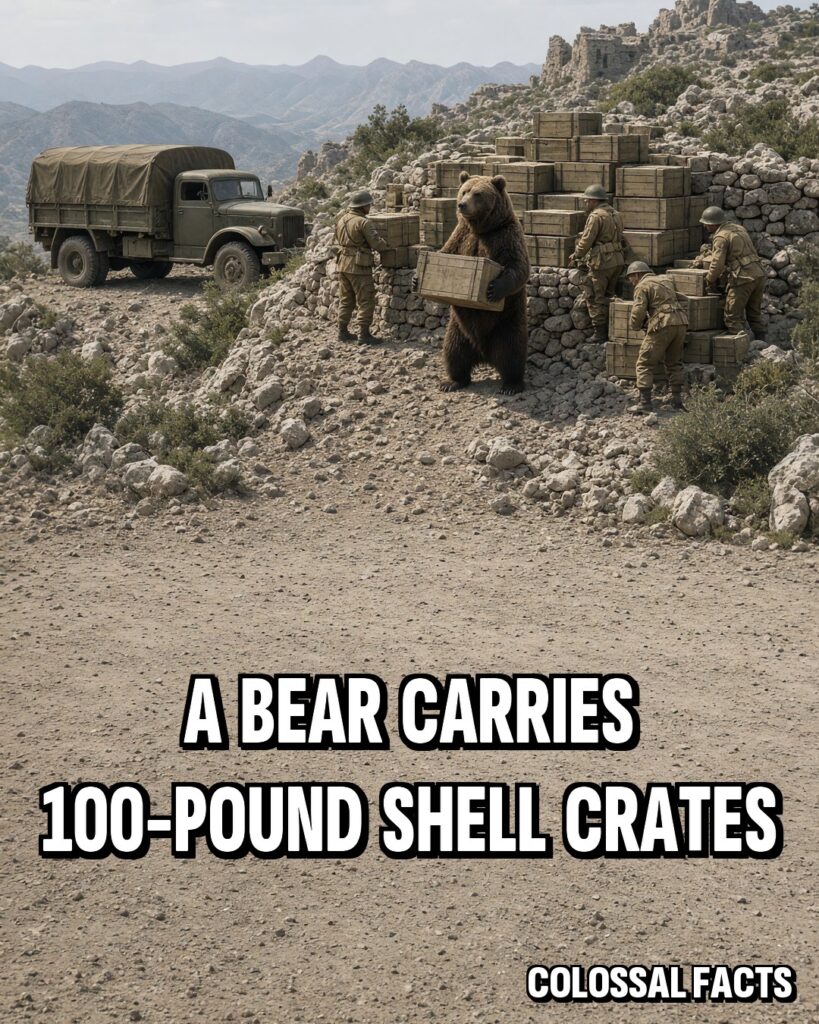
When it was time to leave for Europe, a problem appeared. To travel with them, the bear had to be enlisted in the army. Animals were not otherwise allowed on the troopships in that way. Wojtek got a rank, a serial number, and his own paybook, in the 22nd Artillery Supply Company. He lived with the men in tents, or in a wooden crate hauled by truck. He wrestled, ate, and learned their habits, including, the veterans said, a taste for cigarette butts and beer. How does a soldier like that help in a fight? At Monte Cassino, in May 1944, an exhausted soldier nodded at a metal crate of shells and jokingly told him to carry it. Wojtek rose on his hind legs, took the load, and headed for a nearby gun. After that, the company said, he carried 100-pound (45-kilogram) ammunition crates, more than half the weight of a man of about 165 pounds (75 kilograms). He never dropped one, they said.
Allied soldiers were stunned to see a bear hauling shells. A picture of Wojtek with a shell became the company’s emblem, and he was promoted from private to corporal. The story is a veterans’ story, retold with pride, and the precise number of crates is not a warehouse record. The bear was real, the company was real, and the emblem is real. After the war, the unit was sent to Scotland. Wojtek lived at first with the men and then, when they were demobilized, at Edinburgh Zoo. He died there in December 1963. Statues of him later went up in Edinburgh, in Poland, and elsewhere. They enlisted him so they would not leave him behind. He helped them carry the weight of the battle, and then he became the symbol they kept.
A bear in a paybook
It is easy to make the tale softer than a war story should be. Monte Cassino was a grinding fight. The men who enlisted a bear had already lost homes and years. Wojtek did not win the battle. He was a mascot who, on a supply line, also moved real crates, if the men who were there are to be believed, and there is little reason to think they invented the whole of it. A paybook for a bear is a bureaucratic joke that also tells the truth: they would not leave him on the quay.
Anders’ Army had already walked a hard road out of the Soviet Union, through Iran, and into a British-commanded corps. A bear cub was a scrap of ordinary life in a unit that had little of it. In Palestine and in Italy, Wojtek was a problem of food and discipline as well as a comfort, and the enlistment papers solved a transport rule more than they made him a gunner. At Edinburgh Zoo he was visited by old comrades who sometimes tossed him a cigarette, a habit the keepers cannot have loved. The statues, including one in Princes Street Gardens, came decades later, when the men were old and the bear was a piece of Polish and Scottish memory at once. The paybook, the emblem, and the zoo are the hard evidence. The crates at Cassino sit where veterans left them, in testimony.
Sources: Wojtek (bear) – Wikipedia, The story of Wojtek the bear – Imperial War Museums, Wojtek statue – BBC