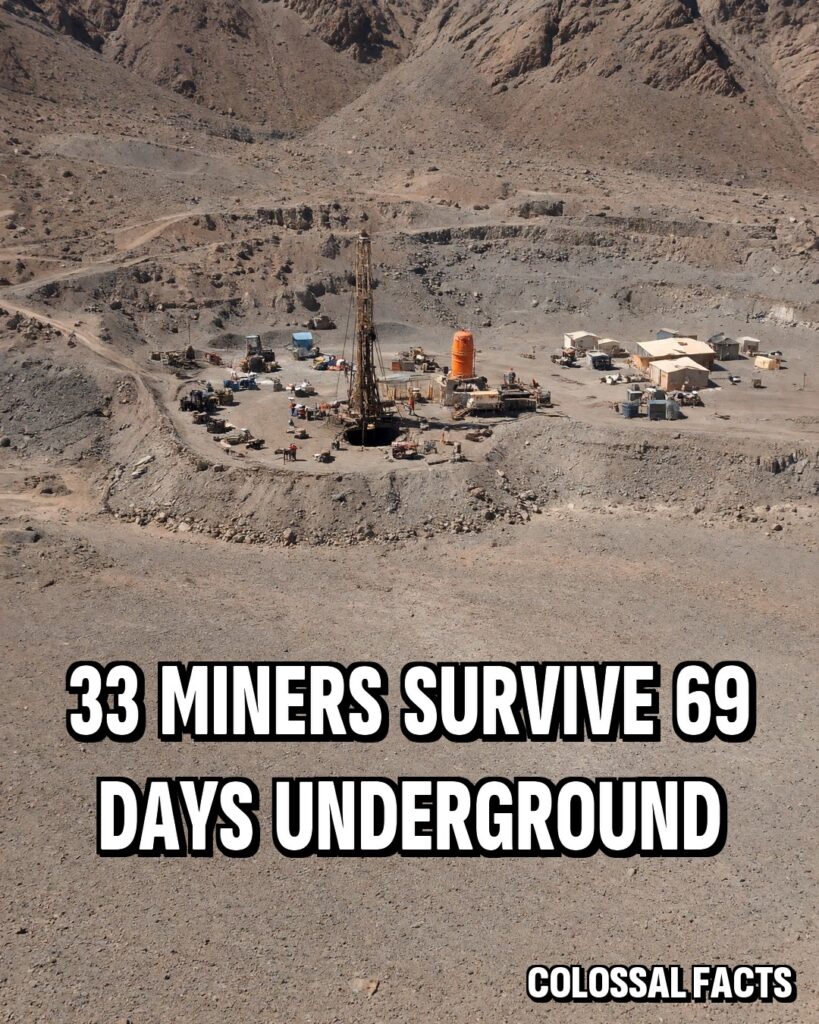
On 5 August 2010, a block of diorite, hard rock the height of a skyscraper, tore loose in Chile’s San José copper-gold mine, near Copiapó in the Atacama Desert. It fell through the levels as if they were cardboard. Thirty-three miners were trapped about 2,300 feet (700 meters) underground, some 3 miles (5 kilometers) from the entrance by the winding tunnels. For 17 days there was no contact at all. No one above ground knew if anyone below was still alive.
Then a drill bit came up with a note taped to it: “Estamos bien en el Refugio los 33.” We are well in the refuge, the 33. The men had reached a small shelter with some emergency food and had rationed it, a sip of spoiled milk, a bite of tuna, stretched across more than two weeks. After the note, rescuers sent down water, food, letters, and a narrow communications line through the borehole. Medical teams and a group of advisers, including specialists from NASA, helped plan how men could live that far down until a shaft wide enough for escape could be drilled.
They waited on long benches while crews from Chile and from other countries drilled rescue shafts. Three bores were tried, often called Plan A, Plan B, and Plan C. Plan B, using a Schramm T130 drill, reached them first. No one in recorded history had survived so long trapped underground. How deep is 2,300 feet? More than one and a half times the Empire State Building, only downward into the rock.
A capsule named Fénix, and a night the world watched
A steel rescue capsule, Fénix 2, was built to fit the shaft. It was just wide enough for one man, with oxygen and a radio, and a harness to hold him if he fainted. On 12 October the first miner, Florencio Ávalos, was brought up. Through the night and into 13 October the others followed, one by one. Luis Urzúa, the shift supervisor who had organized the men below, was the last of the 33. After the last man, rescuers still underground held a sign to the camera: “Misión cumplida Chile.” Mission accomplished, Chile. President Sebastián Piñera was at the surface. More than a billion people watched on television around the world.
The men had been below for 69 days. They came out thin, wearing sunglasses against the desert light, and were taken to hospital in Copiapó. The mine itself, which had a poor safety record, did not reopen as a workplace. The rescue did not erase the collapse. It showed what a long, public, technically stubborn effort could do when the alternative was to leave 33 men under a mountain.
Not because the mountain gave way
The story is often told as a miracle. The work on the surface was more ordinary and more impressive: drills that broke, holes that wandered, a second and a third attempt, and a capsule tested and lowered through rock that had already failed once. The men below kept a shift system and a discipline that made the long wait survivable.
They came out alive. Not because the mountain gave way. Because for 69 days someone kept digging, and because the 33 held on until the shaft was wide enough for one man at a time.
The San José mine had a poor safety record, and the collapse was not a bolt from a clear sky. What followed was a rescue on a national scale: drill crews working in shifts, a camp at the surface, and a medical plan for men who had lived in heat, humidity, and darkness on almost no food. After the first narrow borehole reached them, supplies and letters went down in small capsules. The men kept a routine, with Urzúa still acting as supervisor, so that the group would not come apart in the long wait. When the wide shaft was ready, the climb took one person at a time, because the hole would not allow anything else. The world saw the end of the story in a single night. The work that made that night possible had already lasted two months.
Sources: 2010 Copiapó mining accident – Wikipedia, Chile mine rescue – BBC, Chile miner rescue – The Guardian