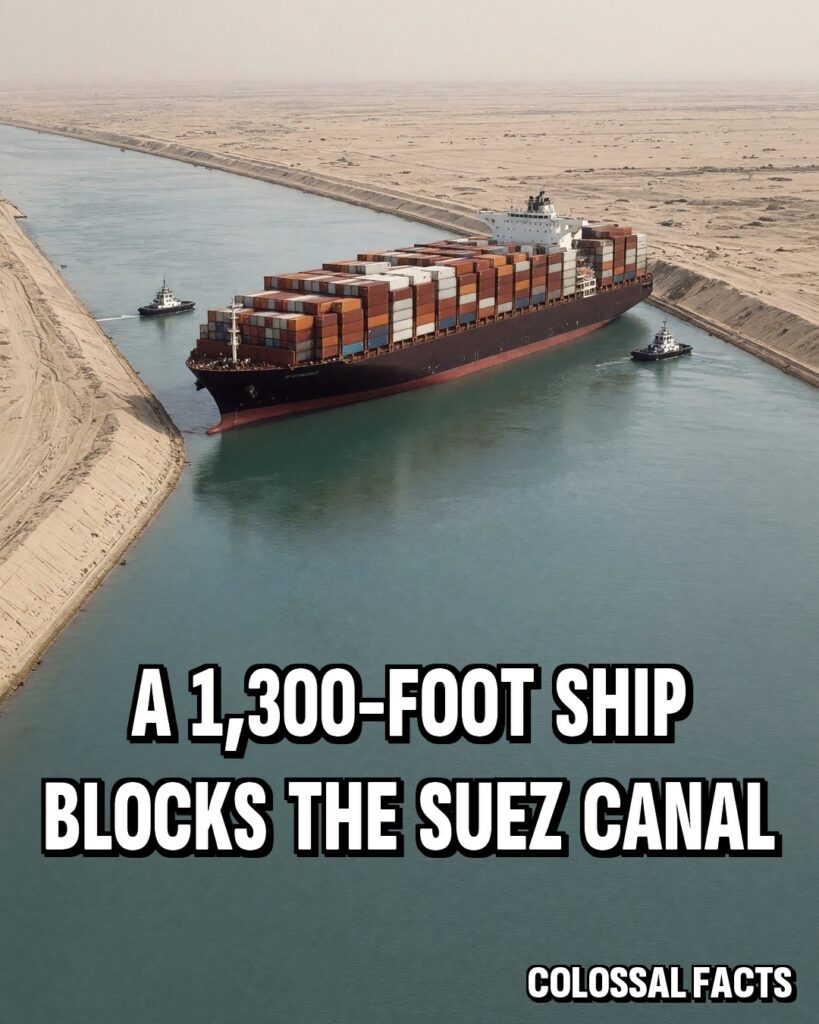
Ever Given is a container ship 399.98 meters (about 1,300 feet) long and nearly 59 meters wide, a 20,000-TEU-class vessel flying the Panamanian flag and owned by Shoei Kisen of Japan. On 23 March 2021, at about 7:40 a.m. local time, it was sailing north through the Suez Canal on a voyage from Asia toward Europe, with a cargo later put at about 18,300 containers. That morning, in strong wind and poor visibility, the ship ran aground. Its bow stuck on one bank and its stern on the other. The hull lay on a diagonal and closed the canal, a cut that carries a large share of the trade between Asia and Europe.
Traffic in both directions stopped for six days. The Suez Canal Authority later said more than 300 ships were waiting. Crews — the Egyptian authority, with salvage specialists from the Dutch firm SMIT (Boskalis) and tugs from several countries — dug tens of thousands of cubic meters of silt from under the hull and pulled with a fleet of harbor and seagoing tugs. A widely cited trade-press estimate put the daily value of delayed goods in the billions of dollars; one figure often repeated was about $9.6 billion a day. That number is an estimate, not a audited invoice, but it captured why a single hull in a narrow cut mattered to factories and shops far from Egypt.
A spring tide, then a free channel
What finally broke the ship free was a combination of dredging, tugging, and a high spring tide. On 29 March 2021, at about 3:04 p.m. local time, the owner and the Canal Authority announced that Ever Given had been successfully refloated. The hull lifted off the bottom; the bow, which had still held the bank, came free too. The ship was moved to the Great Bitter Lake for inspection. There were no crew injuries and no oil spill in the official reports. Later came a legal dispute over the salvage and the delay, and the ship was held for a time before it sailed on.
The length is almost that of four American football fields set end to end. In a channel not much wider than the ship is long, that is enough to become a plug. One hull stopped a route that carries world trade. The delivery schedules of a week waited on dredgers, tugs, and one tide.
Why a 400-meter ship can close a canal
The Suez Canal is a two-way artery only in parts. In the stretch where Ever Given grounded, near kilometer 151 of the waterway, ships in both directions must use the same cut. A vessel almost 400 meters long, turned across that cut, leaves no room to pass. The canal carries a large fraction of container traffic between Asia and Europe; when it stops, cargo waits at both ends or takes the long route around the Cape of Good Hope. That is why more than 300 ships stacked up, and why the salvage was watched in real time around the world.
The owner’s first notices said the crew of 25, all Indian, were unhurt and that there was no leak. Weather was part of the official story from the first day; later comments from the Canal Authority also left room for human or technical error, to be examined after the ship was free. The legal fight that followed — over compensation, arrest of the ship, and insurance — lasted months and is a separate chapter. The physical chapter is shorter: six days, a diagonal hull, dredgers, tugs, a spring tide, and a channel that opened again on 29 March. One ship, almost four football fields long, had been enough to pause a route the modern economy treats as always open.
Sources: Successful refloating of Ever Given – Suez Canal Authority, Owner’s statement on the refloating – Shoei Kisen, Suez Canal unblocked – Boskalis / SMIT Salvage