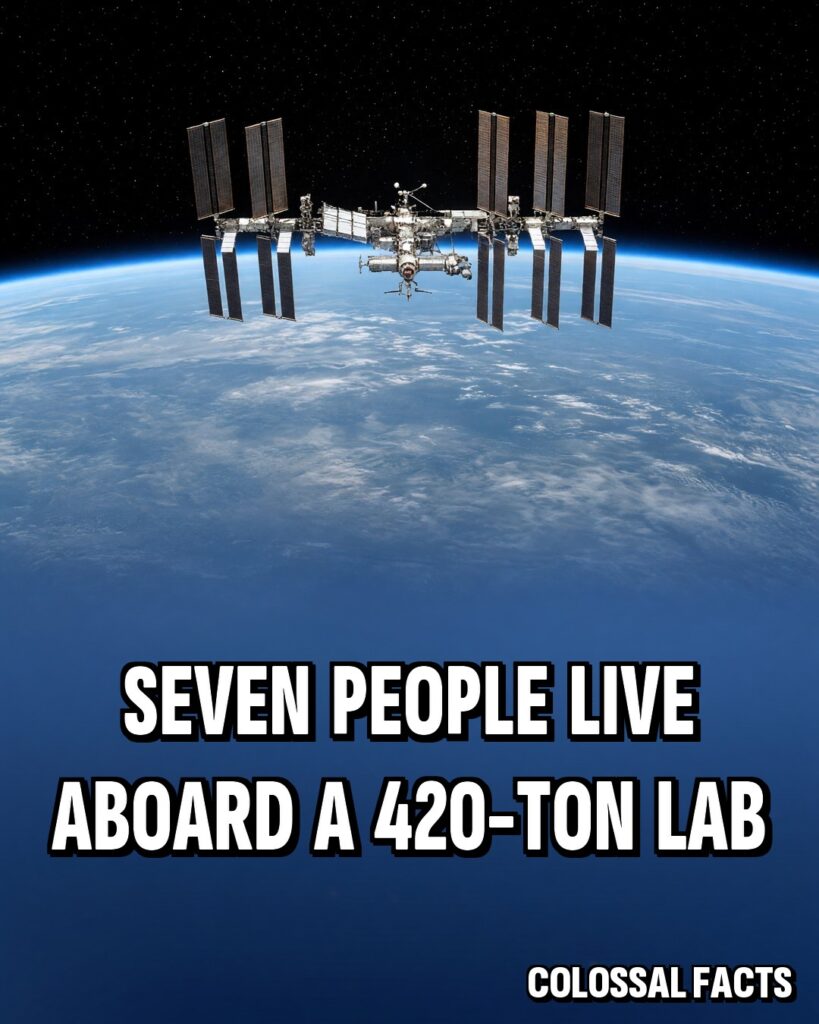
The International Space Station is a shared laboratory where people live while circling Earth. It is a partnership of five space agencies from 15 countries, including NASA, Roscosmos, ESA, JAXA, and the Canadian Space Agency. Assembly in orbit began in 1998. A crew has been aboard without a break since 2 November 2000, a continuous human presence of more than two decades.
NASA puts the station’s mass at 925,335 pounds (419,725 kilograms, about 420 metric tons), not counting visiting spacecraft. End to end it runs 356 feet (109 meters), one yard shy of an American football field including the end zones. About 70 African elephants is a fair comparison for that mass on the ground. The herd is not standing in a field. It circles the planet with a crew sealed inside pressurized modules.
A laboratory that never sits still
An international crew of seven people typically lives and works there. During a handover, when one crew overlaps with the next, the number can be higher. They travel at about 17,500 mph (28,000 km/h), or about five miles per second, and circle the planet in roughly 90 minutes. In 24 hours the station makes about 16 orbits and passes through 16 sunrises and sunsets. It does not hover over a single point on the map. Its path takes it over most of the world’s populated regions.
It flies in the thin upper atmosphere, at an average altitude of about 250 miles (400 kilometers). That air is sparse, but it still drags the station down. Engines fire from time to time — on the station or on a docked spacecraft — and push it back up. A typical stay for a crew member is about six months. To limit the loss of muscle and bone in weightlessness, astronauts exercise at least two hours a day. NASA compares the habitable space in the modules with a large house, and sometimes with the cabin of a Boeing 747. The station has sleeping quarters, two bathrooms, a gym, and a cupola with a wide view of Earth.
A herd in orbit
The work is science and upkeep: thousands of experiments over the years, spacewalks to maintain the outside, and a constant stream of cargo from several countries and commercial suppliers. The cabin may recall a passenger jet. The weight is a whole herd in orbit, moving at five miles a second, and it has not been empty since the first expedition opened the hatch in 2000.
Built in orbit, occupied without a gap
The first module, Zarya, reached orbit in November 1998. The United States, Russia, Europe, Japan, and Canada each supplied major pieces, and crews assembled them in space over more than a decade, with later additions still arriving after the main structure was in place. Expedition 1 docked in November 2000 and opened a period in which the station has not been left empty. Supplies come up on spacecraft from several countries and from commercial providers. Science has grown from a few dozen experiments on the first expedition to hundreds of active investigations on a typical crew rotation.
NASA’s current fact sheet is the source for the precise numbers: 925,335 pounds, 356 feet end to end, about 13,696 cubic feet of habitable volume, and eight solar arrays. The solar-array wingspan is longer than an Airbus A380. The speed, 17,500 mph, means the station covers a distance comparable to a trip to the Moon and back in about a day, while never leaving low Earth orbit. It is a laboratory, a home, and a very heavy object that has to be nudged upward when the thin air at 250 miles slowly pulls it down. Seven people is the usual complement. The herd, in NASA’s own mass figure, stays in orbit with them.
Sources: International Space Station Facts and Figures – NASA, ISS overview lithograph – NASA, International Space Station – Space.com