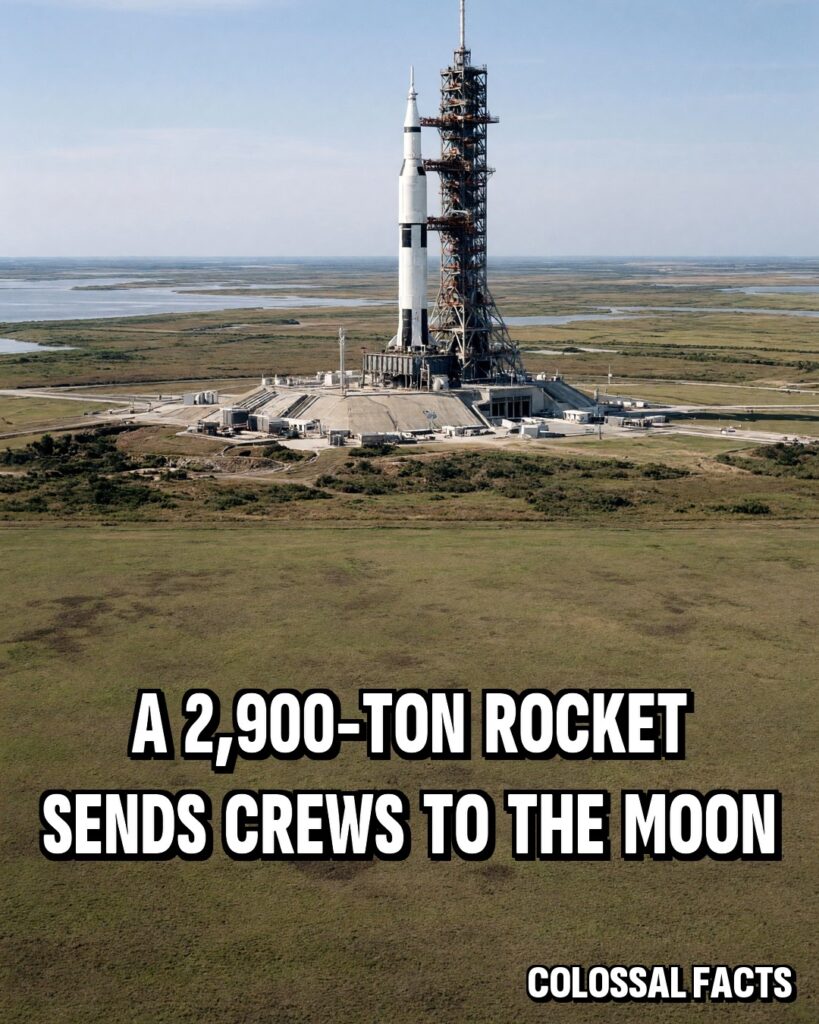
Saturn V is the rocket that first carried people beyond low Earth orbit and on to the Moon. Low Earth orbit is the belt close to Earth where ordinary spaceflights stay. The rocket stood 363 feet (111 meters) tall, about the height of a 36-story building and taller than the Statue of Liberty. Fully fueled, NASA puts its weight at about 6.2 million pounds (2.8 million kilograms), the weight of about 400 elephants. Other round figures come out near 2,900 tons. At liftoff, five F-1 engines on the first stage produced more than 7.5 million pounds of thrust.
From 1967 to 1973 it lifted off 13 times, all from Kennedy Space Center in Florida. Two of those flights were uncrewed tests. Ten were Apollo missions, and the last, in May 1973, placed the Skylab station in Earth orbit. Not one launch failed to put its payload on the planned path, and no crew was lost on a Saturn V. The victory was not a single flight. It lasted through a whole series in which the crews came home.
Twenty-four astronauts toward the Moon
Flights toward the Moon carried 24 astronauts in all. Some flew twice, so the number of seats on those missions was higher, but the number of people who rode a Saturn V toward the Moon is 24. The first crew to leave low Earth orbit was Apollo 8, in December 1968, which circled the Moon and returned. Apollo 11, in July 1969, made the first landing. Later Saturn V missions landed more crews, and on Apollo 13 the rocket did its job even though a later failure in the spacecraft forced the astronauts to abandon the landing and come home.
The vehicle was a three-stage, liquid-fuel rocket managed by NASA’s Marshall Space Flight Center. Boeing built the first stage, North American the second, and Douglas the third. A team led by Wernher von Braun oversaw the design. It could send about 118,000 kilograms (130 tons) into Earth orbit and about 43,500 kilograms (50 tons) toward the Moon. Skylab, at around 90 metric tons, was the heaviest payload it lifted to low Earth orbit. For decades Saturn V remained the only rocket that had taken a crew past that nearby belt of orbit. NASA later built the Space Launch System for the same kind of deep-space work.
A rocket that did not lose its crews
The Moon wanted more than a brave crew. It wanted a rocket that did not lose them. Saturn V’s record is not only its size. It is a run of 13 launches in which the machine, from the first uncrewed test to the last Skylab flight, did what it was built to do. Even the lower weight estimate equals about 400 elephants, lifted as one body. The crews came home because the rocket first got them off the ground in one piece.
Thirteen flights from the same pad complex
The first Saturn V flight was Apollo 4, an uncrewed test on 9 November 1967. Apollo 6 followed, also without a crew. Then came the crewed run: Apollo 8 around the Moon, Apollo 9 testing the lander in Earth orbit, Apollo 10’s dress rehearsal, and the landing missions from Apollo 11 through 17, with Apollo 13 the one that did not touch down. The last Saturn V, on 14 May 1973, lifted Skylab. The station was damaged during ascent — a shield tore away — but it reached orbit, and later crews repaired it. That is why it is fair to say the rocket did not lose its payload, even though Skylab did not arrive in perfect shape.
All 13 vehicles flew from Launch Complex 39 at Kennedy Space Center. The Saturn V remains, decades later, the first rocket to take a crew past low Earth orbit, and for a long time it was the only one. Its low-Earth-orbit record, about 118,000 kilograms in NASA’s account, and its lunar payload of about 50 tons, set a mark that later vehicles were designed to approach. The 400-elephant figure is NASA’s own comparison, not a tourist exaggeration. The Moon wanted a rocket that would not lose its crews. For 13 launches, this one did not.
Sources: What Was the Saturn V? – NASA, Saturn V Launch Vehicle – U.S. National Park Service, Saturn V flight dynamics legacy – NASA Technical Reports Server