The Large Hadron Collider is the world’s largest and most powerful particle accelerator. CERN, the European Organization for Nuclear Research, operates it. The ring crosses the border between France and Switzerland, near Geneva. It sits in a tunnel about 328 feet (100 meters) underground. The tunnel was not dug for it. The Large Electron-Positron Collider, called LEP, ran there first. The same circular tunnel, about 17 miles (27 kilometers) around, was already complete when CERN built the new machine.
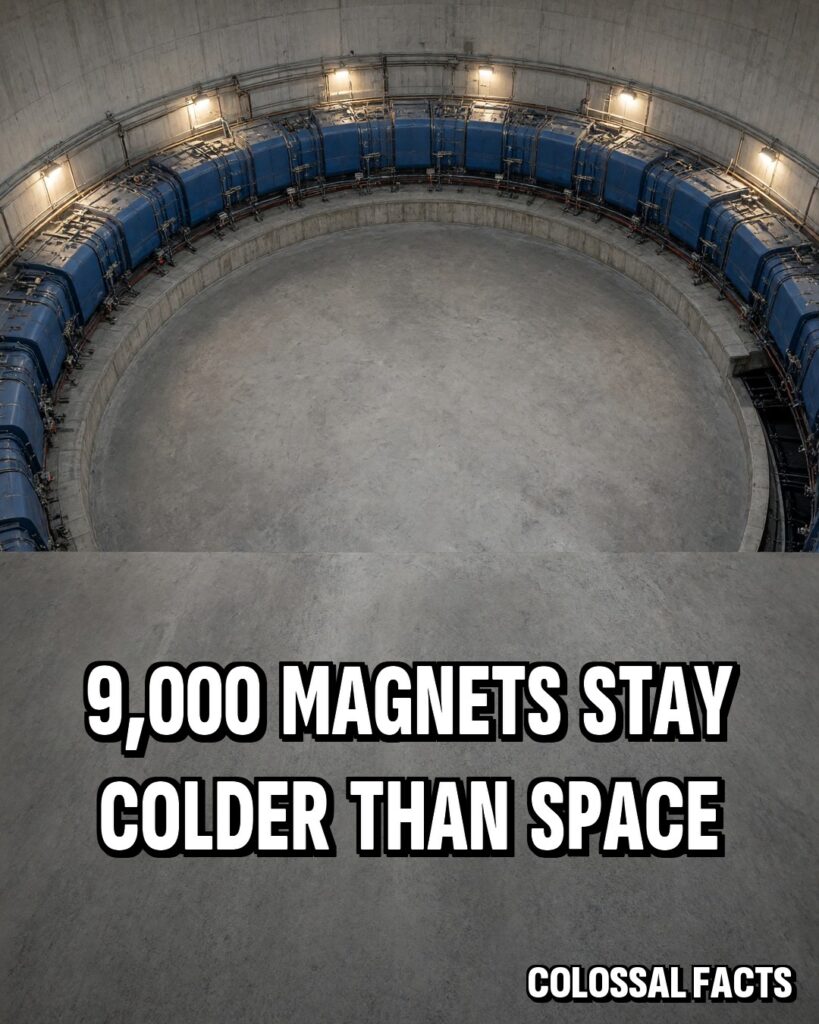
About 9,000 superconducting magnets — CERN often says over 9,000 magnetic elements — line that circle. A superconductor carries electric current with no resistance when it is extremely cold, allowing it to produce a strong magnetic field. The 1,232 main dipole magnets, each about 15 meters long, bend the beams around the ring. They are made with niobium-titanium cable and run at a field of about 8.3 tesla, on the order of 100,000 times Earth’s magnetic field. Quadrupoles and thousands of smaller corrector magnets keep the beams focused and on course.
Why so cold? The magnets are cooled to 1.9 kelvin (about -456°F or -271.3°C), colder than the 2.7 kelvin of outer space. Superfluid helium does the job, in what CERN calls the world’s largest cryogenic system. Cryogenics is the engineering of ultra-low temperatures. Two proton beams race in opposite directions, close to the speed of light, and collide inside four large detectors: ATLAS, CMS, LHCb, and ALICE. In 2012, ATLAS and CMS announced the discovery of the Higgs boson, the particle tied to the mechanism that gives other particles mass.
A hidden ring under a quiet border
And those 17 miles (27 kilometers)? That is about 297 American football fields laid end to end. The ring stays hidden under the border. Ordinary fields, roads, and villages pass overhead. Below them, the stored energy in the beams and in the magnet system is enormous, and the machine is split into sectors so that a fault can be contained. A serious incident in 2008, a failed electrical joint, delayed the first full run. Beams circulated later that decade, and the collider has been upgraded in stages since.
The point of all that cold metal is not the magnets themselves. It is to steer two thin beams into collisions energetic enough to recreate, in a tiny volume, conditions that have not existed naturally since the early universe, and to measure what comes out. The public sees a tunnel and a headline particle. The daily work is to keep 1.9-kelvin magnets stable and the beams inside a pipe thinner, in the vacuum sense, than almost anything else on Earth.
What holds matter together
Ordinary ground passes overhead. Under it, they measure what holds matter together. About 9,000 magnets, colder than space, bend the path. The discovery that made the machine famous was a particle. The machine itself is a refrigerator the size of a city, built in a tunnel that was already there.
Each of the two beams can store hundreds of megajoules of energy when the machine is at high intensity, enough that a uncontrolled beam would wreck equipment, so a collimation and dump system has to be ready at all times. The dipoles were built by firms in several European countries and shipped to CERN as the most industrial part of the project. First high-energy collisions came in 2010. The Higgs announcement in July 2012 was the public proof that a 27-kilometer ring of 1.9-kelvin magnets could do the physics it was funded for. Further upgrades, including the High-Luminosity LHC, are meant to take more data from the same tunnel.
Sources: The Large Hadron Collider – CERN, Facts and figures about the LHC – CERN, Large Hadron Collider – Wikipedia