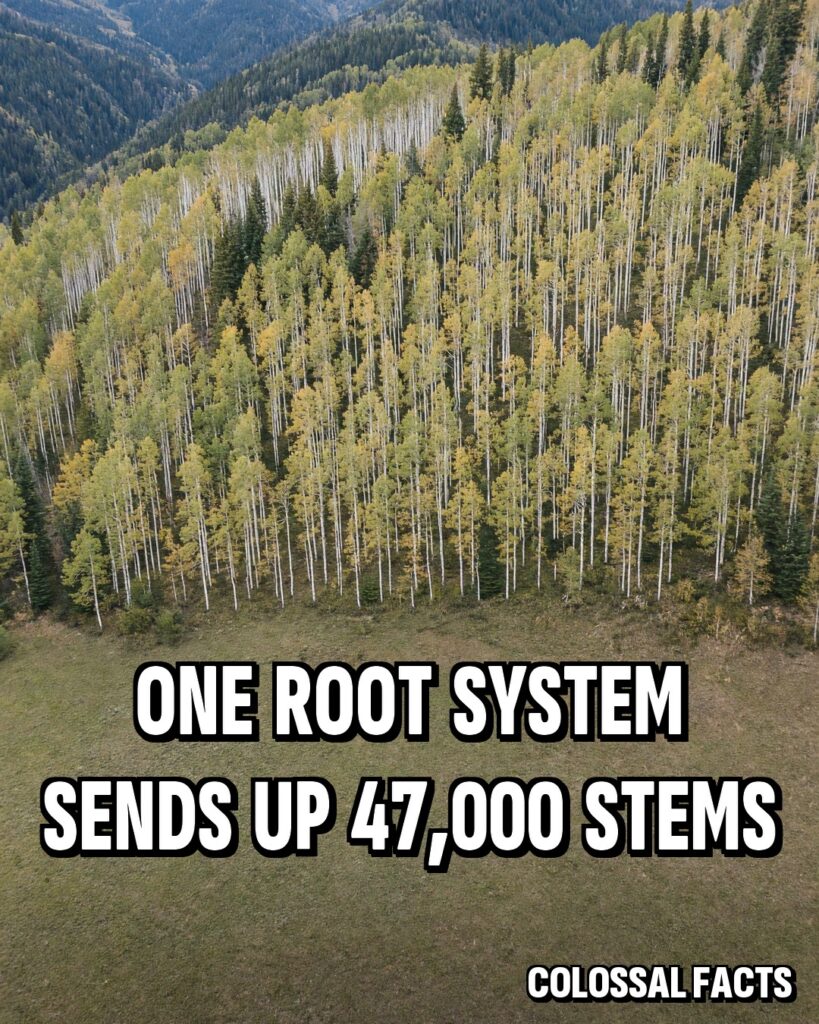
In Fishlake National Forest, in Sevier County, Utah, wind moves quaking aspens that look like an ordinary grove. Pando comes from Latin for “I spread.” It is also called the Trembling Giant. At first glance, these are separate trees. They are not. About 47,000 stems rise from one shared root system. Each is a genetically identical part of a single male quaking aspen, Populus tremuloides. When a stem dies, the root system can send up a new one. That is suckering: growth from the root system, not from a seed.
U.S. Forest Service researchers tested plant tissue and proved Pando is one organism. Karen Mock, a researcher who studied Pando, expected several separate clones, as in other aspen stands. “I was wrong. Pando is a ginormous single clone.” A single stem lives about 100 to 130 years. The organism itself may be thousands of years old; one widely cited estimate says it may be up to 14,000 years old, though the exact age is still argued. It weighs about 13.2 million pounds (6,000 metric tons) and covers about 106 acres (43 hectares). By mass, it is about three times the General Sherman sequoia and is often called the largest organism on Earth by weight. Other clones, including underground fungi, compete for other “largest” titles, depending on how size is defined. What is that weight? About a thousand African elephants, held by roots under a whole forest, not standing in one place.
A giant that is having trouble replacing itself
Pando has looked, from a distance, stable. Up close, foresters have found too few young stems. Deer, elk, and cattle browse the new shoots, and older trunks are dying faster than they are replaced. In recent years the U.S. Forest Service and partners have put up fences around parts of the grove to keep hooves off the suckers, and have tried other ways to help the clone regenerate. The work is still going on. A grove that has lasted for millennia can still thin out in a few decades if the next generation of stems never gets above a deer’s reach.
Visitors come to Fishlake to see the white trunks and the leaves that shake in a light wind, which is how the aspen got the name “quaking.” In autumn the grove can turn a single field of gold, because the stems are one genetic individual and tend to change color together. The road around the lake makes the stand easy to reach, which is good for attention and a risk for the roots and the young growth.
Many trunks, one tree
From the side, Pando is many trees. Under the soil, it is one being. The record it holds is not a single towering trunk. It is a forest that is also a body, spreading by roots, and now depending on fences and foresters to keep that body from shrinking.
Quaking aspens take their common name from the way the leaves shake on flattened stems in even a light wind. In autumn, because the stems of Pando are one genetic individual, large parts of the grove can turn gold together, a single season expressed on 47,000 trunks. Fish Lake lies close by, and the stand is easy to reach by road, which has made Pando a destination as well as a research site. Ease of access is a mixed gift. People come to see the largest tree by mass, and they also bring traffic close to a root system that is already under pressure from animals and from a shortage of new stems. The scientific fact is simple to say and hard to protect: this forest is one tree, and it will stay that way only if enough young shoots are allowed to grow.
Sources: Pando (tree) – Wikipedia, Fishlake National Forest – U.S. Forest Service, The future of Pando – National Forest Foundation