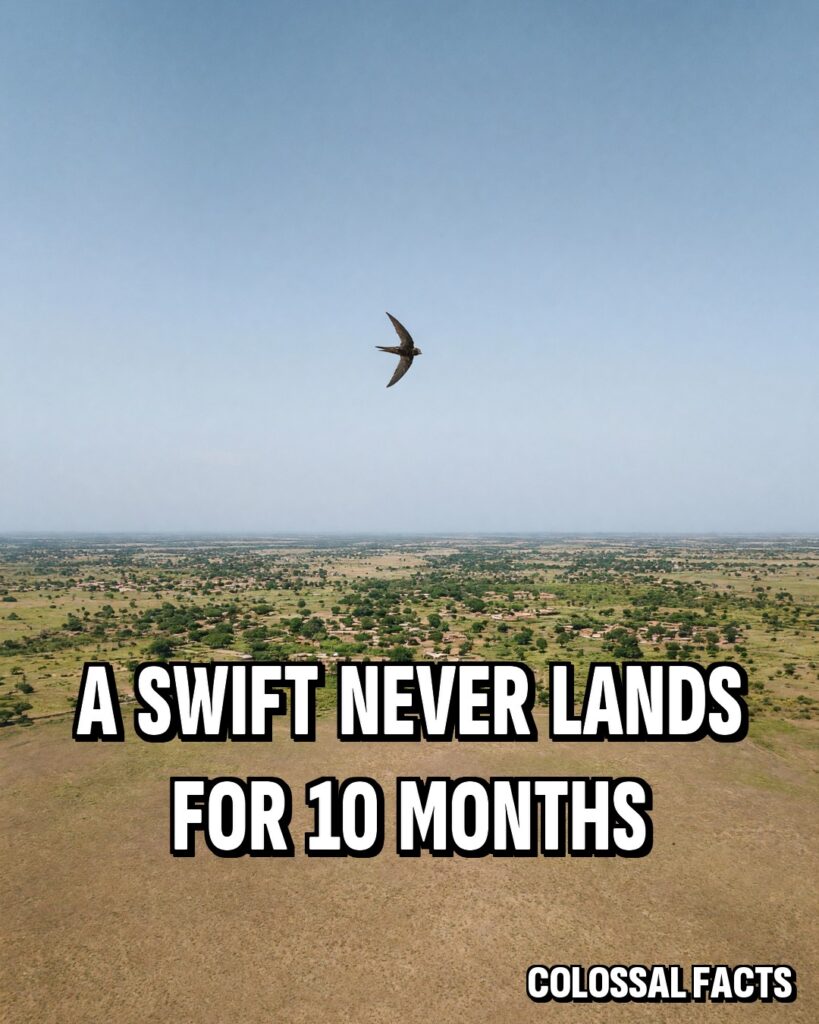
A common swift leaves its breeding site in August.
Its path runs through West Africa to the rainforests of Central Africa.
Some swifts do not land until the next nesting season.
A bird built for the air
People often mistake the common swift for a swallow, but the two are not close relatives. The swift has long, sickle-shaped wings, almost entirely dark plumage, and very short legs.
The Latin name of its genus, Apus, comes from Greek and means “without feet.” The feet exist, of course, but they are so small that the bird can barely walk and struggles to take off from flat ground.
That is why swifts nest high up, in gaps under roofs, in towers, and in old walls, where they can simply drop into the air. In many European towns they are a familiar summer visitor, known for the shrill screams of flocks racing over the rooftops on warm evenings.
The devices from Lund
Researchers at Lund University place recording devices on individual birds and track them to Africa and back to Europe.
The devices are tiny, because a swift weighs only about 40 grams, under an ounce and a half. They record when the bird is moving and when it is at rest. The results were published in 2016.
They confirm a record bird experts have discussed since the middle of the last century.
10 continuous months in the air is the longest flight documented for any bird.
What the data show
Some land briefly, or spend whole nights on the ground in midwinter.
3 of the tracked birds never land once in all 10 months.
Even the birds that land stay airborne more than 99.5 percent of those months.
They spend about 2 months a year on land, only long enough to breed.
Life without landing
Food, water, and sleep happen in flight.
Swifts feed on insects and spiders carried high above the ground by rising air. Scientists call this mix “aerial plankton.” The bird catches its prey with its mouth wide open as it flies.
It drinks by skimming low over water and scooping on the move.
Sleep is still debated. Swifts are thought to climb high at dusk and then glide slowly, resting in short bursts, but nobody has yet measured their sleep in the air directly.
Mating does too.
The feathers?
Birds that land have not replaced their flight feathers. Birds that stay up the whole time have molted, growing new flight feathers, without landing.
That detail matters. Molting is slow, and a wing temporarily loses some of its surface while it happens. The swift does it gradually, feather by feather, so it can keep flying.
Young swifts are thought to spend more than a year on the wing after leaving the nest, before they breed for the first time.
The rival from the Alps
The nearest rival is the alpine swift.
It flies nonstop for up to 6 months a year.
Both species point to the same idea: for some birds, the sky is not just the road between two places. It is the place they live.
The record is not an old guess.
The devices confirm it.
Next time a flock of swifts screams over the rooftops, remember that some of them may not have touched the ground since last summer.
10 months of sky.
Then only the nest.