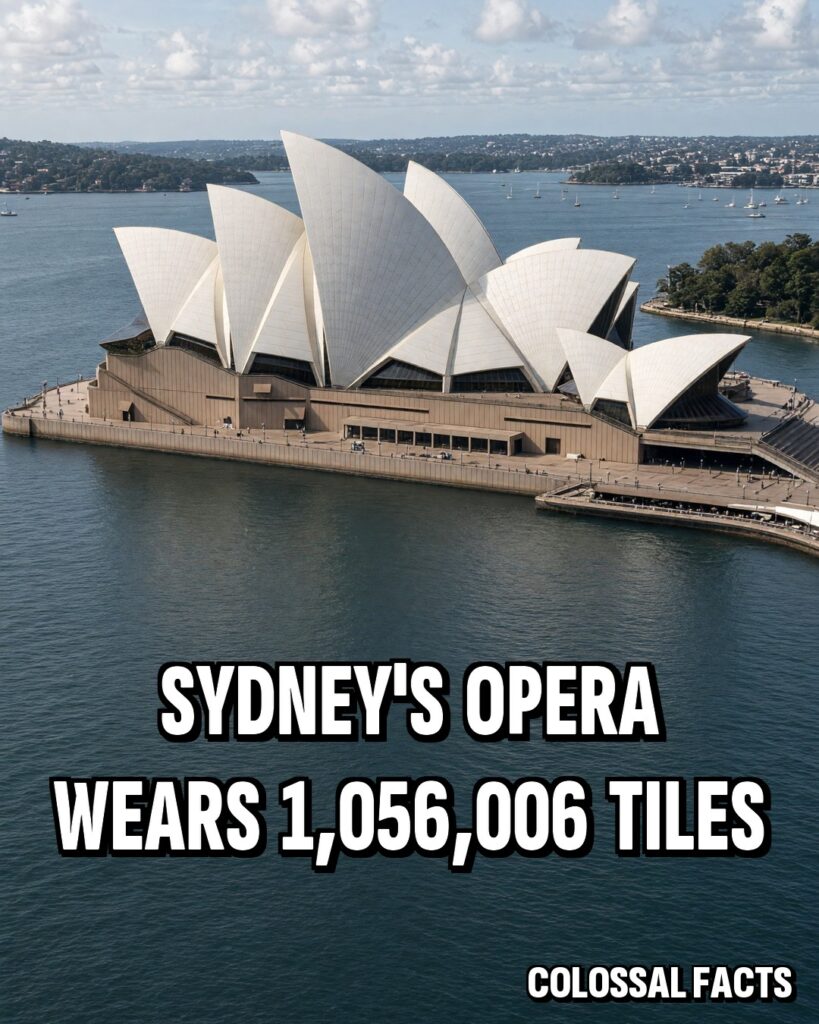
The shells of the Sydney Opera House wear ceramic tiles in white and cream. One tally puts the number at 1,056,006. A 2023 account says 940,840 still cover the building. Whichever figure you pick, it is one of the largest ceramic roofs ever made.
Makers in Sweden call them Sydney Tiles. The mix is clay with a little crushed stone.
A competition won by a sketch
In 1957, a jury picked the design of a little-known Danish architect, Jørn Utzon, from more than two hundred entries sent in from around the world. His drawings showed something nobody yet knew how to build: white shells rising over the harbor like sails.
Construction began in 1959. For years, though, nobody could say exactly what geometry the shells had. Without it, engineers could not work out the concrete or the cladding.
The answer came in the early 1960s. Utzon and the engineers at Ove Arup & Partners settled on an idea: every shell would be cut from the surface of the same sphere. That turned impossible curves into repeatable parts that could be cast in molds and put together.
The recipe for a tile
Utzon worked on the tile recipe for three years with the Swedish company Höganäs.
He wanted rain to clean the roof, not people.
The round shells send water running off, and the glaze washes itself in the rain. Nobody scrubs them.
The tiles are not all the same. Some are glossy white, others matte cream, laid out so the roof does not blind people in the bright Australian sun but shifts in tone with the light. From far away it looks smooth. Up close it is a fine mosaic.
The tiles were not stuck on one by one high in the air. They were set into precast concrete panels shaped like chevrons, which cranes then lifted and fixed onto the ribs of the shells. That moved the delicate work from ropes on the roof to the ground.
The architect who never saw it finished
The build ran far longer and cost far more than planned. The first estimate was around 7 million Australian dollars. The final bill topped 100 million. Much of the money came from a special state lottery.
In 1966, after disputes with the new New South Wales government over costs and payments, Utzon left the project and left Australia. A team of Australian architects finished the interiors.
Queen Elizabeth II opened the Opera House on October 20, 1973. Utzon did not attend and never saw the finished building in person. In 2007, while he was still alive, it was added to the UNESCO World Heritage List.
Checked by hand
Every five years, six engineers and rope specialists, led by operations manager Dean Jakubowski, check every tile by hand.
The check shows which ones have let go. The crew does not wash the roof. It does not strip it. It swaps only the tiles that are coming loose.
Some loosen with age. Sun, salty wind off the harbor, and the swing between day and night temperatures all work on every joint.
If one slips, it drops like a roof tile off a tall building. So the inspection is not cosmetic. It is about the safety of the thousands of visitors below.
From 2006 to 2023, the team had to replace 50 tiles.
Why so few?
Jakubowski says that, at that scale, it is a credit to the people who built the roof.
Fifty tiles in seventeen years works out to about three a year. Against roughly a million, that is close to nothing.
The secret is not an expensive material. It is a set of details working together: a shape that sheds water, a glaze that does not hold dirt, and panels built on the ground under controlled conditions.
Half a century later, the building is a symbol of an entire country and one of the most photographed structures in the world. And its roof is still cleaned mostly by the rain.
Rain washes the ceramic.
People watch the joints.