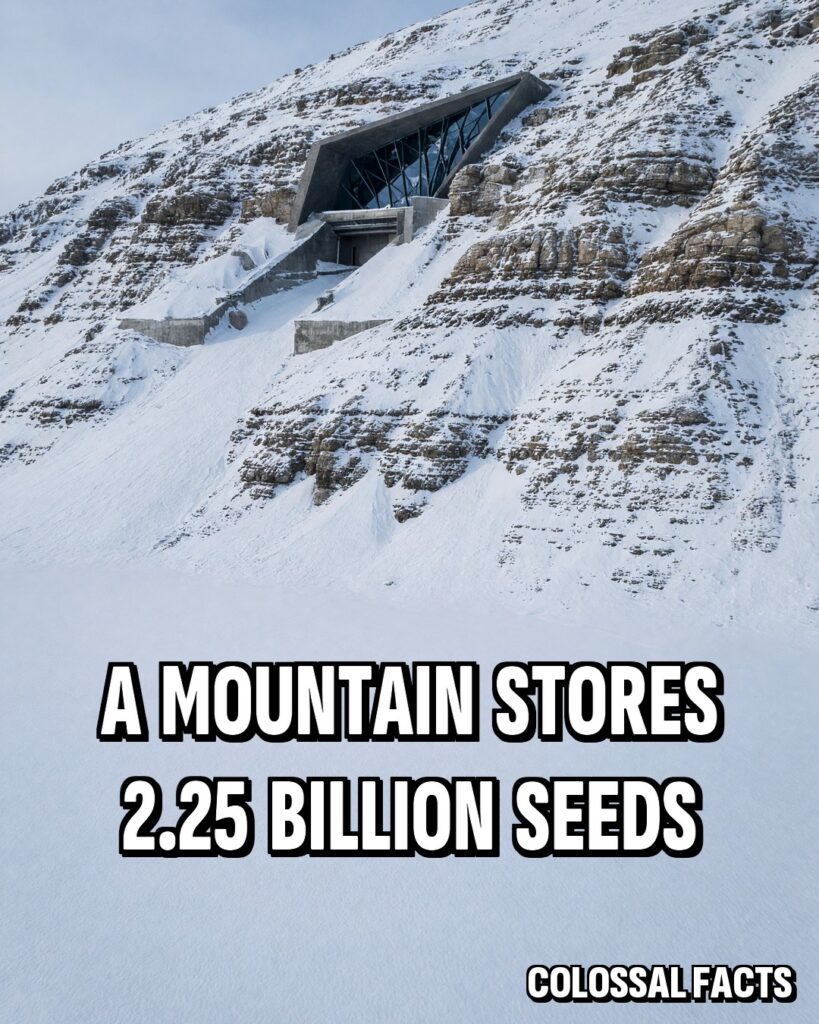
The Svalbard Global Seed Vault is the world’s largest backup facility for crop diversity. It is carved into a mountain on Spitsbergen, in the Svalbard archipelago, about halfway between mainland Norway and the North Pole, not far from the town of Longyearbyen. The Norwegian government paid the construction cost, originally about 45 million kroner. The vault officially opened on 26 February 2008. It is a partnership: Norway owns and maintains the facility; the Nordic Genetic Resource Center (NordGen) and the Crop Trust help operate it. The seeds themselves remain the property of the genebanks that deposit them.
The vault extends about 130 meters (430 feet) into sandstone. Samples are kept at −18°C (−0.4°F). Permafrost — ground that stays frozen year-round — and the thick rock are meant to keep them cold even if mechanical cooling fails. In 2016, meltwater from unusually warm weather entered the access tunnel, not the seed chambers themselves. The incident did not destroy the collection, but it led to waterproofing and other upgrades. The mountain is cold. It is not a magic box that never needs care.
The vault is a backup, not a working farm. It can store 4.5 million seed samples. Each sample averages about 500 seeds, so the designed capacity is about 2.25 billion individual seeds. Depositing is free. More than a hundred depositors — genebanks around the world — have sent samples. The collection stands for more than 13,000 years of agricultural history and is the largest security copy of food-crop seeds on Earth. The first major withdrawal came in 2015, when the International Center for Agricultural Research in the Dry Areas (ICARDA) asked for seeds it had stored there, to help rebuild collections disrupted by war in Syria.
And 130 meters in? A little more than one American football field, and the whole path is rock. If a collection disappears somewhere, the copy here can help restore it. The mountain grows nothing. It saves the chance that someone else can grow it again.
A black box in the mountain, and the first time it was opened
The vault works on a “black box” agreement. Norway provides the hole in the mountain and the cold. The Crop Trust helps with operations and with support for developing-country genebanks. NordGen handles day-to-day management. A depositor sends duplicates of seeds it already holds, sealed in the depositor’s own packaging, and only that depositor can withdraw them. The vault is not a seed bank that lends to farmers. It is a safe-deposit box for other seed banks. That is why the 2015 ICARDA withdrawal mattered. War in Syria had made the center’s collections in Aleppo impossible to use as before. Boxes stored in Svalbard were sent to new ICARDA facilities in Lebanon and Morocco so that the collection could be grown out and restored. It was the first large test of the idea that a copy at the top of the world could restart a genebank in trouble.
The 2016 water in the entrance tunnel was a second test, of the building rather than the legal model. Warm weather and rainfall sent meltwater into the first stretch of corridor. The seed rooms stayed dry, but the event showed that permafrost and rock are not a complete substitute for engineering. Norway funded a major waterproofing and cooling upgrade afterward. Official pages still give the same capacity that made the vault famous: 4.5 million samples, about 2.25 billion seeds. The number of samples actually in place is lower and changes with each deposit. The mountain’s job is not to grow a harvest. It is to keep the spare copies alive, at −18°C, until someone needs them to plant again.
Sources: Svalbard Global Seed Vault – Crop Trust, The Facility – Svalbard Global Seed Vault, The History – Svalbard Global Seed Vault