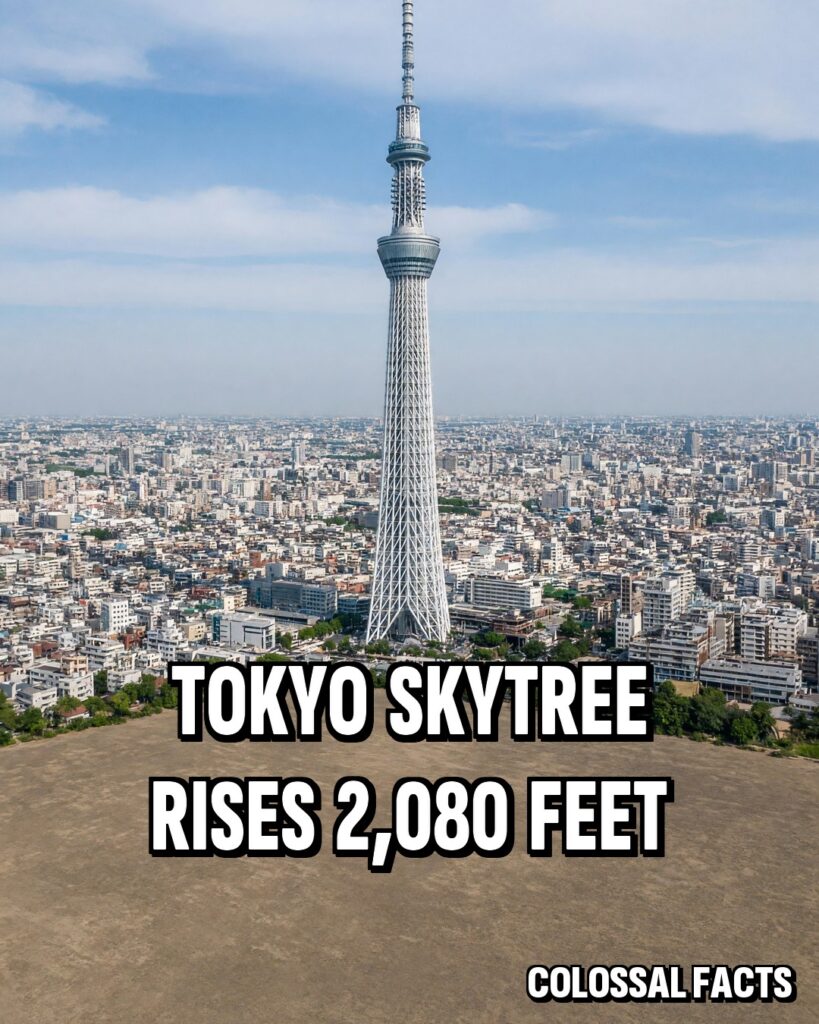
Tokyo Skytree is a freestanding television tower in Tokyo. It is the tallest tower in the world. In 2011, Guinness World Records named it the record holder. It took the title from Canton Tower. Planners first aimed for about 2,001 feet. Then they changed the figure. Why that number? In old Japanese, 634 sounds like “mu-sa-shi,” the historic province around Tokyo.
The base is a triangular steel truss, a lattice of beams. One side is about 223 feet, and the steel frame with the observation decks weighs about 36,000 tons. A reinforced concrete column stands in the center. Builders call it a shinbashira, an idea taken from old Japanese pagodas. Low down, the column is fixed to the outer frame. Higher up, oil dampers join the two, devices that absorb the energy of shaking.
Two rhythms in an earthquake
In an earthquake, the core and the tower sway on different rhythms. The sway falls by up to 50 percent. That is the point of a modern shinbashira: not decoration, but a separate mass that does not move with the shell, and so soaks up part of the energy. Tokyo cannot afford a television tower that, in a strong quake, behaves like a ship with no keel. A height of 2,080 feet (634 meters) makes the task sharper still. Wind and seismic forces grow with the tower.
The tower is free-standing, with no guy wires to the ground. All of its stability has to come from the foundation, the lattice and the inner column. The observation decks lift the public to a height where the city looks like a map. For residents, though, the first job is different: to raise the antennas above newer tall buildings that had already begun to shadow older towers and block the digital signal.
The record for tallest tower is not the same as the record for tallest building. A building has occupiable floors through most of its height. A tower is a structure with antennas and decks. Skytree holds the first title. Other structures in the world are taller as buildings, but that does not take away its tower record. In 2011 the Guinness listing closed the argument with Canton Tower on a clear figure: 634 meters.
A number that speaks
The choice of 634 is not only poetry. It is also a compromise among the original plan near 2,001 feet, the height needed for the signal and the wish for a number people can remember. “Musashi” ties the tower to the place more tightly than a round figure with no story. In Japan, that kind of play on the sound of numbers is not rare. Here it is written into the very height of the steel.
For a visitor the ascent is an attraction. For the city the tower is infrastructure: television, radio, telephony and a landmark on the skyline. The dampers are not visible from the photo deck. They are the reason that photo can still be taken after the next strong quake. 634 meters is a height and a word. 36,000 tons is the mass that has to sway in a controlled way, not freely.
Tokyo Skytree took the record because it is taller than the previous champion and because it is a free-standing tower, not a building with floors to the top. It holds the record because the structure was calculated for wind and earthquake, not only for a view from above. The number 634 tells the story of Musashi. The shinbashira tells why that height can stand in Tokyo.
Sources: Tokyo Skytree official site, Guinness World Records – tallest tower, Japan National Tourism Organization