GPS finds your position by measuring how long radio signals take to travel from satellites to your receiver. Light moves so fast that a tiny timing error becomes a huge distance error.
Every satellite carries an atomic clock. It seems flawless.
It is not enough.
Orbital speed slows that clock by about 7 microseconds a day. Weaker gravity far above Earth speeds it up by about 45 microseconds.
Which one wins?
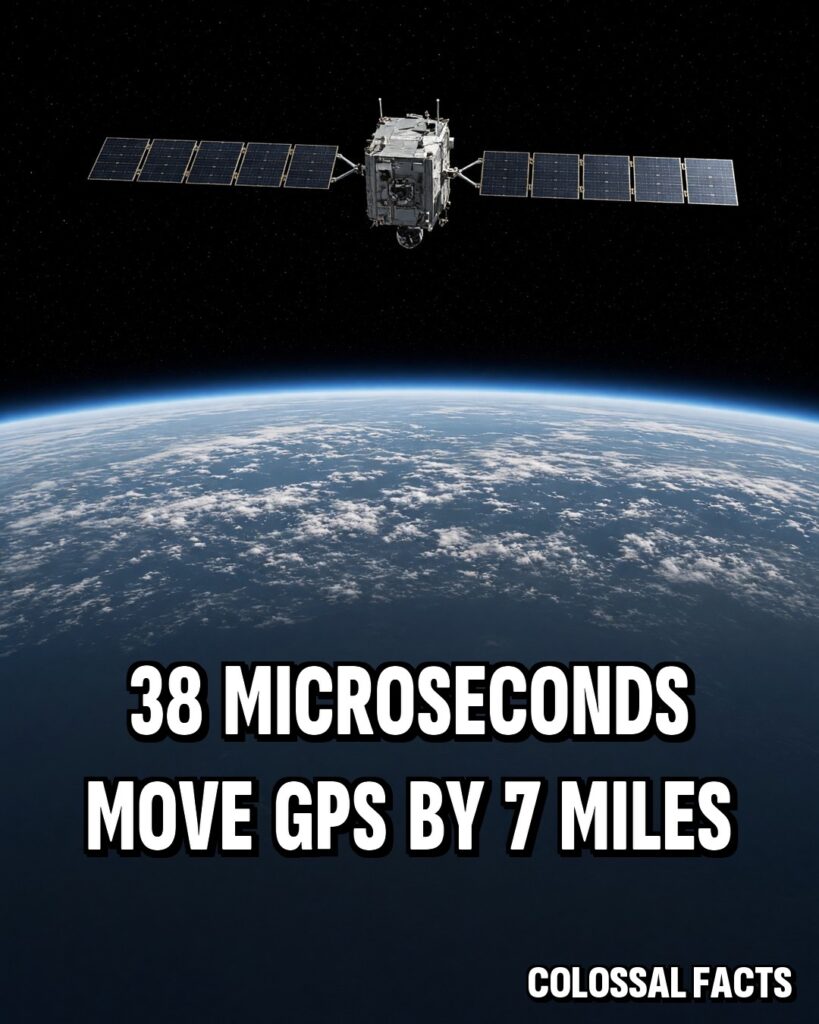
The clock in orbit runs about 38 microseconds fast each day compared with a clock at sea level.
Albert Einstein predicted the effect. Under stronger gravity, a clock runs slower, so an Earth clock falls behind when compared with a satellite clock. Speed pulls the other way, but gravity wins.
One microsecond of timing error equals about 984 feet (300 meters) of distance.
Without the correction, the difference would grow to about 6.8 miles (11 kilometers) in one day. Between daily clock corrections, the receiver would measure every satellite as too close by a common amount.
The timing error accumulates by about 33 feet (10 meters) per minute when expressed as distance.
By evening, the target could sit miles away.
For positioning accurate to about 3 feet (1 meter), GPS has to account for both special and general relativity.
The clock gains time too quietly to notice.
Without the correction, the map loses you in hours.
Enjoyed the story?
Follow Colossal Facts for a new story every day.
Or watch them as short videos on Facebook →