On Christmas Eve in 1971, LANSA Flight 508, a Lockheed L-188A Electra, was flying from Lima toward Pucallpa in Peru. Among the passengers was 17-year-old Juliane Koepcke, traveling with her mother, Maria Koepcke, a well-known ornithologist. They were going to join Juliane’s father, the zoologist Hans-Wilhelm Koepcke, for the holiday.
The aircraft, registered OB-R-941, carried 92 people: 86 passengers and 6 crew. After it entered a thunderstorm, it broke apart in mid-air. Ninety-one people died. Juliane was the only person who lived to leave the forest.
A delayed flight into a storm
The flight had already been hours late when it left Jorge Chávez International Airport in Lima. Its planned route was a domestic hop to Pucallpa, then on to Iquitos. Juliane later recalled sitting by the window in the penultimate row, with a clear view of the right wing. Around midday, the Electra flew into strong turbulence and lightning. Accounts of the official investigation, summarized by the Aviation Safety Network, say lightning struck the aircraft, fire broke out on the right wing, and that wing separated, along with part of the left. The airframe came apart under the loads of the storm and of the pilots’ attempt to level the aircraft. The wreckage fell into forested, mountainous country near Puerto Inca.
The breakup occurred about 15 minutes before the planned landing at Pucallpa. There were no villages at the impact area. LANSA already had a troubled safety record in Peru. Flight 508 was not the airline’s first fatal crash, and the company did not long survive the aftermath.
A fall of about 3,000 meters
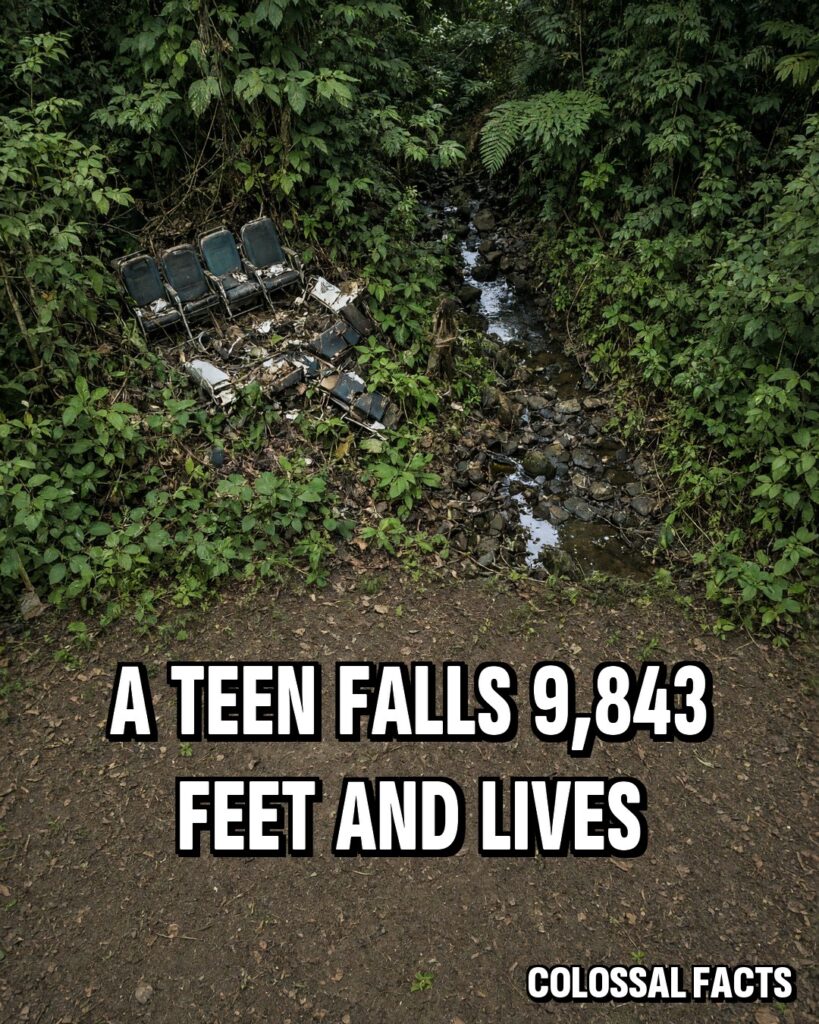
Juliane fell about 3,000 meters — 9,843 feet — still strapped to her seat row, and lost consciousness. That distance is about nine times the height of the Eiffel Tower. She has described seeing the forest canopy spin below her before the fall went dark. She was not the only passenger still in a seat when the aircraft disintegrated. Other people also fell, and some were later found still belted in their seats, dead. The fact that she lived through the same kind of fall is what makes the number stark, not that she was the only person who left the aircraft in a seat.
She woke the next day under the canopy. Her first clear thought was that she had survived a plane crash. She called for her mother. Only the forest answered. She had a broken collarbone, a torn ligament in one knee, a deep cut on her arm, an injured eye, and a concussion, but she could walk.
A rule about water
The area was dense Amazon forest. Search aircraft later flew over wreckage — and, at times, over her — without seeing a girl in a small clearing. What she had, besides a bag of sweets from the flight, was a lesson from her mother: do not try to push a straight line through thick growth. Follow water. A stream leads to a larger stream, and then to a river, and people live on rivers.
She walked for 10 or 11 days. Published accounts differ on how the days are counted from the crash on 24 December, but the span is just over a week and a half. She drank from the streams, ate the sweets while they lasted, and kept clear of what she could not fight. Fly larvae infected her wounds. She kept walking. Toward the end she was almost too weak to stand steadily.
A hut, a boat, and the men who came back
She reached a logging camp that was empty when she arrived: a hut, a boat, no people. She stayed, too weak to go on. She has said she used gasoline she found there to clean the wounds. When the workers returned, they found her, treated her as best they could, and took her downriver by canoe to help, and then to a hospital. Her father had been searching from the other end of the story.
She was the only person from the flight who survived to be rescued. Later reporting, including fact-checks of the public story, has noted that some other passengers appear to have survived the initial fall, among them, by some accounts, her mother, but died before rescuers reached them. The official toll remains 91 dead and one survivor.
What she did afterward
After she was flown out, her injuries were treated and the public story began. She did not turn that story into a career. She trained as a mammalogist, later taking her husband’s surname, Diller, and returned to Amazon forest as a scientist, not only as the girl who had fallen into it. In 2011 she published a memoir, When I Fell From the Sky (the German original is Als ich vom Himmel fiel).
The crash is sometimes retold as a miracle of the seat and the canopy. Koepcke has been more matter-of-fact. She fell, she was hurt, she followed water, and someone came back to the camp. The fall from about three kilometers did not kill her. The forest did not, either. What got her out was unspectacular: a rule about streams, a hut that happened to have a roof, and the men who returned to it.
Sources
- Aviation Safety Network – accident record for Lockheed L-188A Electra OB-R-941, 24 December 1971 (92 people on board, 91 fatalities; investigation summary)
- The Guardian – “A bolt of lightning struck my plane – and I plunged 3,000m into a rainforest” (6 August 2024; Koepcke/Diller’s account)
- The Telegraph – “Sole survivor: the woman who fell to earth” (2012 interview)
- Wikipedia – LANSA Flight 508 and Juliane Koepcke