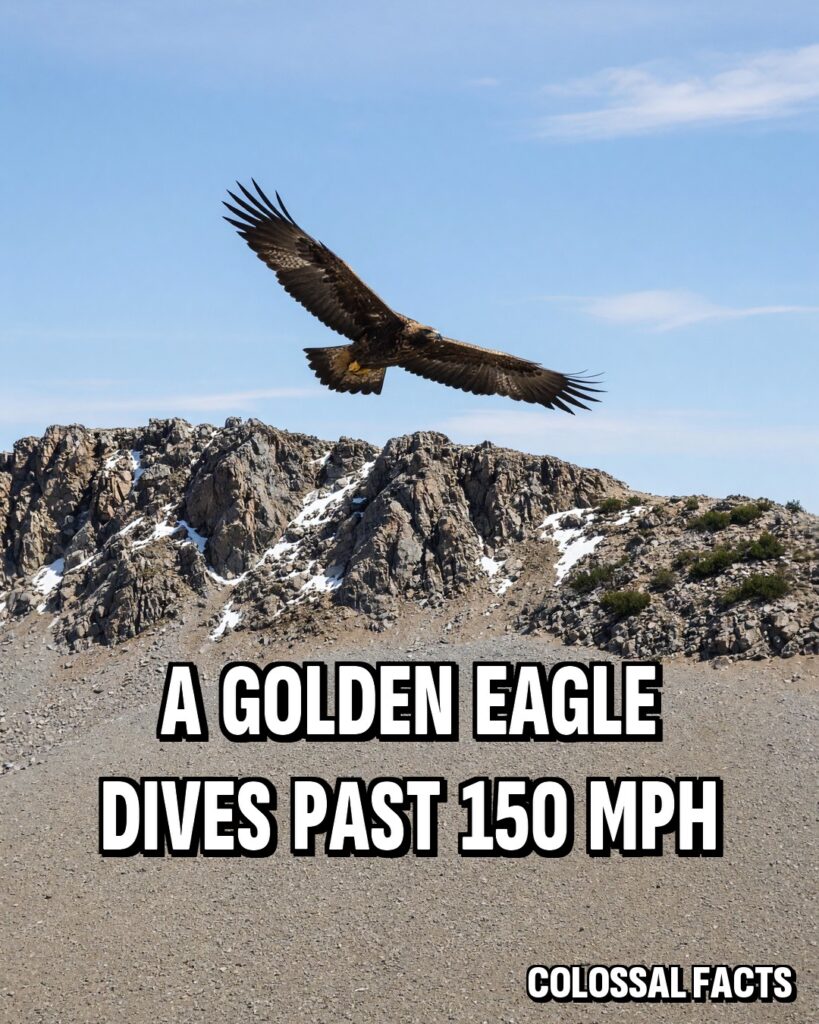
The golden eagle (Aquila chrysaetos) is one of the largest eagles in the Northern Hemisphere and the national bird of Mexico. It lives across much of the Holarctic: North America, Europe, Asia, and parts of North Africa, favoring open and semi-open country, mountains, and hills where it can see far and stoop from a height. The female is much bigger than the male, a common pattern in birds of prey. Wings typically stretch from about 6 to 7.3 feet (1.8 to 2.2 meters). Some measurements approach 8 feet. Females can reach about 14 pounds (6 kilograms) or a little more.
Strength is not just a matter of pounds. In a dive the bird is widely reported to exceed 150 mph (240 km/h), more than twice a typical U.S. interstate speed limit. Exact stoop speeds are hard to measure in the wild, so careful sources treat 150 mph as a well-attested lower figure for a steep dive rather than a laboratory constant. Even at that speed, the strike is sudden.
How it hunts
It drops from a height and grabs prey with sharp talons. Usual meals are mid-sized mammals: rabbits, hares, marmots, and ground squirrels. It also eats carrion, plus reptiles, birds, fish, and large insects when the chance appears. There are reliable records of golden eagles taking animals as large as deer, especially young or weakened ones. A full-grown healthy deer is far heavier than the hunter; such attacks are the exception, not the daily diet. The eagle is a powerful predator, not an animal that routinely pulls down the largest hoofed game.
The nest, or eyrie, is huge — a bulky platform of sticks on a cliff or in a tall tree, added to year after year. A pair may return for several breeding seasons and use the same site for many years. Both parents sit on the eggs. The young usually take their first flight after about two to three months in the nest. In the wild, golden eagles can live two or three decades; a life of around 30 years is possible, though many birds do not reach that age.
A wide range, a famous dive
Because the species is so widespread, it has collected many local names and a long place in human culture, from falconry to Mexico’s coat of arms. The biology underneath is consistent: a long-lived pair, a vast hunting ground, and a dive that, on the usual figures, few other birds of prey can match for speed. A deer is far heavier than the hunter. The hunter, on occasion, still dives at it.
A pair, a territory, and a national emblem
Golden eagles usually mate for the long term and hold a large hunting territory, which is one reason a pair will keep adding sticks to the same huge nest. They often hunt from a soar, watching the ground, then fold into a stoop. In North America they are birds of the West and of open country more than of dense cities, though their global range is much wider. In Mexico the golden eagle appears on the national coat of arms, a place of honor that sometimes leads people to assume it is only a Mexican bird. It is not. It is a Northern Hemisphere species that happens to be Mexico’s national bird.
Field guides from the Cornell Lab of Ornithology and the National Audubon Society describe the same basic facts: marked sexual dimorphism, a diet built on medium-sized mammals, a long breeding cycle, and a lifespan that can reach two or three decades in the wild. Popular claims about dive speed and about eagles killing adult deer should be handled with care. The 150 mph figure is a widely repeated estimate for a steep stoop, not a reading from a speed gun on every hunt. Attacks on large ungulates are documented but uncommon. The bird’s real signature is still that combination of size, range, and a dive fast enough to be compared with highway traffic — and, on rare days, with prey many times its own weight.
Sources: Golden eagle – Encyclopaedia Britannica, Golden Eagle – Cornell Lab of Ornithology, Golden Eagle – Audubon Field Guide