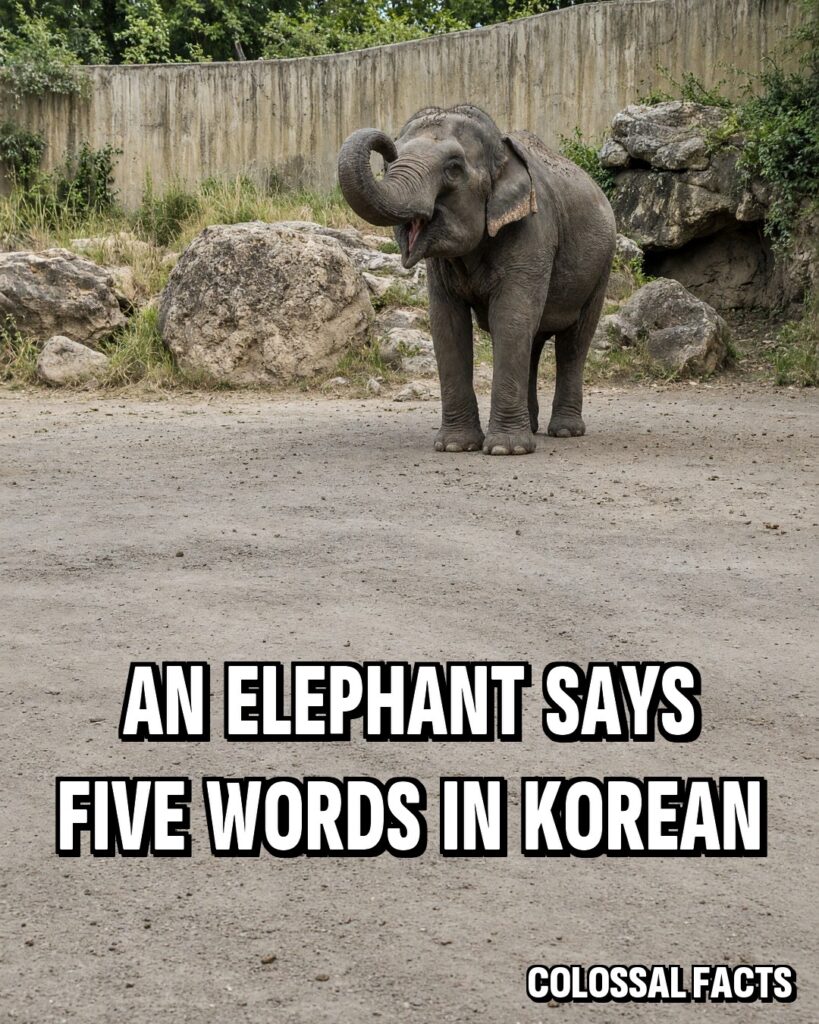
Videos of “clever” elephants travel fast online, and not all of them are real. Some are staged or edited, and some are now generated by AI. The real science is often stranger than the fakes. One of the best documented examples is an Asian elephant in South Korea named Koshik, who learned to imitate human speech well enough that native speakers could write down what he said.
An elephant with a five-word vocabulary
Koshik is a male Asian elephant (Elephas maximus) at Everland Zoo in South Korea. His trainers said he could say six Korean words. In 2012 a team led by biologist Angela Stoeger of the University of Vienna decided to test that claim properly. Stoeger first heard about Koshik through videos posted on YouTube, contacted the zoo and travelled to Korea to record him.
The researchers played 47 recordings of Koshik to 16 native Korean speakers who had never met the elephant and were not told what he was supposed to be saying. Their transcriptions largely confirmed the trainers’ account and pointed to five words:
- annyong – “hello”
- anja – “sit down”
- aniya – “no”
- nuo – “lie down”
- choah – “good”
The match was not perfect. According to the study, published in Current Biology in November 2012, listeners agreed on the vowels about 67% of the time but on consonants only about 21%. “Annyong” was the clearest: 56% of listeners spelled it exactly. Koshik was very good at copying the pitch and tone of his trainers’ voices, and much weaker at the sharp edges of consonants.
The trunk-in-mouth trick
An elephant’s voice is built for very different sounds. Elephants normally produce deep rumbles, some so low that humans cannot hear them, which can carry over long distances. With a huge larynx and a trunk instead of lips, Koshik is not built for Korean vowels.
His solution was something the researchers had never seen in any species. He puts the tip of his trunk into his mouth and uses it to reshape his oral cavity while he vocalises. “He always puts his trunk tip into his mouth and then modulates the oral chamber,” Stoeger told the BBC. In the paper, the team described this as a wholly novel method of vocal production. The result is that his low elephant voice comes out at roughly the pitch of his human trainers.
Why would an elephant learn to talk?
The researchers do not believe Koshik understands the words. Their explanation is social. Between the ages of five and twelve, Koshik was the only elephant at Everland Zoo, during what the scientists describe as a crucial period of elephant development. Humans were his only social contact.
In the study, the team suggests that one function of vocal learning may be to strengthen social bonds, and that in unusual cases those bonds can cross species. In other words, Koshik may have been trying to sound like the companions he had. Klaus Zuberbühler of the University of St Andrews told the BBC that field research on wild elephants is still needed to see whether imitation matters in their natural lives.
Mary, Anchali and the garden hose
Koshik is not the only elephant to surprise scientists. In 2024, researchers at Humboldt University of Berlin published a study in Current Biology on how Asian elephants at the Berlin Zoo handle water hoses.
A female named Mary, then 54 years old, turned out to be an expert. She held the hose behind the tip like a stiff shower head, showered different parts of her body systematically, and, to reach her back, gripped the hose further down and swung it over herself. The team concluded that this met the criteria for tool use.
Then came the twist. A younger female, 12-year-old Anchali, began interfering during Mary’s shower time. She pulled the hose toward herself, lifted it, kinked it and squeezed the kink, which sometimes cut off the water. She repeated the sequence over several sessions and got better at it. She also stood on the hose with her trunk, something the keepers had trained the elephants not to do. In control tests with two hoses, though, the researchers could not show that Anchali specifically targeted Mary’s hose, so whether this was deliberate sabotage remains an open question.
Elephants that get the point
A third study adds another piece. In 2013, Anna Smet and Richard Byrne of the University of St Andrews tested 11 captive African elephants in South Africa. A researcher pointed at one of two containers, only one of which held food. Without any training in this task, the elephants chose the right container about 67.5% of the time. For comparison, the authors noted that 12-month-old children succeed at the same task about 73% of the time.
What it adds up to
Put together, these studies show animals that copy human voices, use and disrupt tools, and read human gestures. They do not show an elephant that understands Korean. Koshik’s five words are a genuine scientific first in how they are produced, but the meaning behind them, as far as anyone can prove, belongs to the humans listening.
Sources: Stoeger et al., An Asian Elephant Imitates Human Speech – Current Biology (2012), Elephant mimics Korean with help of his trunk – BBC News, Water-hose tool use and showering behavior by Asian elephants – Current Biology (2024), This elephant learned to use a hose as a shower – Science, Smet & Byrne, African Elephants Can Use Human Pointing Cues to Find Hidden Food – Current Biology (2013)