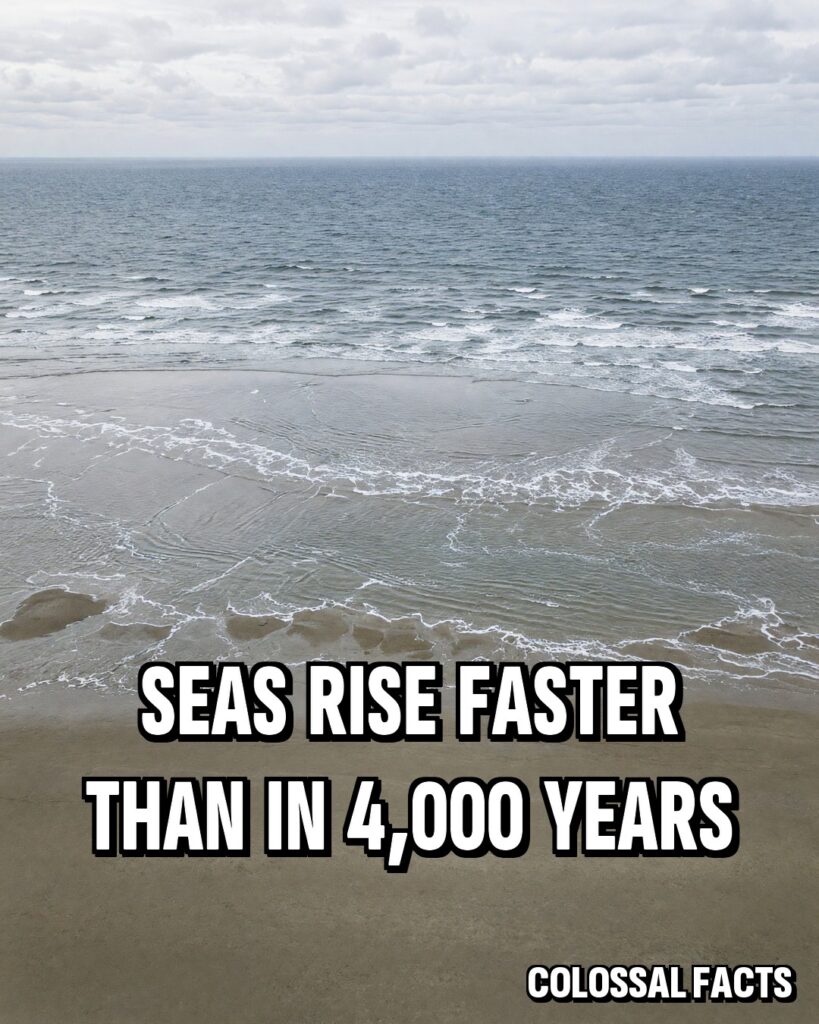
Since 1900, global mean sea level has risen faster than in any century of at least the last 4,000 years. That is the finding of a study published on 15 October 2025 in Nature. A team led by researchers linked to Rutgers University compared the pace of the twentieth and twenty-first centuries with a long reconstruction of sea level through the Holocene.
The record is easy to misread. It is not a claim that the sea now stands at its highest point in Earth history. It is a claim about speed: how fast the global average is climbing compared with any single century in the past four millennia.
Four thousand years of relative stability
The paper reconstructs sea-level change over about 11,700 years, from the start of the Holocene after the last major ice age. The authors describe three stages. In the early Holocene the sea rose quickly as land ice melted. Then, from about 4,200 years ago until the mid-nineteenth century, global mean sea level was comparatively stable. For thousands of years the water rose a little and fell a little, without a lasting change of direction.
That stability ends around the industrial age. For 1900–2020 the study puts the average global rise at 1.51 millimeters a year, with an uncertainty of about ±0.16 millimeters. The authors say it is extremely likely (a probability of at least 95 percent) that this rate exceeds that of any century in at least the previous 40 centuries.
Two rates that should not be mixed
The figure of 1.51 millimeters a year describes the whole period since 1900. It is not the pace of the most recent decade. For 2013–2022 the World Meteorological Organization reported an average rise of 4.62 millimeters a year — more than double the first decade of the satellite record, 1993–2002. The two numbers belong together, but they measure different spans: one is a century-scale average, the other a recent acceleration.
Hold only the 4.62-millimeter pace unchanged, and the level would rise about 1.75 meters (about 5 feet 9 inches) — roughly a person’s height — in nearly 380 years. That is a scale check, not a forecast. Projections depend on emissions, ice-sheet melt, and whether the acceleration continues. Extending one decade in a straight line does not replace those scenarios.
For the twentieth century and the start of the twenty-first, separate assessments put the total rise in global mean sea level at about 15–25 centimeters between 1901 and 2018. Satellite measurements since 1993 make the later acceleration clearer still against the early instrumental record. The 2025 study does not replace those figures. It places them on a longer geological scale and concludes that the pace since 1900 has no equal among the previous 40 centuries.
Why the sea is rising faster
Two mechanisms are well established. The ocean is warming, so the water expands. Ice on land — glaciers and ice sheets — melts and adds water to the sea. Local sea level is not the same everywhere, either. In some places the land is sinking; in others it is rising. People feel the combined effect, not only the global mean.
The Nature paper itself stresses that difference along the coast of southeastern China. There, global rise is compounded by rapid local subsidence in major coastal cities, much of which the authors attribute to human activity. The global record is one number. The risk at a particular shore can be larger.
The record is the speed
The sea has stood higher in the more distant past, when the climate was different and the ice sheets were smaller. Headlines about the “highest level ever” do not describe this study. What it says is narrower and more precise: since 1900 the global average has climbed faster than in any century for at least 4,000 years, and in recent years the yearly pace has been higher still than that long-term average.
The record is not how high the sea stands today. The record is how fast it climbs.
Sources: Lin et al., Modern sea-level rise breaks 4,000-year stability in southeastern China – Nature (15 October 2025), Rising Seas and Sinking Cities – Rutgers Climate and Energy Institute, Pace of rise in global sea level has doubled – Reuters / WMO (2023)