On 23 July 1983, Air Canada Flight 143, a Boeing 767, flew from Montreal to Edmonton, with a stop in Ottawa. The flight plan required 22,300 kilograms of fuel. The number on the fuel slip matched that plan exactly. The unit did not. The aircraft’s fuel-quantity indication system was out of service, so the crew had to rely on manual measurements and arithmetic. Ground crews measured the tanks with mechanical measuring sticks, or dripsticks, and read 7,682 liters. They multiplied that volume by 1.77, the number of pounds in a liter of jet fuel, the factor used for the rest of a fleet that still thought in pounds.
The correct factor for this airplane was 0.803 kilograms per liter. This 767 was among the first in the Air Canada fleet with fuel gauges and a flight-management computer that required fuel mass in kilograms, not volume and not pounds. The crew and the technicians used pounds per liter and never converted that density into kilograms per liter. The airplane left with 22,300 pounds of fuel. That is just over 10,000 kilograms, less than half of what the flight needed.
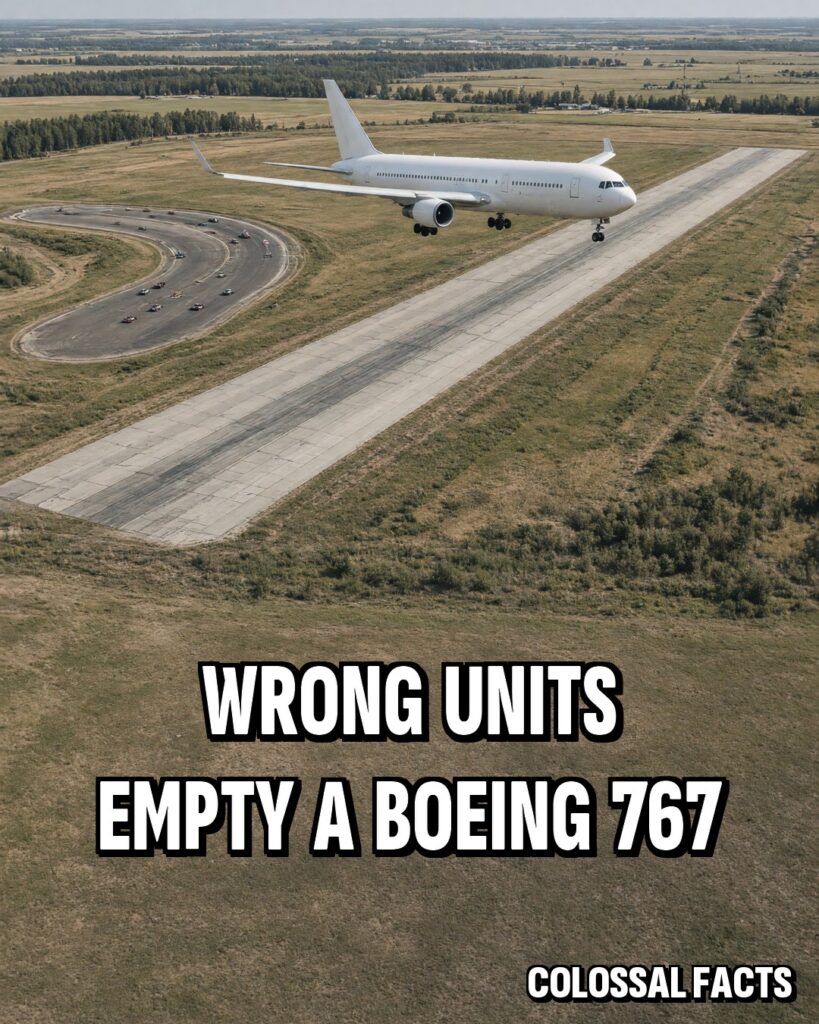
Halfway through the trip, over northern Ontario, the engines ran out of fuel. Both failed. The captain, Robert Pearson, an experienced glider pilot, and the first officer, Maurice Quintal, steered the jet toward a closed runway at Gimli, Manitoba, a former Canadian Forces base. The runway was already in use as a car racetrack, and people were on the site for a go-kart event. Pearson glided the 767 in. The nose gear collapsed on landing, which helped the jet slow down. Nobody died. A few people were injured in the evacuation. The airplane became known as the Gimli Glider, was repaired, and later returned to service.
A conversion error, written in two unit systems
Canada had recently adopted the metric system in aviation, and this was a moment when old habits and new cockpit units sat on the same piece of paper. The investigation found a chain of missed checks, not a single typo: a failed fuel gauge, a density figure from the wrong system, and a calculation that was then trusted because the number 22,300 looked familiar. The board’s lesson was dull and important. If the unit is wrong, the arithmetic can be perfect and still empty the tanks.
The landing itself is taught in flying schools as a piece of airmanship: a heavy jet, no engines, a short, occupied strip, and a captain who had spent time in gliders. The cause is taught in engineering and safety courses for the opposite reason. It was not weather. It was not a broken wing. It was a multiplication.
The number was right
The number on the paper was right. The unit was not. A 767 ran dry in clear air, glided into a drag strip, and left behind a case study that still has the same moral as the later loss of a Mars probe: write the unit, or the machine will do the rest.
The 767 had been in service only a short time. Metric fuel planning was new to the airline, and the inoperative gauges turned a routine pre-flight into an exercise on paper. After the accident, Air Canada and the investigators tightened the way manual fuel figures were calculated and checked, and the case became a standard warning in later unit-conversion training, often mentioned alongside the later Mars Climate Orbiter loss. Pearson and Quintal were first criticized, then widely praised for the glide. The racers on the old runway got a story they had not come for: a silent wide-body, a collapsed nose, and a jet that should not have been there, and would not have been, if 1.77 had been 0.803.
Sources: Gimli Glider – Wikipedia, Gimli Glider pilot relives historic landing – The Guardian, Air Canada Flight 143 – Aviation Safety Network