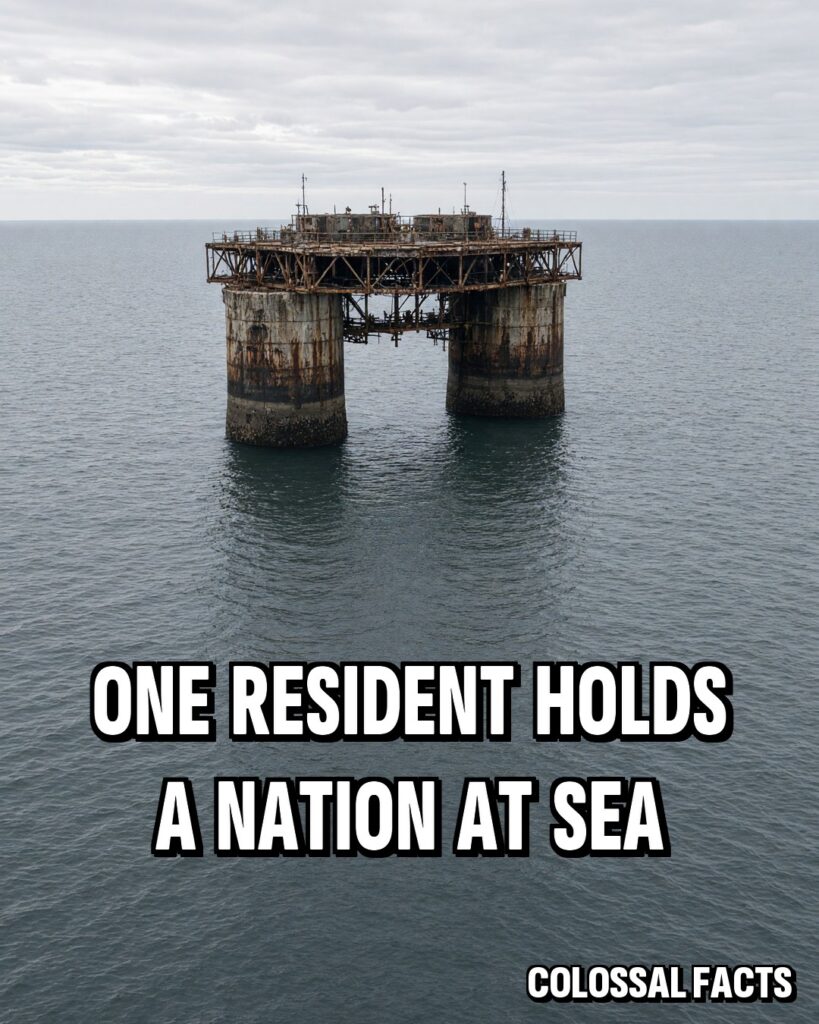
In 1942, Britain built a Maunsell sea fort in the North Sea: a wartime platform of concrete towers and a steel deck, officially HM Fort Roughs and commonly called Roughs Tower. It stood on a sandbar known as Rough Sands, then just outside British territorial waters, about 7 miles (11 kilometers) off the coast of Suffolk. After the war the garrison left, and the platform stood empty. In the 1960s, former Army major and pirate-radio operator Paddy Roy Bates took it over. His first aim was a radio station. He seized the fort from another group of pirate broadcasters already there.
On 2 September 1967 the plan flipped. Instead of going on air, Bates declared an independent state: the Principality of Sealand. He called the abandoned fort nobody’s land and cited a claim, under the law of nations, that unowned territory can be occupied. The motto became E Mare Libertas — from the sea, freedom. He issued passports, stamps, and titles. In 1968 a legal case in Britain over a warning shot from the platform ended without a clear ruling that destroyed the family’s claim in their own eyes. In 1978 a German lawyer and a small group tried to occupy the fort; Bates’s son Michael recaptured it.
A micronation inside later territorial waters
In 1987 Britain extended its territorial sea from 3 to 12 nautical miles. The fort now sat inside those waters. No country recognizes Sealand as a state. The United Kingdom treats the platform as within its sea, not as a foreign capital. The Bates family and their associates still hold it and still call it sovereign. Paddy Roy Bates died in 2012; his son Michael has continued the claim. As of August 2024, one person was living there full time, a caretaker rather than a government. Sealand sells titles and memorabilia, and it remains the world’s best-known micronation: a wartime tower in the North Sea, a flag and a motto, and a state that no country accepts.
An abandoned war fort is an odd place to plant a nation. The story is not that Sealand won a seat at the United Nations. It is that a family has held a platform for more than half a century and still uses the language of sovereignty, even after the sea around it became British in law.
What Sealand is, and what it is not
Maunsell forts were anti-aircraft and anti-naval batteries, poured and assembled in the Thames Estuary and the North Sea during the Second World War. Most were abandoned after 1945; some were later used by pirate radio stations in the 1960s, which is how Bates knew the waters. Roughs Tower’s location just beyond the old three-mile limit is the whole of the legal argument. Once Britain moved the limit to 12 nautical miles, that argument became much harder to make in any court other than Sealand’s own. The 1978 raid, and a later fire and a storm damage over the years, showed how fragile a “capital” on stilts can be.
No embassy accepts a Sealand passport as a national travel document. The family’s business of noble titles is a novelty, not a diplomatic corps. And yet the platform is still occupied, still painted, still described by its owners as a principality. That persistence is the fact worth recording. One resident as of 2024 is not a census of a country. It is a caretaker on a wartime tower, holding a claim that the rest of the world has never signed. From the sea, the motto says, comes freedom. From the sea, in practice, comes a very small, very famous, unrecognized platform.
Sources: Principality of Sealand – Wikipedia, Principality of Sealand official site, Sealand profile – BBC News