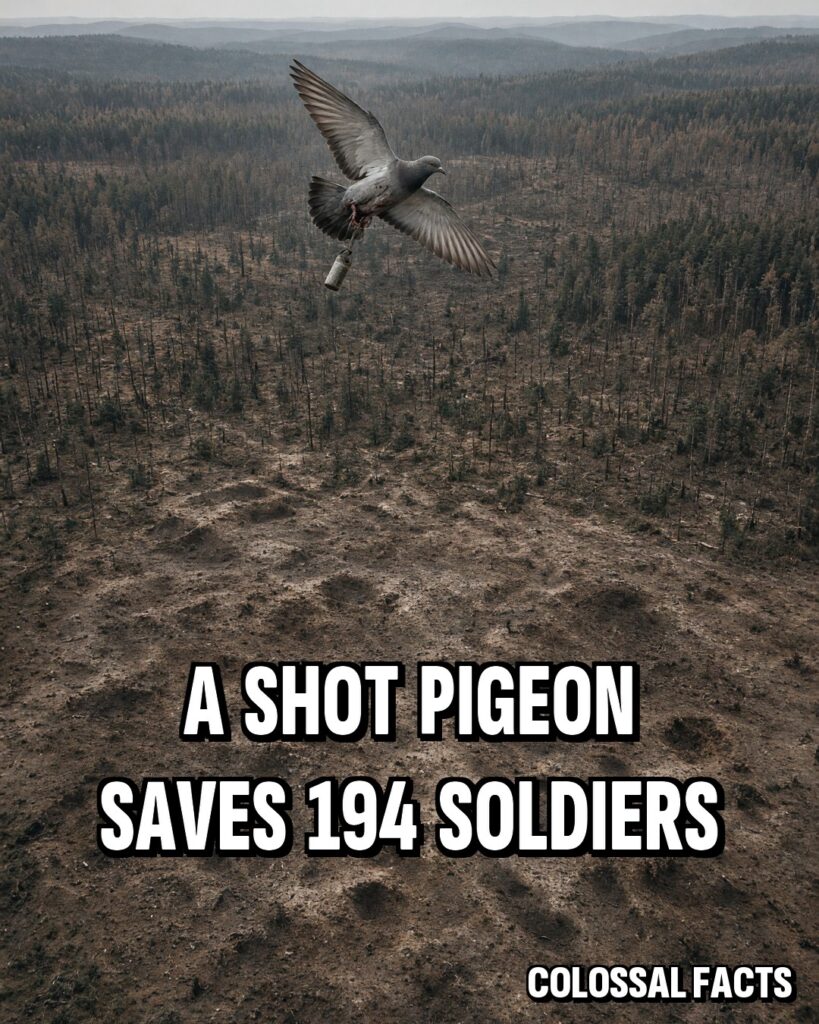
In October 1918, a surrounded American unit in the Argonne Forest came under fire from its own artillery. The force, from the 77th Division, became known as the Lost Battalion. For days the men were cut off, short of food and ammunition, and unable to move without drawing German fire. There was no other way to stop their own guns than to get a message through. One pigeon was left.
Major Charles W. Whittlesey, commander of the pocket, wrote a final note and, in the official story long told by the Army, tied it to Cher Ami. The note read: “We are along the road parallel to 276.4. Our own artillery is dropping a barrage directly on us. For heaven’s sake, stop it.” The bird flew into German fire. A bullet or shell fragment hit its breast. It fell, then rose again. Its right leg was nearly severed. The message capsule hung by a tendon. The route back to the loft was about 25 miles (40 kilometers). One account says the flight took 25 minutes; another says an hour and 15 minutes. The time has never been settled with precision, and it is better left as a disputed detail than as a single famous number.
The note showed the exact spot of the trapped men. The friendly barrage was stopped. On the evening of 7 October, the unit was led out. Almost 70 percent of the men who had gone into the pocket were killed, wounded, or missing. Only 194 walked out. Whittlesey was later awarded the Medal of Honor.
A bird in the Smithsonian, and a story with gaps
Cher Ami was awarded the French Croix de Guerre and, in American memory, credit for saving the remnants of the battalion. The wounded bird was brought to the United States, died in 1919, and was preserved. It is still in the collection of the Smithsonian’s National Museum of American History. Later DNA work has indicated that the mounted bird is male, though popular stories long used both “he” and “she.”
A later review of the paperwork, including a Smithsonian fact sheet, has noted that surviving records do not settle every detail of the popular account, including a complete proof that this exact bird carried that exact message. The Lost Battalion, Whittlesey’s note, and a badly wounded pigeon that reached a loft are all real. Some of the most polished parts of the legend were added as the Signal Corps and the press retold the story. That does not make the flight small. It makes the cautious version enough: a message got through, the artillery stopped, and 194 men walked out of the Argonne.
The message and the tendon
The message hung by a tendon. Without a bird that could fly through fire, their own guns would have kept firing. That is the heart of the story, and it does not need a perfect stopwatch or an undisputed paper trail to remain one of the starkest images of the Meuse-Argonne.
The Lost Battalion was part of the Meuse-Argonne offensive, the great American attack of the last weeks of the war. Several pigeons were sent from the pocket; later retellings say Cher Ami was the last one left. The men had already suffered from hunger, from German fire, and from the artillery of their own side before the barrage was lifted. Whittlesey refused a German demand to surrender. After the relief on 7 October, the 194 who walked out were only the remnant of a force that had gone in hundreds strong. The pigeon, whatever later arguments about the paperwork, was preserved as the emblem of that relief. Tourists still see the mounted bird in Washington. The note about the road at 276.4 is still the sentence the story hangs on.
Sources: Cher Ami Fact Sheet – Smithsonian National Museum of American History, Cher Ami – Wikipedia, Lost Battalion (World War I) – Wikipedia