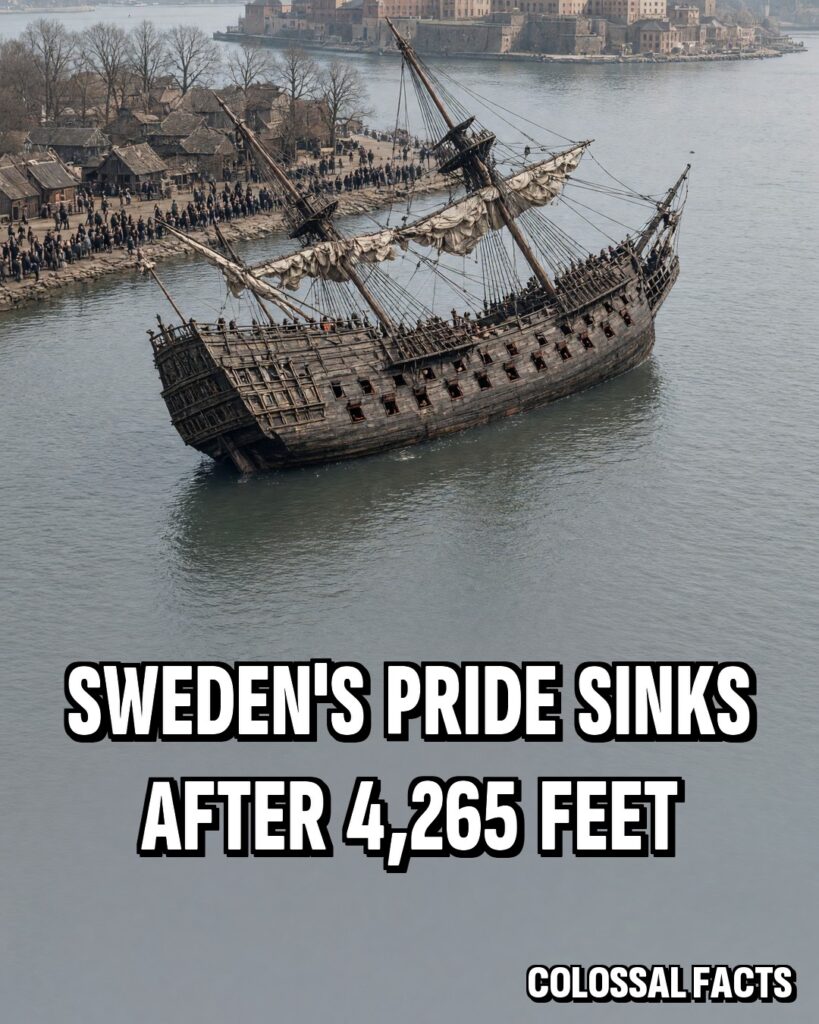
On 10 August 1628, the warship Vasa set sail from Stockholm harbor on her maiden voyage. She was the pride of Sweden under King Gustav II Adolf, built to carry a heavy broadside in the Baltic wars, and she looked ready for a fight. They sent her to sea anyway, despite warnings that she was dangerously unstable. Too much weight sat high in the hull: two gun decks, tall upper works, and heavy ornament. A stability test had already raised the alarm. Thirty men ran back and forth across the deck. The test was stopped because those in charge feared the ship would capsize at the quayside.
About twenty minutes after leaving, she had covered only 4,265 feet (1,300 meters). A light gust tipped her sideways. At the later inquiry, Lieutenant Petter Gierdsson said the wind was too weak to pull the sail ropes, though the pulleys were well lubricated. The crew had to push the sheets out by hand. One man could hold a rope. Water poured in through the open gunports on the lower deck, the openings that should have let her fire a royal salute and a broadside. Instead they let the sea in. Vasa sank in front of thousands of people in the harbor. About 30 of nearly 150 people on board died. Some modern counts put the dead a little higher; the exact number was never known with precision.
She lay on the seabed for 333 years. In 1956 the wreck was found again, largely thanks to the persistence of Anders Franzén, and on 24 April 1961 she was raised, almost intact, because the brackish water of the Baltic is poor in the shipworm that destroys wrecks in saltier seas. Today she stands in the Vasa Museum in Stockholm, one of the world’s most visited maritime museums and the most complete seventeenth-century warship on display.
Sweden’s pride did not fall in battle. She fell under her own weight, a few minutes from the dock, in a wind too light to haul a rope.
A king’s ship, a harbor sinking, a museum
Vasa was built at the Stockholm shipyard in the 1620s for Gustav II Adolf, who wanted a flagship with two full gun decks and a heavy punch. Dutch-born master shipwrights worked on her, under pressure to deliver a tall, heavily armed vessel. The extra deck and the heavy guns raised her center of gravity. Officers had already seen, in the 30-man running test, that she rolled too easily. Those warnings did not stop the maiden voyage, which was also a public display: sails set, gunports open, a crowd on shore. The light breeze that put her over was, in the testimony, almost too weak to handle the sheets. That is what made the sinking so stark. It was not a storm.
The official inquiry that followed heard from officers and builders and did not produce a single, clean conviction. The king was away at war; the ship had been built to his demands. For more than three centuries she sat in the mud, 32 meters down, until she was lifted in 1961 and slowly conserved, including with polyethylene glycol to keep the waterlogged oak from collapsing as it dried. The Vasa Museum, opened in 1990 on the island of Djurgården, was built around her. Visitors walk past the same hull that traveled 1,300 meters, took in water through her lower gunports, and went down in front of the city she was meant to defend. Sweden’s pride fell under her own weight, not under an enemy broadside.
Sources: The history of Vasa – Vasa Museum, Vasa Museum, Vasa (ship) – Wikipedia