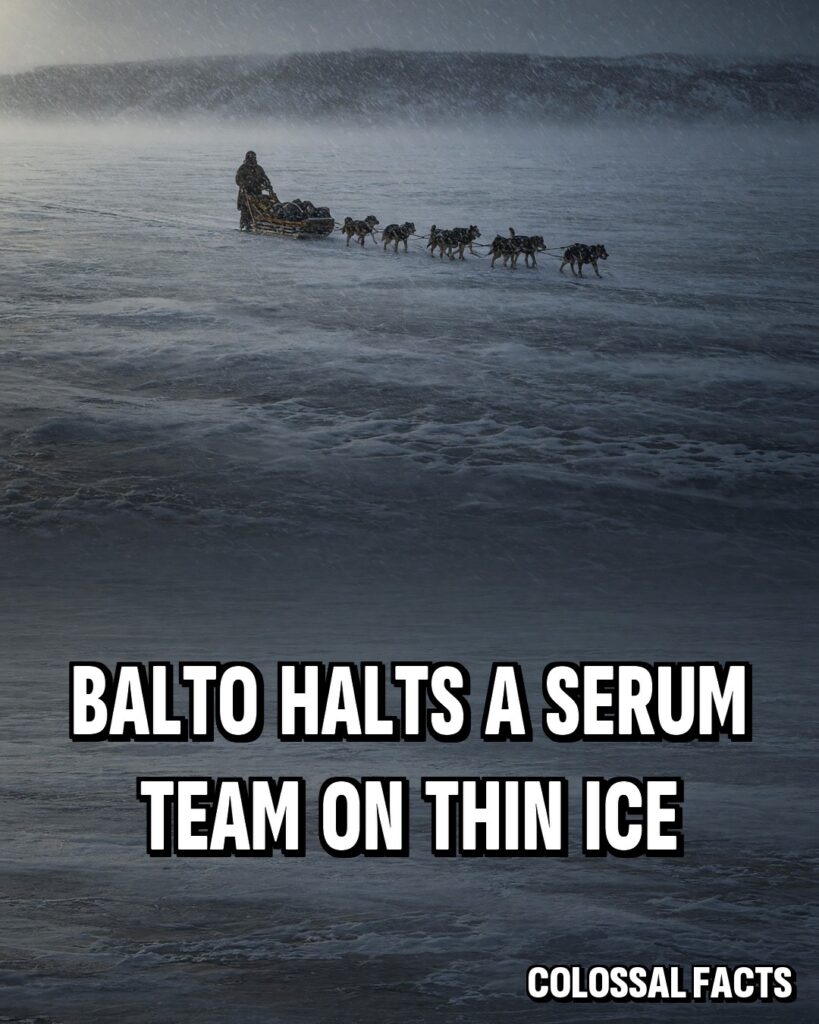
In January 1925, diphtheria threatened Nome, Alaska. The town’s antitoxin was too old and too scarce, and winter weather had closed the usual routes. Fresh serum was sent by train from Anchorage as far as Nenana. From there, a relay of dog teams had to cover the remaining 674 miles (1,085 kilometers) of frozen trail. Twenty mushers and about 150 dogs ran the route in 127½ hours — five and a half days — in extreme cold and blizzard winds.
In the early morning of 2 February 1925, a sled team carried that serum into Nome. Balto led the dogs through a snowstorm, though he was only a backup and not the first choice to lead. The serum sat in a 20-pound cylinder wrapped in fur so it would not freeze. Gunnar Kaasen was the musher. His team of 13 dogs had taken over at Bluff for the last leg of about 53 miles (85 kilometers) and reached Front Street at 5:30 a.m. The ampules arrived intact and were thawed for use that day.
A stop that may have saved the team
On the trail, Balto suddenly stopped and refused the next step. His paws had broken through thin ice over the Topkok River. If he had gone on, Kaasen and the whole team could have fallen into the water. That refusal may have saved them. Balto then led the team by the smell of the beaten trail, not by sight, through a storm in which the musher could not always see the dogs nearest the sled. Ice built up on the dog’s long coat. After the run, Kaasen went back to Balto, hugged him, and called him a damn fine dog.
Kaasen had also pressed on past a planned handoff at Point Safety, where the next driver was still asleep, and brought the serum the rest of the way into town himself. The delivery still had to continue — the antitoxin had to be thawed and given to patients — but to survive the last night, the team first had to stop on that ice and then find the trail in the dark.
The longer run belonged to another team
Balto became the famous face of the relay. Newspapers across the United States treated him as the dog who saved Nome, and in December 1925 a statue of him was unveiled in New York City’s Central Park. A closer look at the mileage tells a wider story. Leonhard Seppala and his lead dog Togo traveled farther than any other team: about 170 miles out from Nome to meet the serum, then 91 miles with the cylinder from near Shaktoolik to Golovin, about 261 miles in all. Their route included a crossing of the ice on Norton Sound, among the most dangerous miles of the run. Charlie Olson then took the serum 25 miles to Bluff, where Kaasen and Balto began the last stage.
Seppala had already left Nome and was heading inland to meet the serum when the plan grew from a two-stage run into a 20-team relay. Unaware of the change, he took a hard shortcut across the ice of Norton Sound and was then met on the trail by another musher, Henry Ivanoff, who already had the cylinder. Seppala turned around and ran the longest single leg with the serum. He later said that Togo had never performed better, and he was stung when Balto, not Togo, became the statue in the park.
Both teams belonged to the same effort. Balto led the final miles into town and became the public hero of a story that newspapers and radio carried across the country. After a celebrity tour, he and several teammates were later sold into a sideshow, then bought for the Cleveland Zoo after a public appeal; Balto died there in 1933, and his mounted skin is kept at the Cleveland Museum of Natural History. Togo ran the longest and some of the hardest ground and was slower to receive the same credit. The serum run is remembered for both. The delivery still had to continue. To survive, they first had to stop.
Sources: 1925 serum run to Nome – Wikipedia, The 1925 Serum Run participants – AlaskaWeb, Togo and Balto, dog heroes – LitSite Alaska