The Hubble Space Telescope launched on 24 April 1990, aboard Space Shuttle Discovery on mission STS-31. Within two months, the first images showed a problem. NASA announced the flaw on 27 June 1990. The 2.4-metre (7.9-foot) primary mirror had been ground too flat at its outer edge, by 2.2 micrometres, or microns — roughly one-fiftieth the thickness of a human hair. Light did not come to a single focus. The defect is called spherical aberration, and the pictures were fuzzy.
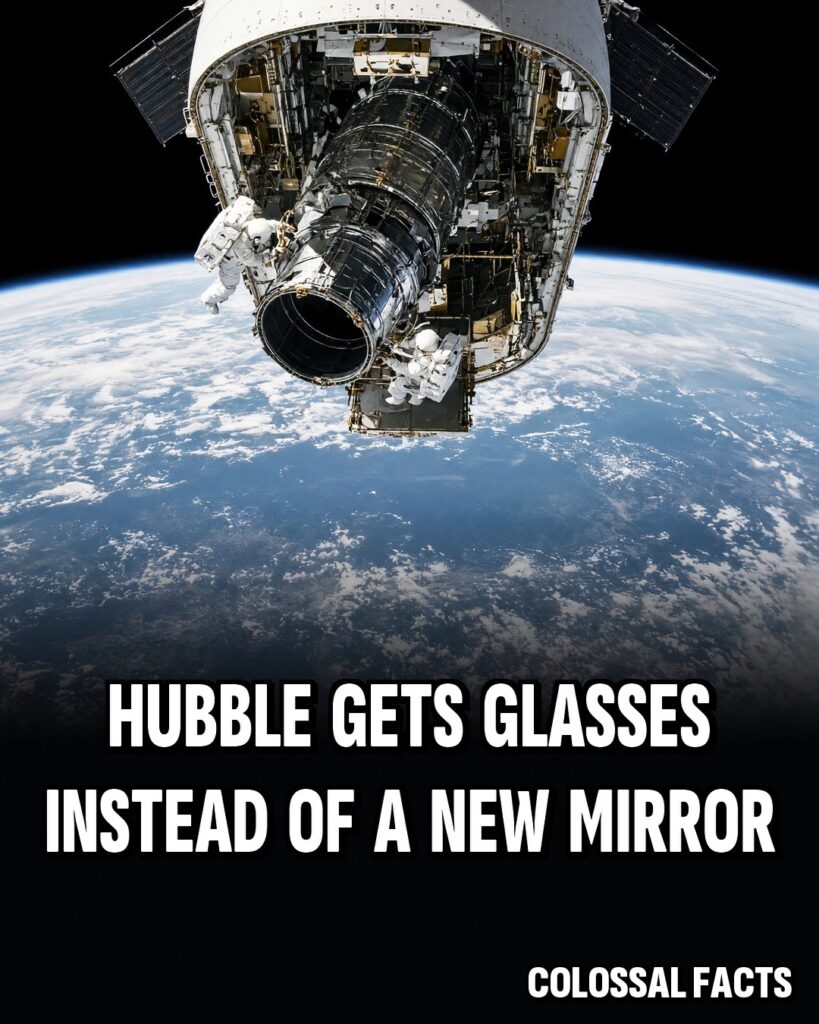
The mirror itself was never replaced. Hubble was designed to be serviced in orbit. In December 1993, astronauts on Space Shuttle Endeavour, mission STS-61, installed corrective optics: a new Wide Field and Planetary Camera with built-in compensation, and a package of small mirrors named COSTAR that acted like eyeglasses for the other instruments. NASA later released sharp “before and after” images. The same slightly incorrect mirror is still flying. The light path was corrected around it.
What went wrong in the shop
Hubble’s primary mirror is a 2.4-metre disk of ultra-low-expansion glass, weighing 1,825 pounds (828 kilograms). It is a compact Ritchey–Chrétien design, chosen in part because it is relatively light for its size. The contractors who figured and polished the mirror used a device called a null corrector to check the curve. NASA’s Hubble Space Telescope Optical Systems Board of Investigation, formed on 2 July 1990, found that a lens in that device had been spaced incorrectly. The official investigation puts the spacing error at 1.3 millimetres. The test said the mirror was right when it was not. The error was about ten times larger than the specified tolerance.
Because the outer edge was too flat, light hitting that zone focused at a different point from light hitting the rest of the mirror. Both of Hubble’s early imaging cameras showed the same distortion, which pointed to the optics rather than to one instrument. For bright objects, computer processing could still extract useful detail, and work in ultraviolet light, which ground telescopes cannot do as well, continued. To reach the telescope’s full design, though, the optics in front of the instruments had to be corrected. The primary mirror could not be swapped in orbit.
Servicing Mission 1: glasses, not a new mirror
Servicing Mission 1 launched on 2 December 1993 and lasted ten days, through 13 December. A camera already being built as a backup, Wide Field and Planetary Camera 2, was redesigned with internal optics that cancelled the aberration, in the same way a prescription lens cancels a flaw in an eye. NASA and Ball Aerospace also built the Corrective Optics Space Telescope Axial Replacement, or COSTAR. It was about the size of a telephone booth or a large refrigerator and deployed five pairs of small mirrors, some no bigger than a U.S. nickel, on arms in front of the Faint Object Camera, the Faint Object Spectrograph, and the Goddard High Resolution Spectrograph. Once COSTAR was in place, those instruments also received focused light.
The crew completed five spacewalks. NASA later released comparison images, including a well-known set dated 13 January 1994, that showed how sharply the telescope could then see. WFPC2 went on to take more than 135,000 images and became Hubble’s workhorse camera for many years. Every new instrument installed after the first deployment has included its own built-in correction for the same mirror error. COSTAR was later removed, once those replacements made the add-on package unnecessary. Four further servicing missions followed, in 1997, 1999, 2002, and 2009.
The mirror that was good enough, once the light was steered
The lasting fact is almost the opposite of the early embarrassment. A polishing error measured in micrometres produced a blur that made headlines. The repair did not grind a new 2.4-metre mirror in space. It added small, carefully shaped surfaces in the light path, and it worked. More than three decades after launch, Hubble is still observing with the same primary mirror that left the factory 1.3 millimetres off in a test fixture and 2.2 micrometres too flat at the edge. The glasses did the job. The mirror stayed where it was.
Why “glasses” were the only practical fix
A 2.4-metre mirror cannot be removed, returned to a shop, and bolted back onto a telescope already circling Earth. Hubble was assembled so that instruments could come out and go in through the aft end, and so that astronauts could change cameras, gyroscopes, and other boxes on scheduled visits. That architecture, planned before launch, is what made a repair possible at all. The spherical aberration was in the primary mirror, but the light still passed through a chain of smaller optics on the way to each instrument. Change those smaller optics, and the same imperfect primary can deliver a sharp image.
The 2.2-micrometre error sounds tiny, and it is, until it is compared with the precision the design required. NASA’s investigation found that the actual figure was about ten times outside the allowed tolerance. That is why the first pictures had a halo, not a slight softness. The spacing mistake in the null corrector, 1.3 millimetres, was large enough in the test setup to hide a curve that was wrong by those 2.2 micrometres at the edge. Independent checks that might have caught the error were not followed through in a way that stopped the mirror from being accepted. The board reconstructed that chain of testing after the fact, once the images from orbit had made the problem undeniable.
The 13 January 1994 comparison images became the public proof that the repair had worked. They were not the only data. Spectrographs and the Faint Object Camera also recovered focus once COSTAR’s arms were in place. Later instruments no longer needed that add-on package, because their own internal optics were built to the known error of the primary. In that sense the “glasses” were a first-generation fix. The long-term fix was to bake the same prescription into every new instrument. The flawed mirror remained, unchanged, at the heart of the telescope.
Costs for the original development and launch have been quoted in different ways over the years, sometimes around $1.5 billion for the observatory as launched, and much higher if the full servicing program is included. Those program-wide totals are easy to mix together, so this account stays with the optical facts NASA documents in detail: the 2.2-micrometre edge error, the 1.3-millimetre null-corrector spacing, the announcement on 27 June 1990, the ten-day STS-61 flight in December 1993, and the still-orbiting mirror that never needed to be swapped once the light path was corrected.
Sources
- NASA Science – Hubble’s Mirror Flaw
- NASA Science – Servicing Mission 1 (SM1)
- NASA Goddard archive – The Hubble Program – SM1
- NASA – STS-61