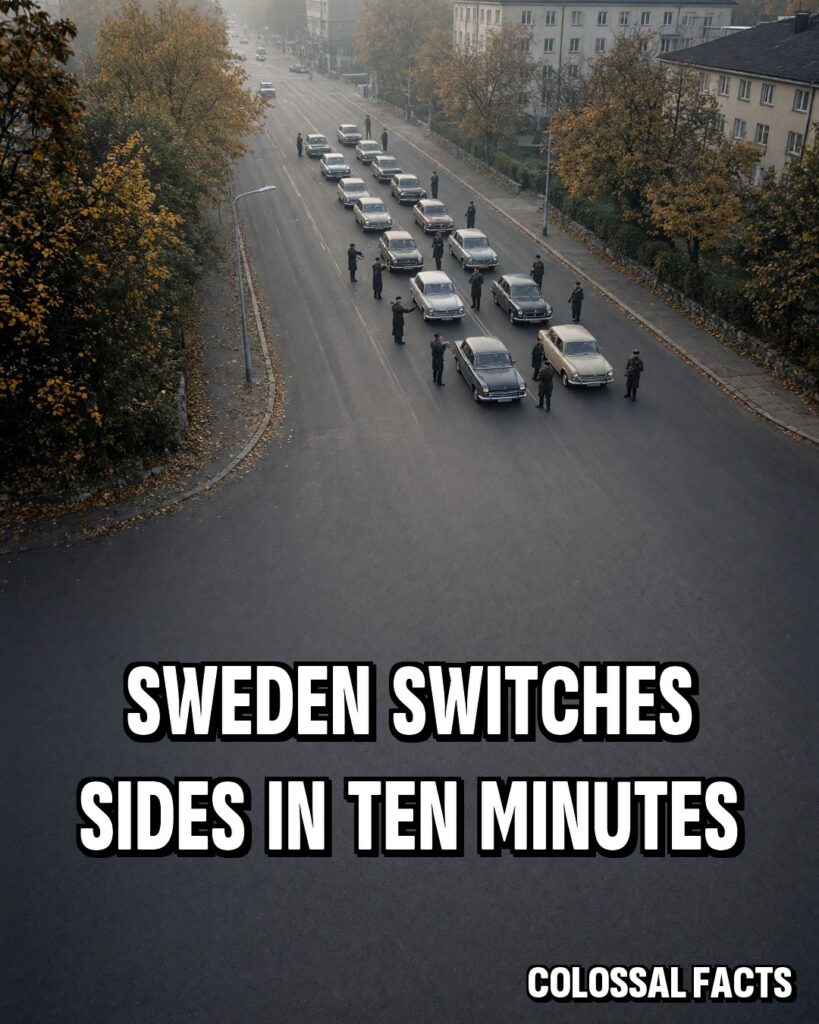
On 3 September 1967, Sweden stopped traffic on its roads. The time was 4:50 in the morning. Cars halted. They crept across to the other side of the road and waited. Ten minutes later, at 5:00, traffic was allowed to resume, now moving on the right. The operation was called Dagen H — Högertrafikomläggningen, the right-hand traffic conversion. Until that morning, the country had driven on the left, almost alone in mainland Europe. Norway, Finland, and Denmark already kept to the right. Sweden’s own cars were often left-hand drive imports, which made overtaking on the left more awkward, not less.
For 40 years, many Swedes had refused to give left-hand traffic up. In a 1955 referendum, about 83 percent voted to keep driving on the left. The government did not treat that result as the last word. On 10 May 1963, parliament approved Prime Minister Tage Erlander’s plan to switch to the right. The number of cars on the road had tripled, and a growing share of the country’s trade and travel was with neighbors who already drove on the right. Olof Palme, then minister for communications and later prime minister, spoke about the change on the radio. He called it “a very large change in our daily existence, our everyday life.”
350,000 signs, and a quieter Monday than feared
Overnight, crews reversed about 350,000 road signs. Intersections were rebuilt, bus doors and stops were rethought, and headlights were adjusted. Soldiers, police, student traffic officers, and volunteers stood in the streets at the changeover. Crashes that day were few. Serious ones were rarer still, and some official comparisons found that accidents fell in the weeks just after the switch, when drivers were unusually careful, before the numbers drifted back. The public had said no in 1955. The state turned right anyway, in ten minutes before dawn, after years of planning, and the country has driven on the right ever since.
A European outlier, corrected in a decade of planning
Sweden’s left-hand traffic was a leftover of older custom, not a tight fit with its neighbors or with the left-hand-drive cars already common on its roads. The 1955 vote showed how attached people were to the habit. The 1963 parliamentary decision, and the four years of engineering and public information that followed, showed that the government was willing to spend money and political capital to line the country up with Norway, Finland, and the rest of the continent. Dagen H was not an improvisation at 4:50 a.m. It was the visible end of a long project: new signs, new road markings, new habits for buses, and a nationwide broadcast so that everyone moved at once.
The fear had been chaos and a spike in deaths. The first hours and days were instead unusually careful. That does not mean the switch was risk-free, only that the ten-minute pause, the flood of workers on the streets, and the years of warning did their job. From 5:00 on 3 September 1967, Sweden has kept to the right. The public had said no twelve years earlier. The state turned right anyway, and the change became ordinary so quickly that Dagen H is now a historical curiosity rather than a live argument.
Drivers who remember that Monday usually recall how quiet the first hours felt, not how chaotic. The ten-minute pause at dawn, the flood of temporary officers, and the 350,000 new signs did what the 1955 referendum had refused to do. Sweden has not driven on the left since 5:00 a.m. on 3 September 1967.
Sources: Dagen H – Wikipedia, Dagen H – Encyclopaedia Britannica, Sweden’s changeover to the right – The Guardian