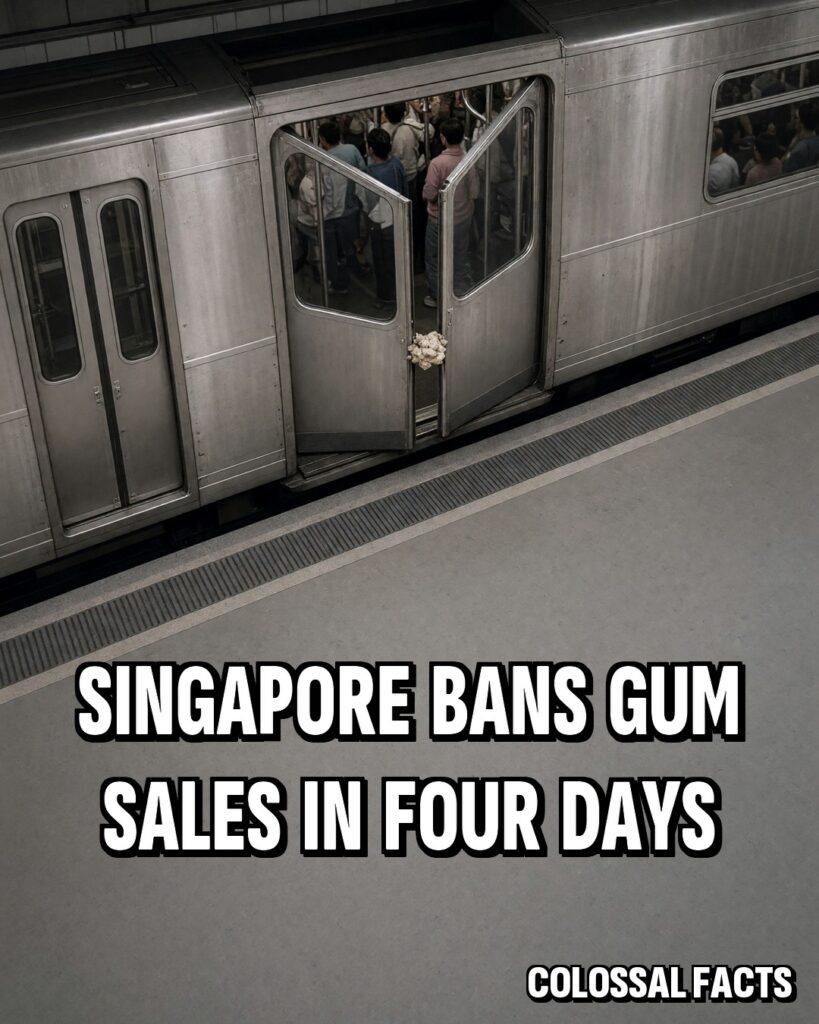
In the summer of 1991, trains on Singapore’s mass rapid transit system stopped because of something tiny. Used chewing gum had jammed between the doors. It kept the doors from closing all the way, and that blocked the whole run. There were two such disruptions, in July and August. The Environment Ministry later pointed to those failures, and to the cost of scraping gum off housing estates and public places, as the main reasons for a ban.
On 30 December 1991 the ministry announced the measure. On 3 January 1992 the sale, import, and manufacture of chewing gum became illegal — only four days later. The idea had actually been discussed as early as 1983. The Housing and Development Board, HDB, was already spending about S$150,000 a year just to clean gum stuck to surfaces. The ban covered substances made from a gum base, including bubble gum. What it did not cover, then or now, is the act of chewing itself.
A ban on the supply, not on the chew
The famous rule is often misunderstood. Chewing, by itself, is not a crime in Singapore. The law closed the path to the ordinary shop counter. Penalties targeted sellers and importers: fines, and in serious import cases the possibility of jail. Within weeks, inspectors had ordered stocks off shelves and confiscated millions of packets. Town councils later reported a sharp drop in gum litter on pavements, lifts, and benches.
In 2004 the rules got a narrow exception, after talks on a free-trade agreement with the United States. Therapeutic gum — including nicotine gum and certain dental gums — can be imported and sold as a health product, from a doctor or a registered pharmacist, under tight controls. That is not a return of ordinary gum to supermarket shelves, and advertising remains restricted. So the measure still closes the path to the everyday counter. It does not turn chewing into a crime, and a traveler may have a small amount for personal use. The 20-second story of the ban is really a story about doors that would not close, a city that would not wait, and a law that arrived four days after it was announced.
Why four days were enough
Singapore is a dense city-state with a new metro, a huge stock of public housing, and a government that was already known for strict rules on litter and public order. Once the ministry had named a start date, shops had almost no time to sell remaining stock. Some retailers were left with gum they could neither sell nor easily export. Public reaction split between people who were tired of gum on pavements and lift buttons, and people who thought a total ban was too blunt. The official measure of success was simpler: daily gum-litter cases, which had been counted in the hundreds, fell sharply within a year.
The 2004 exception is sometimes described as if the ban were lifted. It was not. The United States asked, in trade talks, for access for therapeutic products such as nicotine gum. Singapore agreed, then wrapped those products in pharmacy and prescription rules so that a supermarket aisle of ordinary gum would not return by another name. Import through the post remains tightly controlled. Thirty years on, the rule is still one of the facts outsiders know about the city, often in a slightly wrong form. The accurate version is the one from January 1992: the supply was banned four days after the announcement, chewing itself was not criminalized, and the doors of the MRT were the last straw, not the only reason.
Sources: Chewing gum is banned – National Library Board, Singapore, The chewing gum ban – Singapore Infopedia, Chewing gum sales ban in Singapore – Wikipedia