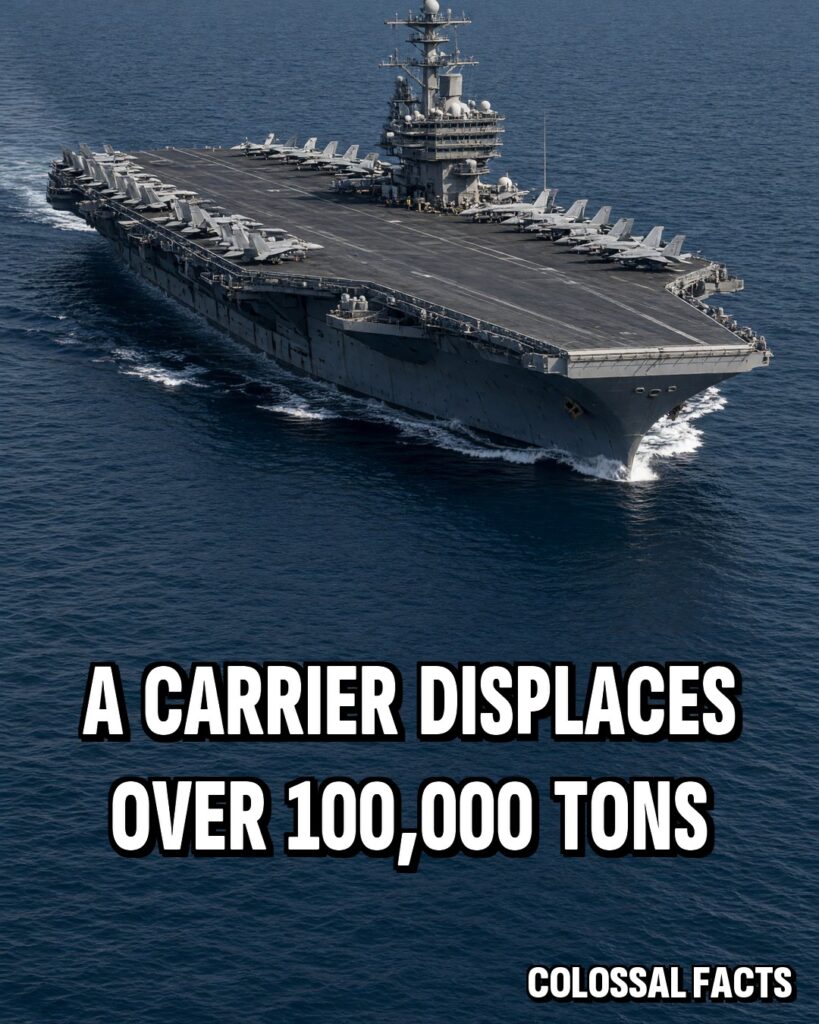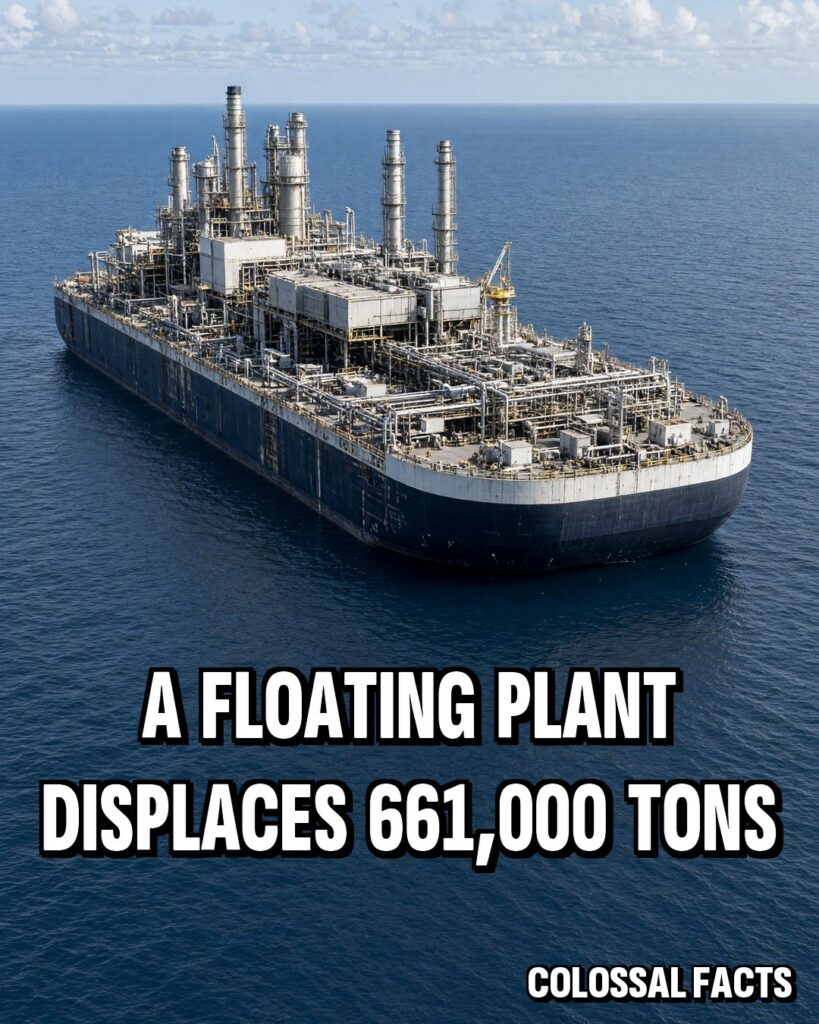
Shell’s Prelude is the world’s largest floating facility for liquefied natural gas. It is 488 meters (1,601 feet) long and about 74 meters wide and, fully loaded, displaces about 600,000 metric tonnes (661,000 US tons) of water. It runs almost as long as five American football fields laid end to end. More than 260,000 metric tonnes (286,600 US tons) of steel went into the structure. That scale puts the processing plant and the storage tanks in one hull.
Prelude sits over a gas field in the Browse Basin, about 475 kilometers north-northeast of Broome, off Western Australia. It does not pipe the gas ashore. FLNG means floating liquefied natural gas: the facility cools the gas until it becomes a liquid, right at the offshore field, and loads it onto tankers at sea. Official project figures put its yearly capacity at 3.6 million tonnes of LNG, plus about 1.3 million tonnes of condensate and 0.4 million tonnes of liquefied petroleum gas.
A plant that stays at the field
That design removes the need, for this field, of the usual shore chain: a pipeline to land, a gas plant on the coast, and a loading port. The processing happens on the water. The facility is designed to remain on station for about 25 years, weathervaning around its mooring as conditions change. Shell is the operator. Its partners include INPEX, KOGAS, and OPIC, with Shell holding the majority share.
The hull and topsides were built by Samsung Heavy Industries at Geoje, South Korea, in a consortium with Technip. The hull was launched in December 2013. The completed facility was towed to the Prelude field in 2017 and entered service in 2018, with LNG production and cargoes following as the plant was brought up to operation. Lloyd’s Register classed the vessel as the first of its kind at that scale.
Why the size is the point
A floating LNG plant has to hold the equipment of a shore terminal and the storage of a cargo station, then stay safely moored in open water. Power generation, living quarters, water, and safety systems all have to travel with the hull, because the field is hundreds of kilometers from a city or a port. That is why Prelude is as large as it is. Once the gas is cooled to a liquid, its volume falls dramatically, which is what makes tanker transport possible from a point so far offshore. Condensate and LPG are handled on the same facility, so one moored plant loads more than one product.
The first cargoes marked the end of a long hook-up and commissioning period after the tow from Korea. At this scale, Prelude was the first floating LNG facility of its kind, a type of plant that can, in principle, be moved if a field runs down, but that is designed in this case to stay on station for a quarter of a century. Record size is only part of the story. The deeper change is the location of the work: the gas does not travel to a shore plant. The plant works at the field.
Shell developed floating LNG as a way to reach offshore gas that would be costly or awkward to bring ashore by pipeline, especially far from existing plants. Prelude is the largest expression of that idea. It is moored on the field and can turn with the weather, so the hull does not have to meet every wave head-on. Tankers then come to the plant, load, and leave, as they would at a coastal terminal — only the terminal is a steel island 475 kilometers from Broome.
Sources: Prelude FLNG factsheet – Shell Australia, Prelude FLNG – INPEX, Prelude enters Lloyd’s Register class – Lloyd’s Register