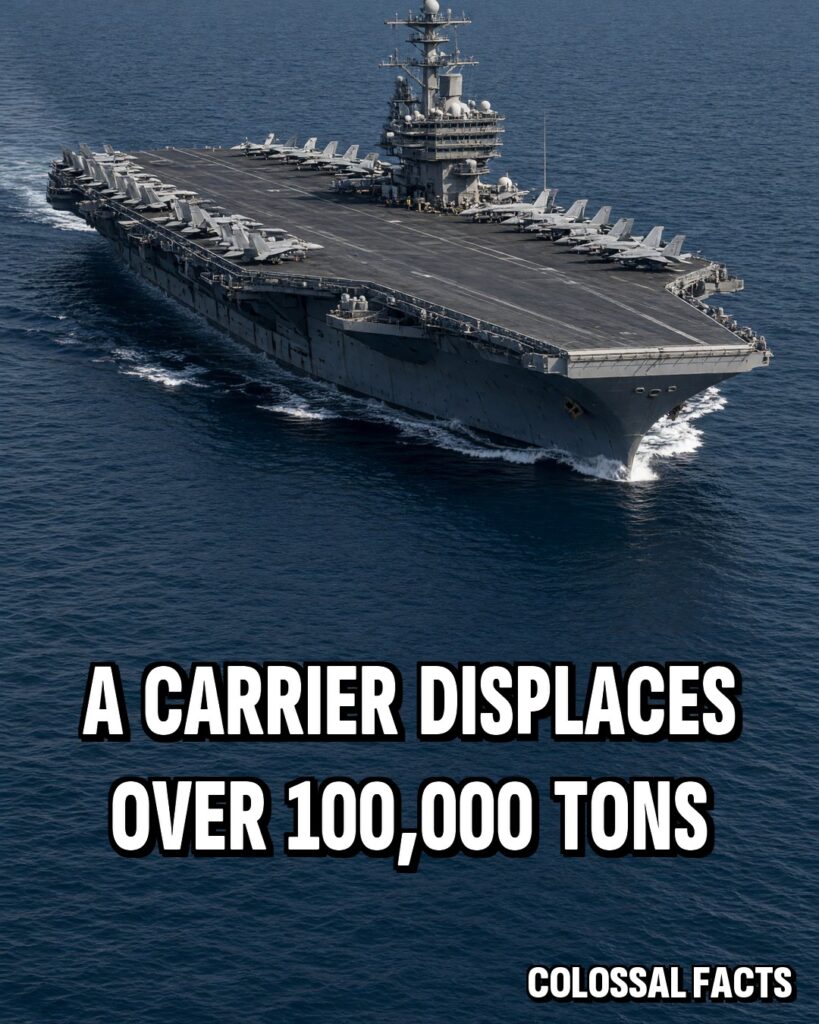
USS Gerald R. Ford (CVN-78) is a U.S. Navy aircraft carrier and the lead ship of a new class. It is the first American carrier designed from a clean sheet since USS Nimitz more than 40 years earlier. Today it is the largest aircraft carrier in the world, and the largest warship afloat.
The Navy took delivery of the ship in 2017. It was commissioned on 22 July 2017. Huntington Ingalls Industries built it at Newport News Shipbuilding in Virginia, the yard that has produced the Navy’s nuclear carriers for decades. The keel was laid in November 2009, and the ship was christened on 9 November 2013. The sponsor was Susan Ford Bales, the daughter of President Gerald R. Ford, for whom the ship is named.
A 100,000-ton hull with a smaller crew
At full load the ship displaces about 100,000 long tons. That figure is the weight of the water the hull pushes aside, not a scale reading of the steel. Official Navy fact sheets put the length at about 1,092 feet (333 meters), with a flight deck about 256 feet wide. Two nuclear reactors and four shafts give it a speed of more than 30 knots, or about 34.5 miles per hour.
The Navy’s own media materials put the total for the crew, the air wing, and staff at 4,539 people. A Nimitz-class carrier is usually listed at about 5,500. The new ship is bigger than its predecessor, yet the complement is smaller. Automated systems now handle jobs that once took hundreds of sailors. The Defense Department’s operational testers have described the Ford-class design as intended to cut required manning by about 15 percent.
It carries more than 75 aircraft. And those 100,000 tons? That is about the mass of 67,000 typical cars packed into one hull.
New ways to launch and recover aircraft
The most visible change on the flight deck is how aircraft get into the air and back again. Instead of the steam catapults used on Nimitz-class ships, Ford uses the Electromagnetic Aircraft Launch System, or EMALS. The Advanced Arresting Gear, or AAG, brings aircraft to a stop on landing. Both systems are meant to handle a wider range of aircraft, including future unmanned types, with smoother acceleration and more precise control of speed than steam equipment allows.
The new nuclear plant generates nearly three times as much electrical power as a Nimitz-class carrier. That capacity is what makes electromagnetic launch possible, and it is also meant to leave room for systems added later in a service life of about 50 years. The island — the superstructure on the starboard side of the flight deck — is smaller than on earlier carriers and sits farther aft, which opens more of the deck for flight operations and maintenance. Weapons and stores move on redesigned elevators intended to get ordnance from the magazines to the aircraft more quickly, with fewer people in the handling chain.
From the building dock to deployment
Because so much of the design was new, the ship spent years in tests after delivery. The Defense Department’s operational test office later reported that USS Gerald R. Ford completed a 262-day deployment and returned to its home port in January 2024. During that cruise the ship and its embarked air wing carried out missions assigned by combatant commanders. The Navy reported 8,725 EMALS catapult launches on the deployment.
The ship remains the lead vessel of its class. Later Ford-class carriers follow the same basic design: a larger, more electrified flight deck, fewer people than a Nimitz-class crew, and the same aim of launching more sorties with less steam-era machinery. The first of the class is already a floating city of steel — with fewer people than the ship before it.
Sources: Gerald R. Ford (CVN 78) – U.S. Navy All Hands, USS Gerald R. Ford command history – Naval Air Force Atlantic, FY2024 Annual Report, CVN 78 – Director, Operational Test and Evaluation