In 1999 the Atlantic Ocean was only a short distance — tens of feet — from the base of the Cape Hatteras Lighthouse in North Carolina. The shoreline had been retreating for decades on the Outer Banks, a place long called the Graveyard of the Atlantic. The brick tower, completed in 1870 and still the tallest brick lighthouse in the United States, had to be saved. When it was new, it stood about 1,500 feet from the sea. By the late twentieth century that margin was almost gone.
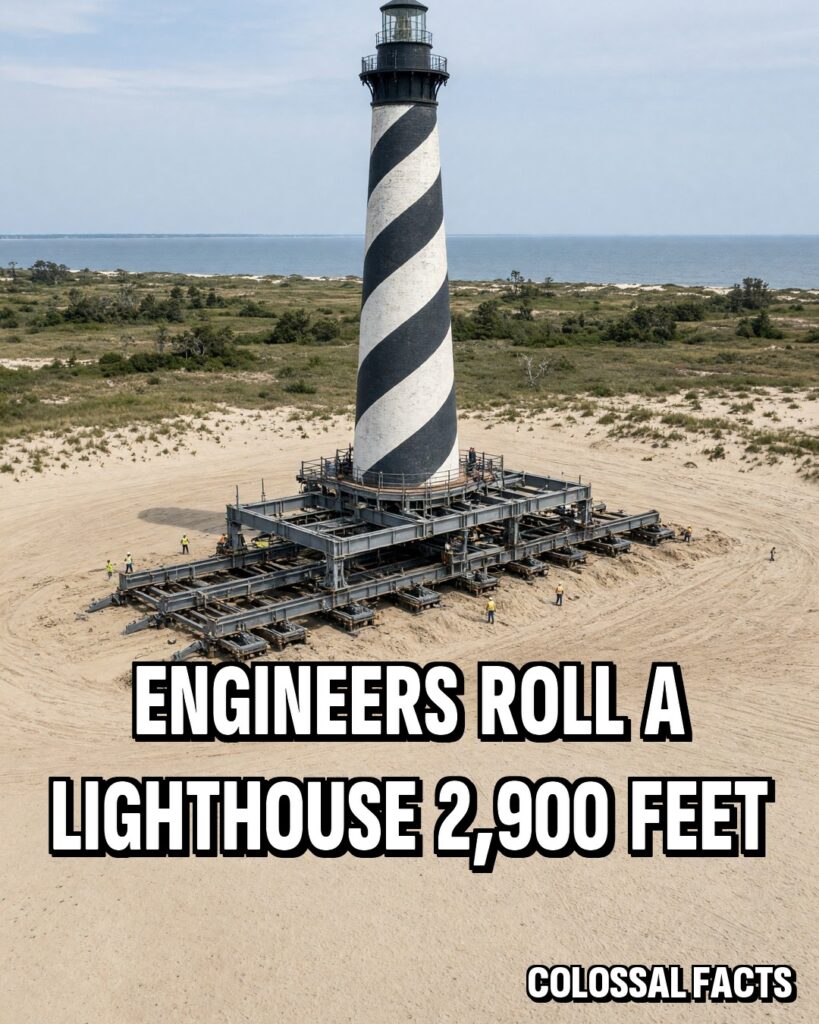
The National Park Service chose to move it whole, not take it apart. The new site was 2,900 feet (884 meters) inland, almost ten American football fields set end to end, and about 1,500 feet from the water again — the same kind of margin the tower had when it was built. The work was done by International Chimney Corporation, with Expert House Movers and other contractors, at a cost of $11.8 million. The keeper’s houses, oil house, and cisterns were moved first, in the spring, so that the station would keep its original layout.
How do you free a whole tower from its base? The lighthouse, a structure of about 4,830 tons, was shifted onto steel beams. Hydraulic jacks built into those beams raised it about 6 feet so rollers could slide underneath. Then other jacks pushed it along a prepared steel track, about 5 feet at a time. Sixty sensors watched tilt, vibration, and load the whole time. The move itself ran from 17 June to 9 July 1999, 23 days, and ended with no damage. The tower was set on a new concrete and brick foundation. The light returned to service on 13 November 1999.
They did not take the tower apart to save it. They moved it with all of its weight, and set it back as far from the ocean as it had stood in 1870.
The tallest brick lighthouse, and a shoreline that would not stay
The present Cape Hatteras tower was finished in 1870, replacing an earlier sandstone light. It rises 198 feet, the tallest brick lighthouse in the United States, and since 1873 it has worn the black-and-white spiral daymark that makes it easy to recognize from the sea. It stands on Hatteras Island to warn ships away from Diamond Shoals, where the Gulf Stream meets the Labrador Current and wrecks earned the coast its grim name. A first-order Fresnel lens once threw its beam from the lantern; the station’s job has always been navigation, not scenery, even though the spiral tower became a national postcard.
By the 1930s the water was already at the base, and the light was even abandoned for a time in favor of a steel skeleton tower farther inland. Dune work and groins bought decades, but they did not stop the island from moving. In the 1990s the National Park Service had to choose among a seawall, moving the tower, or losing it. The move was debated and closely watched. In the end the whole light station — tower, keepers’ quarters, oil house, cisterns — went 2,900 feet southwest, in the same arrangement as in 1870, and the light resumed on 13 November 1999. Officials said the new 1,500-foot setback should protect the station for about a century. They did not take the tower apart. They moved 4,830 tons of brick as one piece, because the shoreline would not come back.
The light still works as a navigational aid, not only as a monument. That was the argument for moving the station as a whole, keepers’ houses and all, instead of letting the sea take the 1870 tower and replacing it with a modern skeleton light. The 23-day roll was the visible part of a project that had taken more than a year to prepare and $11.8 million to finish.
Sources: The Move – Cape Hatteras National Seashore, NPS, Historic Cape Hatteras Lighthouse Site – NPS, Cape Hatteras Light Station – NPS