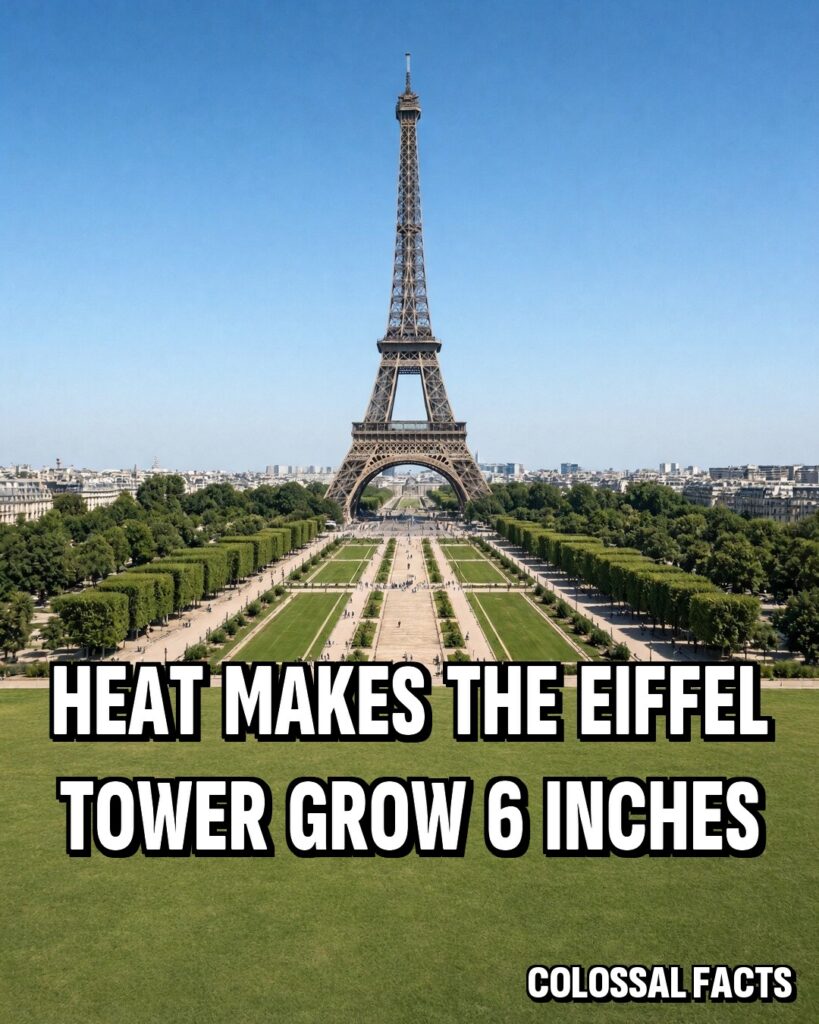
The Eiffel Tower is made of puddled iron, an old form of wrought iron, assembled in Paris for the 1889 World’s Fair. When the metal heats up, it expands. That is ordinary physics, not damage. The atoms take in energy, vibrate more intensely, and move apart. Volume grows, and height grows with it. From cold winter days to the hottest summer days, the tower stands about 5 to 6 inches (12 to 15 centimeters) taller. The official site of the tower cites a variation on that order. The difference is small, and it can be measured.
The sun adds a lean as well. It does not heat the four sides equally. The warmer side stretches a little more, and the summit tips a fraction of a degree away from the sun. As the sun moves through the day, the top traces an almost circular path about 6 inches (15 centimeters) across. After dark, the temperatures even out and the tower returns toward its earlier position. The iron frame was designed to accommodate both the extra height and the tilt. Joints, rivets, and the open lattice are not a solid bar; they can take a little movement.
A 300-meter thermometer over Paris
The tower stood 300 meters high when it was finished, not counting later antennas that have taken the tip to about 324 meters. It is still a lattice of more than 18,000 iron pieces, held by millions of rivets, and it sways a little in strong wind as well as in heat. In practice, the structure is a giant thermometer. Its height and daily lean follow the heating and cooling of Paris. Visitors do not notice the change. Instruments do. The iron does not sit still. The eye simply cannot see it moving, a few centimeters up in July and a few centimeters off-plumb as the sun crosses the sky.
Built as a temporary marvel, still expanding every summer
Gustave Eiffel and his engineers designed the tower to be taken down after the 1889 exhibition. It stayed, first as a radio mast and then as the symbol of Paris, because it was useful and already loved. The same open ironwork that made it light enough to stand on a relatively modest foundation also makes the daily and seasonal movement possible. Solid stone would crack or lean in a more dangerous way; a lattice can grow and shrink. Official measurements and popular science notes from the monument itself have long used the 15-centimeter figure for the summer-to-winter change, and the modest daily loop of the tip as the sun moves.
Wind pushes the top as well, by a larger margin in a storm than heat does on a still day. Neither motion is a defect. Both were expected. The tower has been repainted many times, and antennas have been added and replaced, but the puddled-iron frame of 1889 is still the thing that rises a few inches in a heat wave and leans a few inches away from the afternoon sun. In practice it is a 300-meter instrument sitting in the weather of Paris. The iron does not sit still. The queues at the base simply cannot see it.
Engineers still inspect and repaint the frame, but they do not try to stop the seasonal growth. To stop it would be to fight the metal itself. A few inches in a Paris heat wave is the tower behaving as designed: a lattice thermometer, 300 meters tall, that rises and leans and then settles again when the air cools.
Sources: The Eiffel Tower and science – Official Eiffel Tower site, History of the Eiffel Tower – Official site, Eiffel Tower – Wikipedia