The Kola Superdeep Borehole SG-3 is the deepest vertical hole people have ever drilled. It sits on the Kola Peninsula in Russia’s Murmansk region, in the Pechenga structure not far from Zapolyarny. This was a scientific well, not an oil well. On 24 May 1970, Soviet crews started drilling with one clear goal: 15,000 meters down.
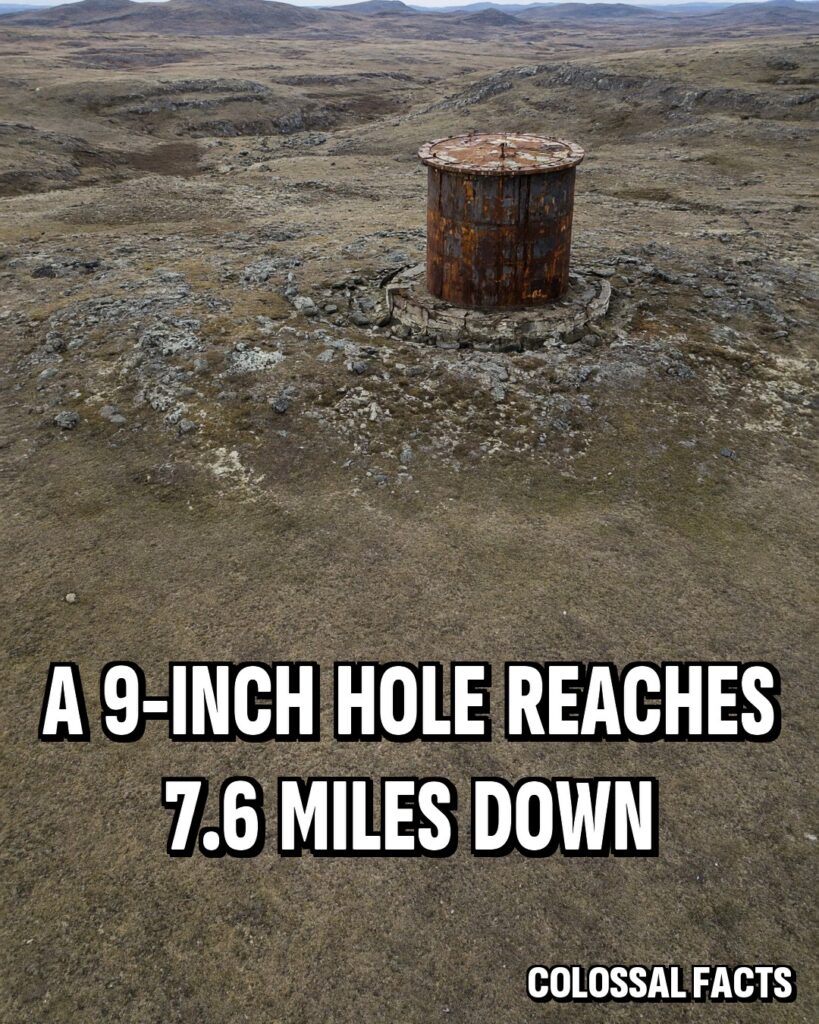
Since 1979 the hole has held the world record for vertical depth. In June of that year it passed 9,583 meters, the mark set by the Bertha Rogers gas well in Oklahoma. In 1983 the Kola hole reached 12,066 meters. In 1989 it reached 40,230 feet (12,262 meters). That is deeper than Mount Everest is tall. The main shaft is only about 9 inches (23 centimeters) across.
The plan looked simple. The bit was supposed to pass from granite into basalt, a denser rock beneath it, following a model of the continental crust that many textbooks still used. The bottom was supposed to run much cooler than it did. There was no basalt layer at the depth they expected. Drilling the old crystalline rock of the peninsula knocked out that granite-basalt picture. Water carrying dissolved minerals turned up in rock that was supposed to be dry.
Heat that the drill was not built for
Engineers had expected the temperature to rise slowly in the stable Baltic Shield, to something like 120 °C at great depth. Direct measurements told a different story. At about 10 kilometers the temperature reached 180 °C. At the bottom it hit 212 °C. At that heat the rock acts like plastic. It softens, warps the walls, and seals the shaft over and over. Drill strings jammed and broke. Crews had to cement lost sections and start again from a sidetrack. Below about 7 kilometers, several parallel branches were driven as accidents stacked up.
A purpose-built Uralmash 15000 rig, with a lifting capacity of hundreds of tonnes, carried the later stages of the work. The cores came up in pieces that are still studied in Russian repositories. They showed metamorphic rock and signs of mineralization far deeper than many ore models had placed such things. They did not show the simple layered crust the project had been drawn to find.
A record that heat would not let grow
Drilling stopped in 1992. The 15,000-meter target was never reached. Funding faded with the end of the Soviet Union, and the heat would not yield another foot. The site was later abandoned. Today a rusted steel plate covers the opening. Other wells have since reached greater measured depths along slanted paths, especially in oil fields, but the Kola hole remains the deepest of its kind as a near-vertical scientific borehole.
The depth record still belongs to that narrow shaft. A cap in the tundra marks 12,262 meters of unfinished work, and a lesson written in temperature: the crust was hotter, wetter, and less neatly stacked than the maps had said.
The borehole is a scientific well, not a shaft for oil or gas. It sits in the far northwest of Russia, on the Baltic Shield, not far from the Norwegian border. After drilling stopped, the surface works were left to decay, and the hole was later capped. Cores and logs from SG-3 are still used in studies of the continental crust, heat flow, and deep rock. The record is easy to misstate. Some later oil wells have a greater measured length because they travel sideways for kilometers. Kola’s claim is vertical depth, a hole that goes almost straight down for 12,262 meters and then stops, because the bottom was too hot to keep open.
Sources: Kola Superdeep Borehole – Wikipedia, The 50th Anniversary of the Start of Drilling the Kola Superdeep Well – Arctic and North, Kola Superdeep Borehole – HowStuffWorks