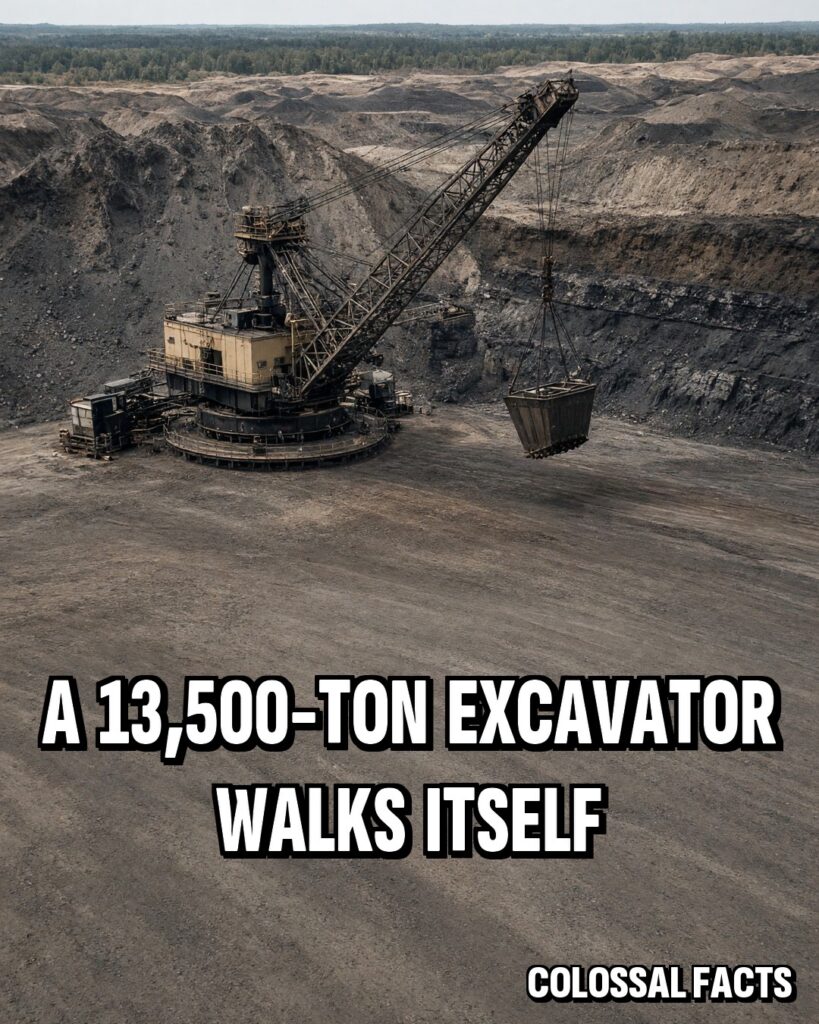
Big Muskie was a walking dragline: a digger that hauled its bucket in with cables, instead of swinging a rigid arm like an ordinary excavator. Bucyrus-Erie built it as model 4250-W and never built another of this model. It was the largest dragline ever made. From 1969 to 1991 it stripped overburden and uncovered coal for the Central Ohio Coal Company in Muskingum County, Ohio, in the coalfields of the state’s southeast.
It weighed 13,500 short tons (12,247 metric tons). Its bucket could grab about 325 tons of earth, or about 220 cubic yards, in a single bite. A pair of Greyhound buses could sit inside, side by side. The boom that held the cables stretched hundreds of feet. The machine did not crawl on tracks. It stepped on huge hydraulic “shoes” or feet and crept along at about 0.1 mph, a walking pace so slow that a person could easily keep up. Electricity came through a trailing cable. At full load the dragline was said to use as much power as tens of thousands of homes — a figure often given as 27,500 households — which was one reason it became so expensive to run.
A machine built for cheap coal, then scrapped
Big Muskie existed because a mine wanted to move an entire landscape of soil and rock off a coal seam, then put some of that earth back. A bucket that large made sense when high-volume stripping paid. In the 1970s and 1980s, tighter rules on air pollution and a falling demand for high-sulfur Ohio coal undercut that logic. The huge power bill did the rest. The machine was shut down in 1991. A campaign tried to save it as an industrial museum. In January 1999 the coal company announced that a contract to take it apart for scrap had already been awarded. The bucket was saved and now stands as a monument at a miners’ memorial park in the same county. The rest of the 13,500-ton machine was dismantled and recycled.
It was built to move a mountain with a single bucket. Falling demand for that coal, and a power draw few museums could ever feed, made it too expensive to keep. What remains is the bite: a bucket large enough for two buses, sitting still on the ground it once walked.
What a walking dragline actually does
A dragline of this size did not load coal into trucks. It removed the earth and rock that lay on top of the seam — the overburden — and dumped it to one side, so smaller machines could get at the coal. Each “step” with the hydraulic feet moved the whole 13,500-ton house a short distance, and then the bucket went out again. The trailing cable was a lifeline: there was no diesel generator on board large enough for that draw, so the mine had to feed it like a small town. When the economics failed, there was no cheap way to mothball a machine that large. Scrap was the rational end, which is why the preservation campaign lost.
The saved bucket, at the miners’ memorial in Muskingum County, is the one piece a visitor can still walk up to. It is a blunt monument to a kind of mining that moved landscapes by the hundreds of tons in a single pull, and then vanished when the coal and the power bill no longer added up. Big Muskie was the only 4250-W Bucyrus-Erie ever built. There will not be another. The feet no longer walk. The cable is gone. The bite of 325 tons is a static object in a park, which is the only scale left to judge it by.
Sources: Big Muskie – Wikipedia, Ohio History Connection, Big Muskie Bucket – Atlas Obscura