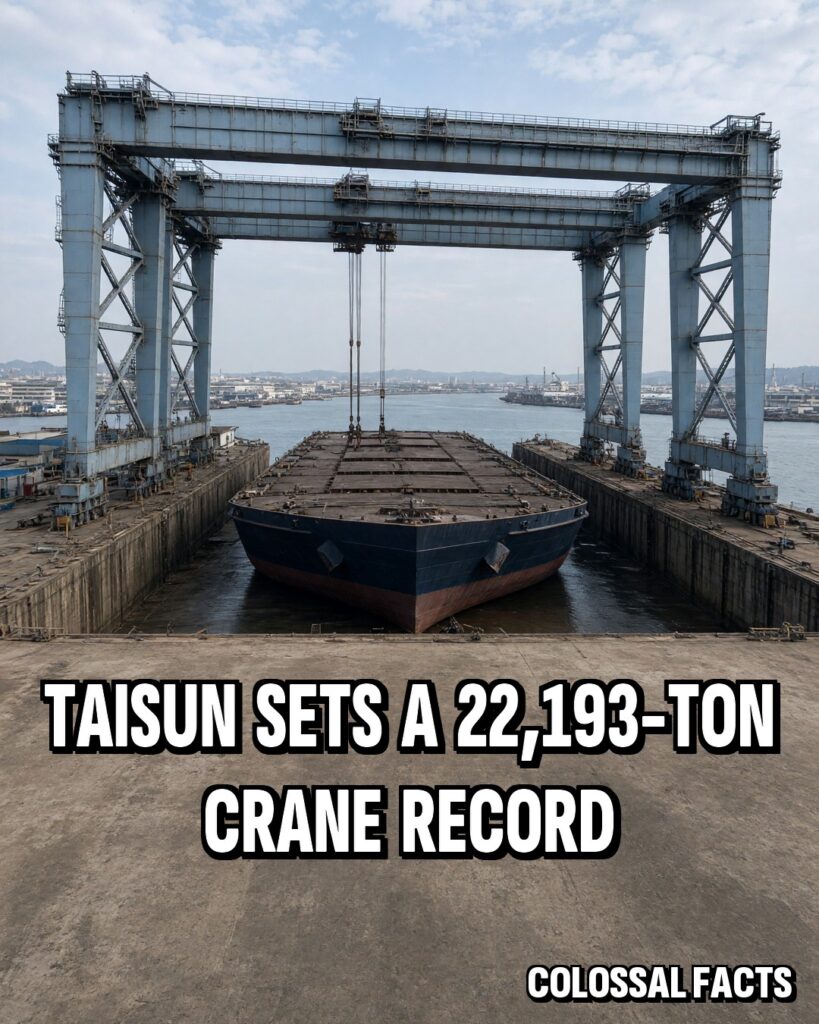
Taisun is a fixed dual-beam gantry crane — a two-beam crane that spans the dock and stays in place — at Yantai Raffles Shipyard in Yantai, Shandong, China. Its name refers to Taishan, the sacred mountain in the province. DHHI, or Dalian Huarui Heavy Industry, designed it to place enormous modules onto semi-submersible rigs and onto FPSOs, the floating vessels that produce, store, and offload oil.
Its safe working load is 20,000 metric tons (22,046 short tons). That rating alone put it in a class of its own when the crane entered service. The point of such capacity is not a circus stunt. It is to lift a finished deck or module in one piece, instead of assembling it high above the water, piece by piece, in the wind.
The record lift
On 18 April 2008, Taisun raised a barge filled with water for ballast. The American Bureau of Shipping witnessed the test and certified the load. Guinness World Records recorded 20,133 metric tonnes (22,193 tons; 44,385,667 pounds). That is the heaviest weight ever lifted by a crane, a record Guinness still lists under Taisun’s name.
The object was not a finished oil platform. It was a launching barge used as a known test weight, ballasted with water so the load could be measured. The lift broke Taisun’s own earlier trials and confirmed that the crane could work at the top of its rated range. A water-ballasted barge is a practical test weight: the load can be measured, adjusted, and witnessed, without risking a finished platform on the first full-load attempt. After the demonstration the crane moved into commercial service at the yard. The shipyard said it already had a run of commercial lifts lined up for semi-submersible rigs and other large offshore hulls over the following two years.
Build on the ground, lift once
Offshore platforms are usually pieced together from modules of about 1,000 to 2,000 metric tons (about 1,102 to 2,205 short tons), often high above the deck. Work at height takes time, adds risk, and depends on weather. Taisun’s method is the reverse. Large sections are built on the ground, or on the dock, and then lifted complete into place. The controls are precise enough that a huge section can be landed on the columns or hull in its exact position.
The first commercial job came later in 2008, when the crane installed the 14,000-ton deck box of the semi-submersible drilling rig COSL Pioneer onto the rig’s columns and hull in a single operation. Trade reports at the time noted that the lift could continue in the winter weather of Shandong, unlike a mating done in open water. The shipyard said that building the deck and the hull at the same time, then joining them with one heavy lift, cut around two million man-hours on the project and improved safety and quality by reducing work at height.
Why a crane this large exists
Semi-submersibles and FPSOs have grown so large that a conventional yard crane cannot place a finished deck in one move. A gantry that stays fixed over the dock, with two beams sharing the load, is a way to bring that step onto land. The dual-beam design spreads a weight that would be too much for a single beam, and because the crane does not travel out to sea, the mating can be done over the dock instead of in open water. The record figure of 22,193 tons is the test. The everyday purpose is to treat a platform deck as a single object: built low, checked on the ground, and then set on the hull as one piece.
The module is born on the ground. The crane puts it in the sea.
Sources: Heaviest weight lifted by a crane – Guinness World Records, Yantai Raffles christens world’s largest crane – Offshore, Moving on up – Cranes Today