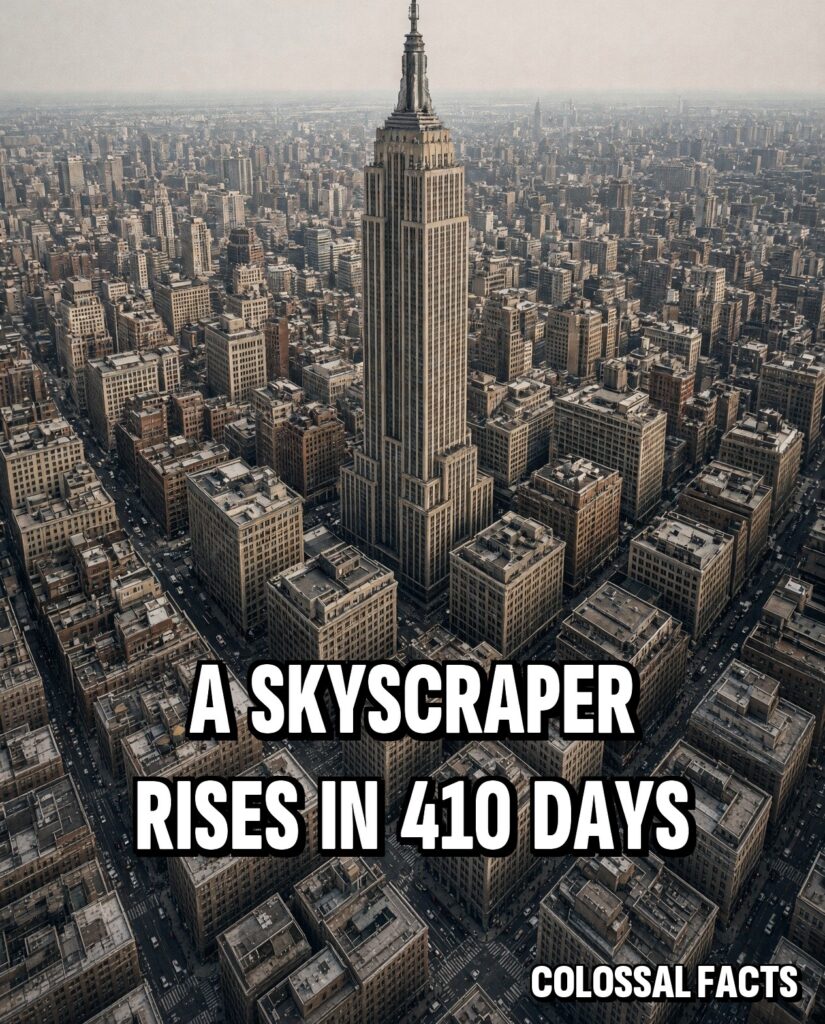
The Empire State Building in New York rises in sharp setbacks and metal trim, an Art Deco tower designed by Shreve, Lamb & Harmon and built for a group led by John J. Raskob. To the tip of its antenna it stands 1,454 feet (443 meters) today. When it opened, the official height to the top of the mooring mast was 1,250 feet (381 meters), already taller than anything else on Earth; the television antenna was added later and brought the tip to the present figure. Work began on 17 March 1930, in the middle of the Great Depression, on the site of the old Waldorf-Astoria, at Fifth Avenue and 34th Street.
The steel frame climbed about four and a half floors every week. No one waited for a floor to be finished before the next one started. Beams, stone, and windows arrived on a tight schedule, and the build ran like a factory line. On the busiest days about 3,400 workers filled the site. The whole job, from the start of construction to opening, took 410 days, ahead of schedule and under the original time plan. The official opening came on 1 May 1931. The cost was about $41 million, less than some early estimates, in a city short of work and short of tenants.
A mast for airships, a title that lasted 39 years
There is an odd detail at the top. The mooring mast was first meant as a dock for airships, not only as the crown of the tower. In practice the idea was unsafe in the winds around Manhattan, and it was barely used. The mast still added height, and from opening day the building stayed the world’s tallest for 39 years, until the North Tower of the World Trade Center surpassed it in 1970. The comparison is easy to feel on the skyline: 1,454 feet is the Eiffel Tower plus about a third — offices, elevators, and steel, raised in a little more than a year.
The height kept the title for decades. The pace won it in year one. A Depression-era skyscraper of 102 stories, put up in 410 days, is still the standard for how fast a tall building can rise when the steel, the stone, and the schedule are made to move together.
Steel, stone, and a city short of tenants
The site is a tight Manhattan block. Trucks delivered steel from Pittsburgh-area mills and limestone and aluminum already cut to size, so the crews on the floors were assembling, not shaping, most of what went into the walls. Five or so men died in construction accidents, a number often cited and far smaller than later myths about scores of deaths. The building opened with a lot of empty offices. The Depression had begun in 1929, and for years the tower was nicknamed the “Empty State Building.” The observation decks, and later a more prosperous city, filled the floors that 3,400 men had raised in a little over a year.
102 stories, a mooring mast that never became a regular airship dock, and a 39-year reign as the world’s tallest building are the public facts. The quieter fact is the schedule: 410 days from a cleared lot to a ribbon on May Day, 1931, in the worst economic crisis of the century. The height kept the title until the World Trade Center rose at the other end of the island. The pace is still what architects and contractors cite when they talk about the Empire State. The factory line of steel, going up four and a half floors a week, is the real record inside the skyline.
Sources: History – Empire State Building, Empire State Building – U.S. National Park Service, Empire State Building – Wikipedia