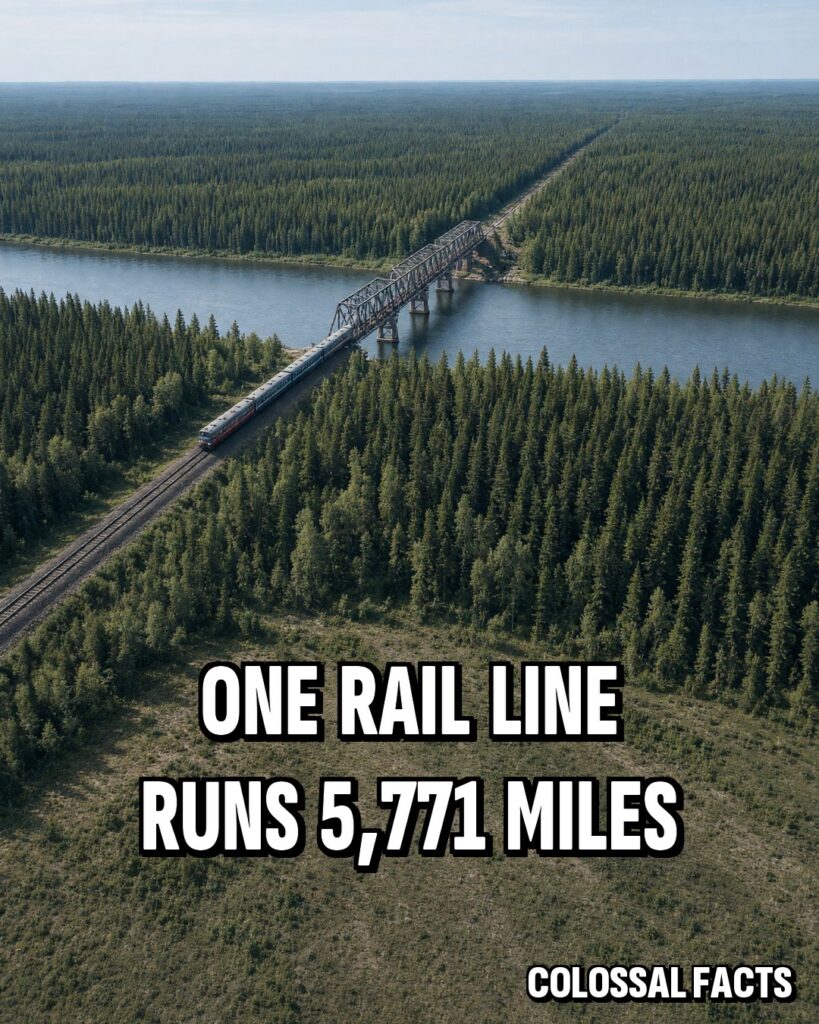
The Trans-Siberian Railway is often called the longest single railway in the world — one connected route, not a web of separate lines. It links Moscow with Vladivostok and crosses Russia from end to end. The usual official length of the main passenger route is 9,289 kilometers (5,771 miles), or 9,288.2 kilometers in a precise measurement. A through passenger train covers it in about seven days, with the traveler remaining on the same train while rivers, cities, and the continent change outside the window.
The line is widely described as passing 87 cities and 12 major rivers, among them the Volga, the Ob, the Yenisei, and the Amur. The route starts in Europe, but Asia covers about 81 percent of the miles. That is the heart of the journey. The record does not come from the speed of the train. It comes from one line that never breaks across the whole country.
Construction began in 1891, under Tsar Alexander III, and the continuous rail link was finished in 1916, when the bridge over the Amur at Khabarovsk opened and the last gap was closed. Sections had opened earlier, and for a time travelers still depended on ferries or temporary workarounds. The finished railway became a spine for settlement, freight, and military movement across Siberia, not only a passenger route.
And 5,771 miles? That is about 82 hours of driving at 70 mph (113 km/h), the usual U.S. interstate limit, with no stop at all. A comparison with an ordinary commuter train fools the eye. The scale is in the miles under the wheels, not in the height of the car. Europe ends early on this route. Asia takes nearly all the rest.
A railway built to hold a continent together
Work started in 1891 at both ends of the line, in a ceremony that included the future Nicholas II at Vladivostok. For a quarter of a century, crews laid track across taiga, permafrost, rivers, and mountains. Lake Baikal was an early obstacle: at first trains were ferried across the water, and in winter rails were even laid on the ice, before a loop around the southern shore closed that gap. The last great missing piece was the bridge over the Amur at Khabarovsk, completed in 1916, which made it possible to ride from the capital to the Pacific without leaving Russian rails. The project was strategic as well as commercial. It was meant to bind Siberia to European Russia, move troops, and open land for settlement and grain.
The main passenger train on the route today is still a days-long journey, often under the name Rossiya, stopping at cities that mark the stages of the continent: Yaroslavl, Yekaterinburg on the edge of Europe and Asia, Omsk, Novosibirsk, Irkutsk near Baikal, Khabarovsk, and finally Vladivostok on the Sea of Japan. Freight, including coal and containers, is now as important as the sleeping cars in any account of the line’s work. Branch routes — the Trans-Manchurian and Trans-Mongolian among them — leave the main stem for Beijing and other cities, but the record length is the Moscow–Vladivostok trunk itself, those 9,289 kilometers of one railway. Seven days is not a sprint. It is what a single pair of rails, laid from the 1890s to 1916, still asks of a passenger who wants to see the whole country go by.
Guidebooks sometimes compare the trip to circling a large country by rail and never changing trains. That is the point of the record. Other railways cover many miles in a network. This one does it on a single named trunk, 5,771 miles long, with Asia under the wheels for four-fifths of the way. The scale is in the miles, and in the quarter-century it took to lay them.
Sources: Transsib Handbook: Records, The Trans-Siberian in figures – RIA Novosti, Trans-Siberian Railway – Wikipedia