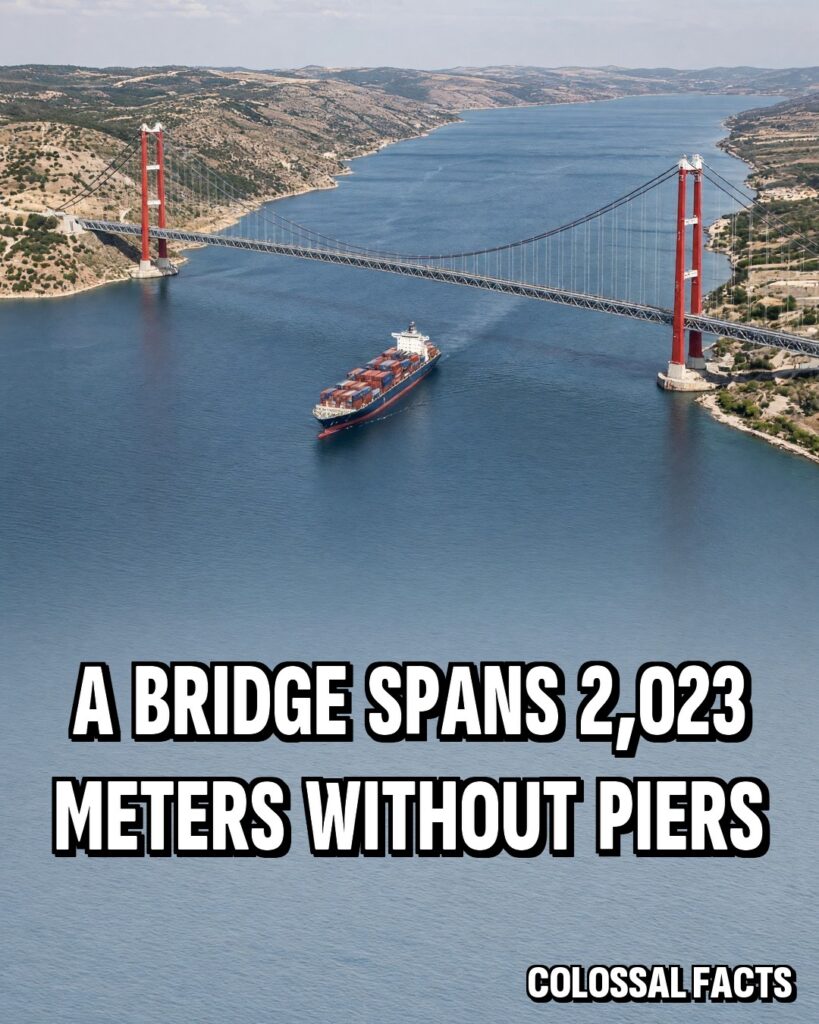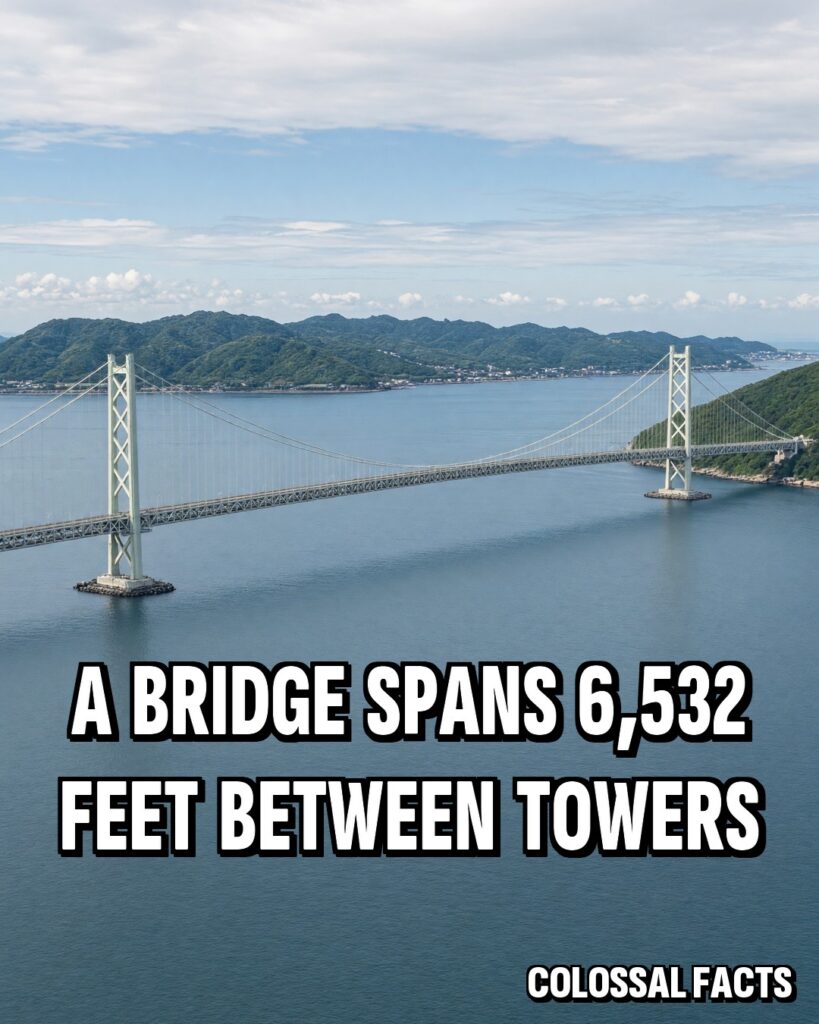
The Akashi Kaikyo Bridge is a suspension bridge in Japan. It crosses the Akashi Strait between Kobe, on Honshu, and Awaji Island, a stretch of water open to earthquakes and heavy sea storms. Traffic started on 5 April 1998. The central span measures 1,991 meters (6,532 feet). It was then the longest main span of any suspension bridge in the world, a record it held until the 1915 Çanakkale Bridge in Turkey, with a 2,023-meter span, opened in 2022.
The drawing had called for about a meter less. The two main towers were already standing, almost the only finished parts of the bridge, when the Great Hanshin (Kobe) earthquake of 17 January 1995 pushed the foundations apart. Engineers lengthened the opening by about one meter, or roughly 3 feet. Those finished towers never moved back to the line on the original drawing. The official span became 1,991 meters, and the total length of the crossing grew by the same amount, to 3,911 meters.
Then came the other work. The bridge is built to ride out strong winds and earthquakes — official descriptions have long said it is designed for a quake up to magnitude 8.5 — with pendulums, dampers, and a stiff steel truss deck. A pendulum here is a heavy swinging mass that soaks up sway instead of letting it grow. The span still does not hold still. In a single day it can grow and shrink by up to about 2 meters (6.5 feet), only because the temperature changes and the steel expands and contracts. How long is that span on the ground? Almost 22 football fields, laid end to end.
Length made the record. Movement shows the math. The world’s longest suspension span, for 24 years, was a number written in part by an earthquake that would not let the towers stand where the drawings had put them.
A record written, then overtaken
The bridge is the central jewel of the Honshu–Shikoku crossing at this strait, a six-lane road that replaced a ferry in weather that can close the water to ships and small craft. Its towers rise nearly 300 meters. The main cables are spun from tens of thousands of wires, and the deck is a stiff truss built to take typhoon winds as well as earthquakes. When the Great Hanshin quake struck on 17 January 1995, Kobe was devastated, but the unfinished towers stood. What changed was the distance between them. Designers altered the span and the approaching deck to match the new geometry rather than try to force the towers back. The official opening came on 5 April 1998.
For 24 years the 1,991-meter figure was the one in every record book of suspension bridges. In March 2022 the 1915 Çanakkale Bridge in Turkey opened with a main span of 2,023 meters and took the title. Akashi Kaikyo remains one of the longest and most carefully instrumented spans on Earth, and it is still the longest in Japan. The 2-meter daily change in length with temperature is a reminder that a record span is not a rigid bar. It is a hanging road that has to be allowed to move. Length made the record while it lasted. The meter added by the 1995 earthquake is still in the official length, a permanent scar that became the number.
Drivers on the six-lane deck see a straight road and a long drop to the strait. The official numbers under that road now include a span that an earthquake lengthened and a record that another bridge later beat. The Akashi crossing remains the engineering answer to a narrow, stormy, seismic waterway that once had to be ferried. Length made the record. Movement — of the towers in 1995, of the steel in the heat of a single day — still shows the math.
Sources: Akashi-Kaikyo Bridge – Honshu-Shikoku Bridge Expressway Company, Akashi Kaikyo Bridge – Wikipedia, Akashi Kaikyo Bridge – Roads & Bridges