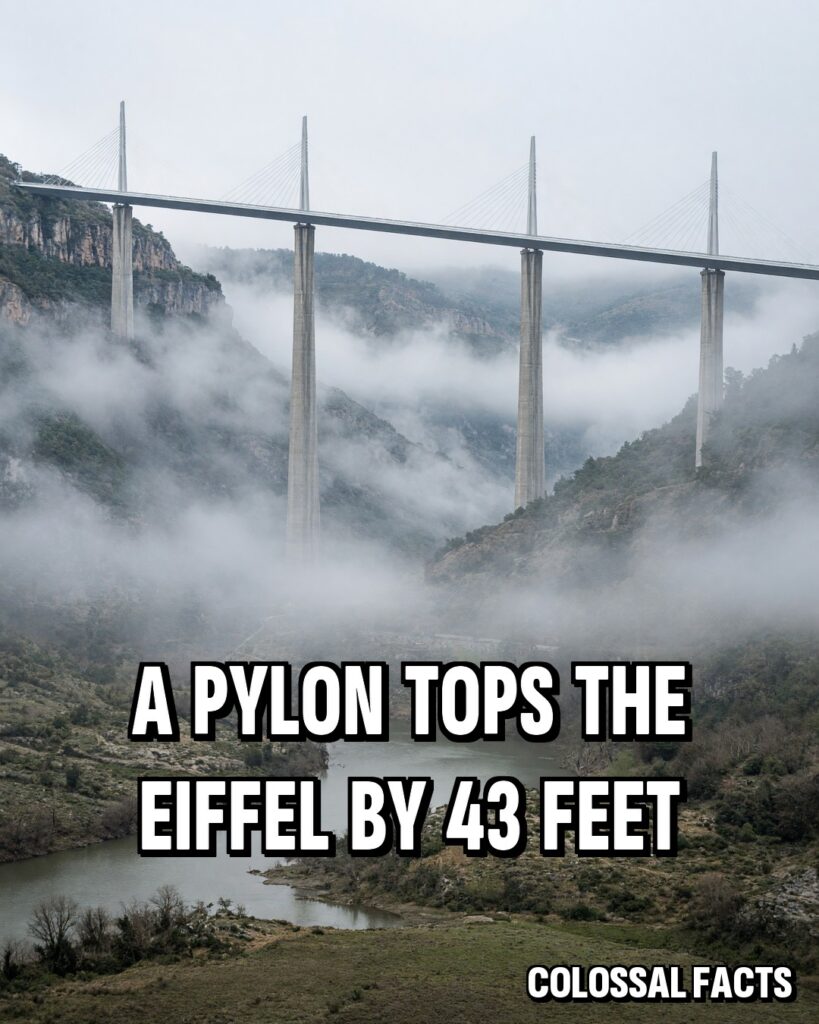
The Millau Viaduct in southern France is a cable-stayed bridge over the Tarn valley, on the A75 motorway. The road deck is suspended from steel cables, not arches. The tallest pier and pylon reach 1,125 feet (343 meters) above the valley floor. It is the tallest structure in France. It stands about 43 feet (13 meters) above the Eiffel Tower, when that tower is counted at its later height with antennas, about 330 meters. The deck crosses 890 feet (270 meters) above the river at its highest point, making it the highest road deck on a bridge in Europe. The viaduct is 8,070 feet (2,460 meters) long, with seven piers. The longest span between supports is 1,122 feet (342 meters). The Eiffel Tower would fit upright in that gap.
The bridge is more than a road over a drop. The steel deck alone weighs 36,000 tons. It was pushed out from the ends, section by section, until it met in the middle, a launching method that avoided building a forest of temporary supports in the valley. Slanted steel stay cables — 154 of them — carry that load to the piers. The structural engineer was Michel Virlogeux. The architectural design was led by Norman Foster. The viaduct opened on 16 December 2004, after about three years of construction. It cut a long detour through the town of Millau and took through-traffic up into the wind above the Tarn.
Foster has said that his first look at the finished bridge left him so anxious he nearly felt sick. He agonized over the color of the 154 cables. Light cables would vanish into the sky. They would stand out against the land. The chosen colour was meant to sit between those two mistakes: visible enough to read as a structure, not so heavy that the valley disappeared behind a fence of steel.
A tower that holds a road
And 1,125 feet? It is a tower that does not stand in a city, but holds a road over a valley, and still beats the Eiffel. From far away the piers look like needles in mist. Each pier is a concrete shaft that splits into two, like a wishbone, where the deck passes through, so the road can expand and flex in the wind and the heat without tearing the mast. Drivers cross in a few minutes and may never see the river. From the valley floor, the same crossing is a row of pale towers, and a thin line of road that seems too light for 36,000 tons of steel.
A tower symbolizes height. Here height carries cars. The record is not a viewing platform. It is a motorway that needed to cross a deep gorge without dropping into a town, and did it by building the tallest bridge towers in France.
Each of the seven piers stands on a different height of slope, so the shafts are not the same length; the tallest, P2, is the one that sets the 343-meter record. Wind was a design driver as much as gravity. The deck is narrow and long, a ribbon that can move, and the stay cables and the split pier heads are part of how that motion stays safe. Tolls on the crossing paid for a private concession, a model that got the viaduct built quickly once the route was chosen. For drivers coming down from the Massif Central toward the Mediterranean, the bridge is a few minutes of thin air. For Millau, it is the structure that finally took the through-traffic off the valley floor.
Sources: Millau Viaduct – Wikipedia, Millau Viaduct – Structure magazine, Millau Bridge – Encyclopaedia Britannica