On 25 August 1896, Sultan Hamad bin Thuwaini of Zanzibar died. Britain had backed him. Under a protectorate agreement of 1890, a new sultan was supposed to have the consent of the British consul. Instead, Prince Khalid bin Barghash seized the palace in Stone Town and refused to step aside, even after a British ultimatum. Britain favored Hamoud bin Muhammed. Khalid had not sought the required approval.
Why did he refuse? He believed the British would not follow through. He barricaded himself inside with his supporters — several thousand people, including palace guards, servants, and others hastily gathered — and trained a few guns on the ships in the harbor.
Less than an hour under fire
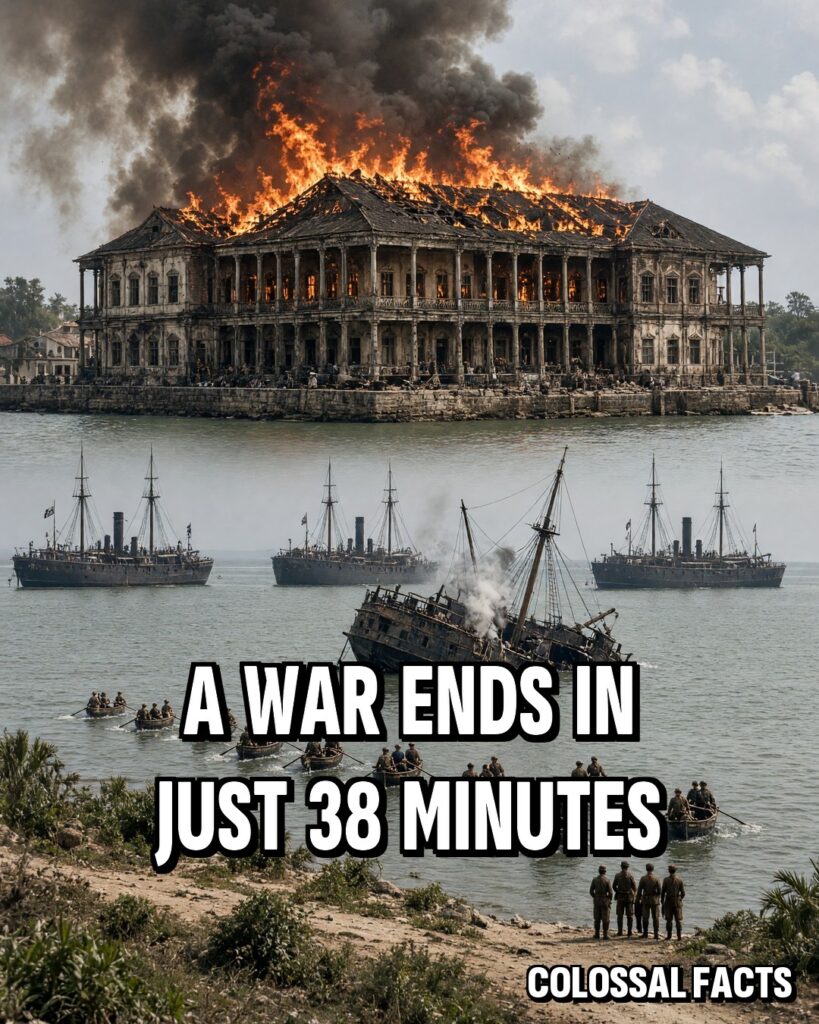
The ultimatum expired at 9:00 on the morning of 27 August. Rear-Admiral Harry Rawson commanded the Royal Navy force in the harbor. Around 9:02, British ships opened fire on the palace. Contemporary and later accounts name HMS Racoon, Thrush, and Sparrow among the vessels that took part, with other warships also present in the anchorage. The largely wooden palace burst into flames almost at once. The royal yacht Glasgow, the only substantial ship in the Zanzibar fleet, was sunk; her masts stood in the harbor for years afterward.
How long did it last? The usual figure is 38 minutes, and the war is widely called the shortest in recorded history. The range in the sources is a little wider. Some careful accounts put the bombardment between about 9:02 and 9:40. Guinness World Records lists it from 9:00 to 9:45. Other reports from the time said 40 or 45 minutes, or even gave still different figures. The clock tower in town was hit, and there was no single official stopwatch. What is not in dispute is that the firing was over in less than an hour.
Short, but not bloodless
About 500 Zanzibaris were killed or wounded, including civilians in and around the palace. Britain had one sailor badly wounded. Most of the deaths came from the shelling of a crowded wooden building, not from a long battle in the streets. Khalid left the palace and took refuge in the German consulate, later reaching German East Africa. Marines and sailors landed, together with pro-British Zanzibari troops under Lloyd Mathews, and advanced on the burning ruins. They met almost no resistance. The palace and the attached harem had caught fire, the defenders’ guns had been silenced, and the sultan’s flag was down.
By the afternoon Britain had installed the successor it had wanted, Sultan Hamoud bin Muhammed. Zanzibar remained a British protectorate, now more tightly under British control, and the short war is often treated as the end of the sultanate as a genuinely independent state. The mismatch in force was overwhelming: a Royal Navy squadron against a palace, a royal yacht, and a few guns, some of them outdated. That is why the firing could end in minutes. It is also why the casualty list was so one-sided.
The shortest war was not a harmless curiosity. A palace was destroyed, a yacht was sunk, and hundreds of people on the Zanzibar side were killed or wounded, while the other side barely bled. The shortest war was not bloodless. Only one side barely bled.
On the morning of the bombardment Khalid still tried to open talks. A message from the palace around 8:00 asked for a parley; the British refused unless he accepted the ultimatum and left. He replied, in effect, that he did not believe they would fire. An hour later they did. The war’s length is a curiosity. The decision that started it was a refusal to believe the ultimatum was real.
Sources: Shortest war – Guinness World Records, The Anglo-Zanzibar War – History Today, Anglo-Zanzibar War – Wikipedia